NFPA 13 sprinkler hazard classification is the first decision in a sprinkler design, and it comes before any hydraulic calculation. The standard places each part of a building in one of five occupancy hazard classes: Light, Ordinary Group 1 or 2, or Extra Group 1 or 2, based on the quantity and combustibility of its contents. That class then sets the design density and area, sprinkler spacing, hose stream allowance, water supply duration, tank volume and, ultimately, fire pump flow and pressure.
This article covers how the class is decided and what it changes. The calculation method is covered in Sprinkler Hydraulic Calculations: Concept, Inputs and How to Review Them. If your project needs a documented design basis that starts from occupancy analysis, that is part of AZEIDK’s Engineering Design & Calculations service.
Key takeaways
- NFPA 13 sorts non-storage spaces into five hazard classes, and each space is classified on its own.
- NFPA 13 hazard classes are not Saudi Building Code occupancy groups: one describes fire severity, the other serves life safety.
- Since 2022, new systems use a fixed density/area point per class; the 2025 edition dropped the curves.
- Moving from Ordinary to Extra Hazard raises the hose allowance from 250 to 500 gpm and lengthens the duration, so the tank grows several times over.
- Storage beyond the miscellaneous or low-piled limits leaves the hazard-class method and goes to the storage chapters.
In this article
- What is NFPA 13 sprinkler hazard classification?
- What is the difference between Light, Ordinary and Extra Hazard?
- How does the hazard class set design density and area?
- How does the class affect sprinkler count and spacing?
- How does classification change tank volume and fire pump size?
- When does design move from hazard classes to the storage chapters?
- How is the classification decided in practice?
- Common hazard classification mistakes
- How AZEIDK can help
- Frequently asked questions
- Conclusion
What is NFPA 13 sprinkler hazard classification?
NFPA 13, Standard for the Installation of Sprinkler Systems, defines the occupancy hazard classes in Chapter 4 (Section 4.3 in the 2019, 2022 and 2025 editions) and gives example occupancies for each class in Annex A. The class reflects the quantity and combustibility of contents, expected heat release and pile height.
As NFPA engineer Robin Zevotek notes (2025), the classes do not line up with building code occupancies, and each space is classified by what it contains: a laboratory in a school may warrant a higher class than its classrooms.
In Saudi Arabia, the Saudi Fire Protection Code SBC 801 sets where sprinklers are required in Chapter 9 (Section 903, Automatic Sprinkler Systems). The 2024 edition has been mandatory since 30 June 2025. Density and spacing come from NFPA 13 as the technical reference the designer adopts, in the edition the code references or Civil Defense accepts.
What is the difference between Light, Ordinary and Extra Hazard?
The definitions as presented by the Massachusetts Firefighting Academy course, based on the 2007 text; Zevotek’s 2025 NFPA article confirms their substance and the 8 ft and 12 ft stockpile limits:
- Light Hazard: the quantity and/or combustibility of contents is low, and fires with relatively low rates of heat release are expected.
- Ordinary Hazard Group 1 (OH1): combustibility is low, quantity is moderate, stockpiles do not exceed 8 ft (2.4 m), and fires with moderate rates of heat release are expected.
- Ordinary Hazard Group 2 (OH2): quantity and combustibility are moderate to high, stockpiles of moderate heat release contents do not exceed 12 ft (3.7 m), and stockpiles of high heat release contents do not exceed 8 ft.
- Extra Hazard Group 1 (EH1): quantity and combustibility are very high, with dust, lint or similar materials that make rapidly developing fires likely, but little or no flammable or combustible liquid.
- Extra Hazard Group 2 (EH2): moderate to substantial amounts of flammable or combustible liquids, or extensive shielding of combustibles.
Annex examples
These Annex examples are as presented in Massachusetts Firefighting Academy course MFA 644, which is based on the 2007 edition. They are guidance only, not a substitute for reviewing actual contents or the Annex of the edition adopted for the project:
| Class | Examples from NFPA 13 Annex A |
|---|---|
| Light | Offices, residential, hospitals, educational buildings, places of worship, museums, restaurant seating areas, auditoriums excluding stages |
| Ordinary Group 1 | Car parks and showrooms, bakeries, beverage manufacturing, dairy plants, electronics plants, laundries, restaurant service areas |
| Ordinary Group 2 | Mercantile, repair garages and machine shops, printing and publishing, dry cleaners, large library stack rooms, stages |
| Extra Group 1 | Aircraft hangars (unless governed by NFPA 409), combustible hydraulic fluid use areas, die casting, saw mills |
| Extra Group 2 | Flammable liquid spraying, varnish and paint dipping, solvent cleaning, plastics processing, open oil quenching |
How does the hazard class set design density and area?
Before 2022, designers could pick any point on a class’s density/area curve. For new systems, the 2022 edition’s Table 19.2.3.1.1 gives one point per class, plus a 3,000 ft² alternative used only where 19.2.3.1.5 requires it (QRFS cites buildings with unsprinklered combustible concealed spaces). The 2022 curves remained only for existing systems; according to QRFS, the 2025 edition removed them and permits an existing system to be evaluated against the edition it was designed under.
Values from Table 19.2.3.1.1 per NFPA’s 2022 errata; QRFS reports that the 2025 edition applies the same table to all systems.
| Class | Density/area (gpm/ft² / ft²) | Metric (mm/min / m²) | Alternative point where required |
|---|---|---|---|
| Light | 0.10 / 1500 | 4.1 / 140 | 0.07 / 3000 |
| Ordinary Group 1 | 0.15 / 1500 | 6.1 / 140 | 0.12 / 3000 |
| Ordinary Group 2 | 0.20 / 1500 | 8.1 / 140 | 0.17 / 3000 |
| Extra Group 1 | 0.30 / 2500 | 12.2 / 230 | 0.28 / 3000 |
| Extra Group 2 | 0.40 / 2500 | 16.3 / 230 | 0.38 / 3000 |
How does the class affect sprinkler count and spacing?
The class also caps the area per sprinkler and the spacing, which drives sprinkler count and pipe length. For standard spray sprinklers:
- In Ordinary Hazard, protection area per sprinkler may not exceed 130 ft² (about 12 m²) under Table 10.2.4.2.1(b) of the 2025 edition, and spacing may not exceed 15 ft (4.6 m) in Light and Ordinary Hazard.
- In Light Hazard, protection area comes from Table 10.2.4.2.1(a) and depends on ceiling construction, which is why the LADBS 2025 checklist asks for the ceiling type on the drawings.
- In Extra Hazard, the LADBS NFPA 13-2022 checklist for mechanical parking lifts (classed there as Extra Hazard Group 2) caps protection area at 100 ft² (about 9.3 m²) and spacing at 12 ft (3.7 m) under Table 10.2.4.2.1(c).
The same floor area needs more sprinklers as its class rises. Sprinkler type and K-factor affect the details, covered in Automatic Fire Sprinkler Systems in Saudi Arabia.
How does classification change tank volume and fire pump size?
NFPA 13 adds an inside and outside hose stream allowance and a required water supply duration to the sprinkler demand, both tied to the hazard class in Table 19.2.3.1.2. Los Angeles Department of Building and Safety (LADBS) checklists confirm hose allowances of 100 gpm for Light and 250 gpm for Ordinary Hazard in the 2025 edition, and 500 gpm for Extra Hazard Group 2 in the 2022 edition. The durations are from the table as published in the 2002 edition (USFA) and as shown on the Newport Beach Fire Department sprinkler plan cover sheet; confirm them in the edition adopted for the project:
- Light Hazard: 100 gpm (about 380 L/min) for hose, 30 minutes.
- Ordinary Hazard: 250 gpm (about 950 L/min), 60 to 90 minutes.
- Extra Hazard: 500 gpm (about 1,900 L/min), 90 to 120 minutes.
The 2016 edition (11.2.3.1.3, as quoted on MeyerFire) permits the lower duration only where waterflow and supervisory devices are electrically supervised and monitored at an approved, constantly attended location; otherwise the upper value applies. Confirm the clause in the adopted edition, and note that the authority may still require the upper value.
The table below is illustrative only: density × area plus hose allowance, times duration. Real hydraulic demand is higher than density × area, so treat these as rough minimums.
| Class | Minimum sprinkler demand (gpm) | With hose (gpm) | Duration (min) | Approx. water volume (m³) |
|---|---|---|---|---|
| Light | 150 | 250 | 30 | 28 |
| Ordinary Group 1 | 225 | 475 | 60–90 | 108–162 |
| Ordinary Group 2 | 300 | 550 | 60–90 | 125–187 |
| Extra Group 1 | 750 | 1,250 | 90–120 | 426–568 |
| Extra Group 2 | 1,000 | 1,500 | 90–120 | 511–681 |
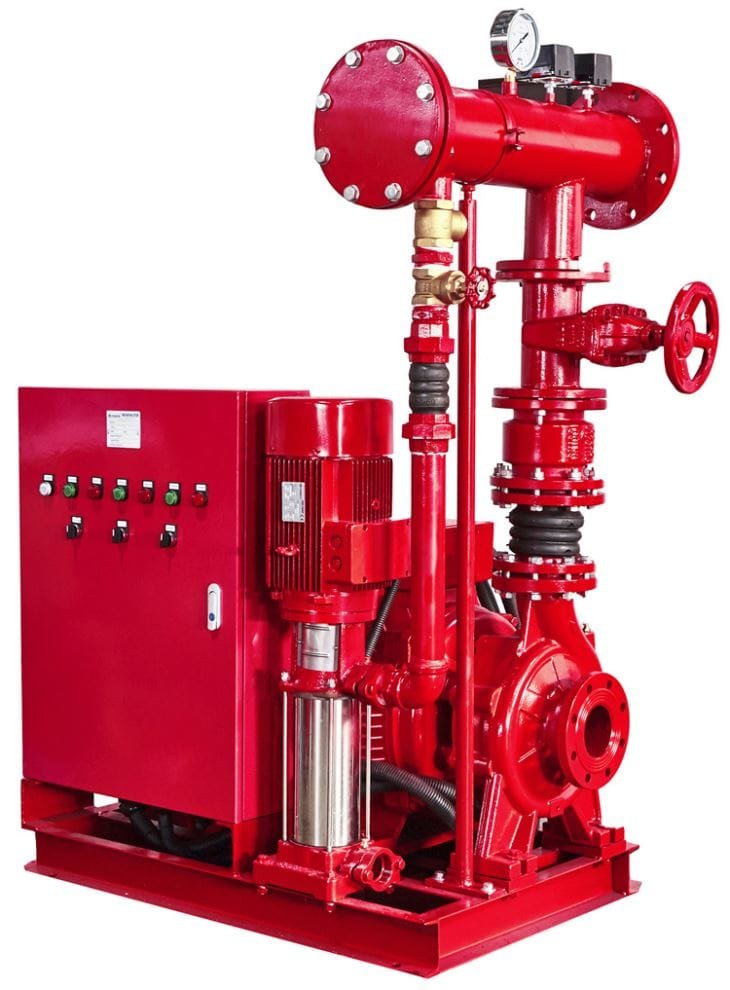
Between Light Hazard and Extra Hazard Group 2, flow rises six-fold and water volume about twenty-fold. A higher class therefore usually means a larger fire pump, larger pipework and a bigger pump room. Pump selection is covered in our Fire Pump Selection Guide for Projects in Saudi Arabia.
When does design move from hazard classes to the storage chapters?
The hazard-class method is for non-storage spaces, although the standard allows miscellaneous storage and low-piled storage to be protected under the occupancy class within set limits. The 2019 edition defines low-piled storage as storage up to 12 ft (3.7 m) high; the 2022 edition added a lower limit for Group A plastics, and the permitted limits vary by commodity class, so check the Chapter 4 tables of the adopted edition. Storage beyond these limits is protected under the storage chapters by commodity class, arrangement and height, not by an occupancy hazard class.
A high-rack warehouse therefore cannot be designed as Ordinary Hazard Group 2. See Fire Protection for Warehouses and Logistics Facilities in Saudi Arabia.
How is the classification decided in practice?
- Split the building by use: offices, kitchens and service areas, stores, car parks, plant rooms.
- Survey contents: materials, quantities, pile height, flammable liquids or dust.
- Check definitions first, then examples: the definition governs; the Annex is guidance.
- Separate storage: check height and arrangement to see whether it moves to the storage chapters.
- Allow for future use: in leased buildings a higher class may be safer if tenants change.
- Document the decision: record each area’s class and basis in the design basis report and drawings for consultant and Civil Defense review.
NFPA 13 provides for an Owner’s Information Certificate, listed among the project documents in the 2022 edition; according to the 2007-based reference, the owner uses it to describe the intended use and contents, which makes it the formal input to this decision. The designer of record should state the final class explicitly, even when detailed design is delegated.
Common hazard classification mistakes
- Treating the code occupancy group as the hazard class: a “business” group does not by itself set the sprinkler class.
- One class for the whole building: designing a hotel as Light Hazard while ignoring its kitchens, stores and car park.
- Classing retail as Ordinary Group 1: the Annex lists mercantile under Ordinary Group 2.
- Ignoring storage height: a store room stacked above 12 ft leaves the hazard-class method.
- Using the lower duration without monitoring: taking 60 minutes for Ordinary Hazard when alarms are not monitored at a constantly attended location.
- Using old curves on a new system: not permitted since the 2022 edition.
How AZEIDK can help
AZEIDK’s Engineering Design & Calculations service covers occupancy analysis, design basis, hydraulic calculations for sprinklers and pumps, drawings, specifications and bills of quantities. AZEIDK then supplies TYCO and Victaulic sprinklers, KDI pipe, and Jack Pump and 3PUMP fire pumps to match the result. For the standard’s scope, see NFPA 13: Standard for Sprinkler System Design and Installation.
Frequently asked questions
Is the NFPA 13 hazard class the same as the SBC 801 occupancy classification?
No. The building code occupancy serves life safety and sets when sprinklers are required. The NFPA 13 hazard class describes expected fire severity and sets the design criteria.
Can I choose a lower density over a larger area to reduce the pump size?
Not for new systems under the 2022 and 2025 editions; the 3,000 ft² alternative applies only where the standard requires it.
When is the Ordinary Hazard duration 60 minutes rather than 90?
Under the 2016 edition text, when waterflow and supervisory devices are electrically supervised and monitored at a constantly attended location, unless the authority requires the upper value.
Who decides the hazard class?
The designer of record, based on the Owner’s Information Certificate, with review by the consultant.
Conclusion
Too low a class gives a system that may not control the fire; too high a class gives a bigger tank and pump for no benefit. Classify each area against the NFPA 13 definitions, separate high storage, and document the decision before the hydraulic calculation.
Need the hazard classes for your project fixed before the hydraulic calculation? Send us the architectural drawings and a description of the use and contents, and we will review the design basis and its effect on the tank and pump with you. Contact the AZEIDK team
Related guides
- Fire Sprinkler Brands in Saudi Arabia: How to Verify UL and FM Approval per Model and SIN
- Fire System Maintenance Contracts in Saudi Arabia: Key Clauses
- Fire Hydrant Flow Testing: Method and How to Read the Results
- Foam Fire Extinguisher (AFFF): Which Fires It Suits, Foam vs Dry Powder, and 6 to 12 Litre Sizes