CCTV questions and answers collected from what homeowners, shop owners and facility managers in Saudi Arabia ask about security surveillance cameras: which camera to choose, how many days the recorder keeps, what the Saudi law requires, whether cameras work without power or internet, and what drives the cost. Each answer is short and links to the detailed article.
See AZEIDK’s security and surveillance systems and the CCTV cameras and recorders on the Saudi product pages.
Key takeaways
- A camera is chosen by technology, form, resolution for the distance, night vision and storage.
- Recording happens on site; the internet is needed only for remote viewing, alerts and cloud storage.
- Covered facilities follow the Law on the Use of Security Surveillance Cameras, its Implementing Regulations and the conditions document.
Choosing cameras
1. How do I choose a CCTV camera?
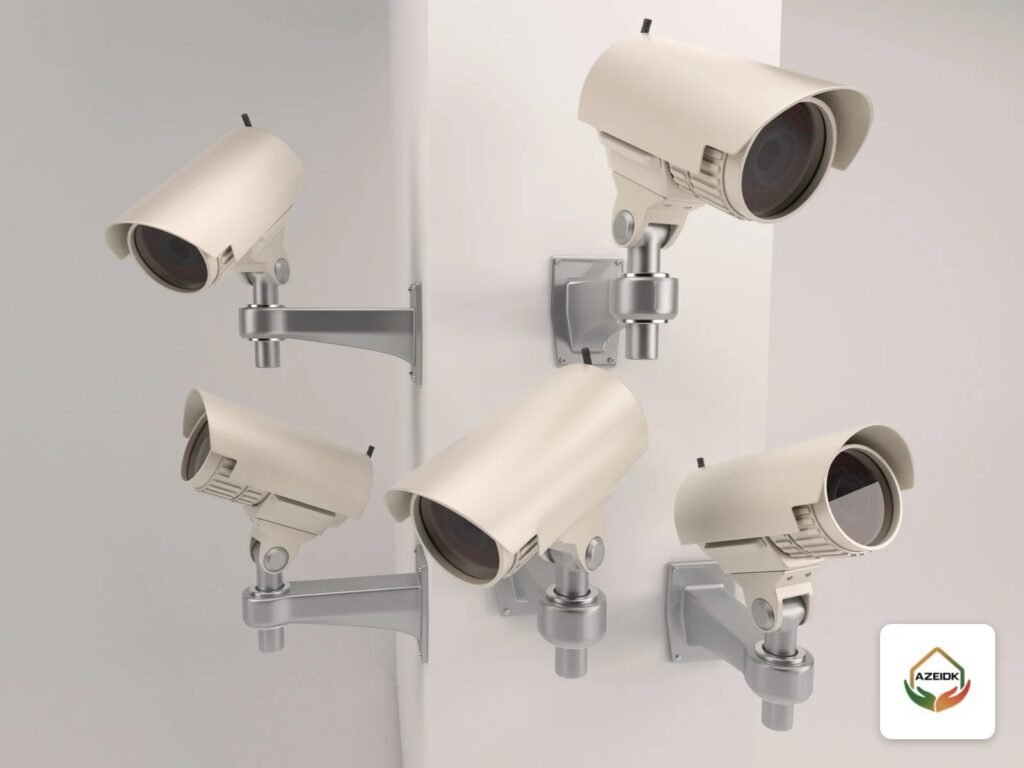
Through five decisions: IP or analog, camera form (dome, bullet, turret, PTZ, fisheye or thermal), the resolution needed for the distance, the night vision technology, and storage capacity. See CCTV camera types.
2. IP or analog cameras?
For most new medium and large facilities, IP cameras are the stronger choice: more detail, they run on the building network and integrate with access control, analytics and central monitoring. Modern HD analog still suits some upgrades on existing coax. See IP vs analog CCTV.
3. Dome, bullet or turret?
Bullets suit entrances, fences and longer distances; domes suit indoor ceilings and places where tampering is likely; turrets suit corridors and close entrances. See dome vs bullet vs turret.
4. How do cameras see at night?
In one of three ways: infrared illumination for a black-and-white image over longer distances, low-light sensors that keep colour in dim light, or full-colour night cameras with an F1.0 lens and white or warm light. See night vision CCTV cameras.
5. Hikvision or Dahua?
There is no single answer: both offer IP and HD analog cameras, recorders, human and vehicle classification and mobile apps, so the decision is made model by model for each location. See Hikvision or Dahua.
Recording and storage questions
6. How much storage do the cameras need?
Storage equals total bitrate times recording time: every 1 Mbps recorded continuously needs about 10.8 GB per day, and H.265 needs about half the bitrate of H.264 for similar quality. See CCTV storage and bandwidth calculation.
7. How many days does the recorder keep footage?
The recorder keeps writing until the drive is full, then overwrites or stops. Retention days equal drive capacity divided by the number of cameras times the daily consumption per camera. See how long CCTV keeps recordings.
8. Do cameras record during a power cut?
No, unless the recorder, cameras and power equipment between them are on a backup source such as a UPS, or the camera runs on battery or solar power. See CCTV recording during power or internet outages.
9. Do cameras work without internet?
Yes. Recording happens on the recorder’s hard drive or the camera’s memory card; internet is only needed for viewing off site, instant alerts and cloud storage. See CCTV cameras without internet.
10. How much internet data do cameras use?
Zero while they only record locally. Data is used when video leaves the site: each hour of viewing a 1 Mbps stream uses about 0.45 GB. See CCTV internet data usage.
Law and security questions
11. What does the Saudi surveillance cameras law require?
Covered entities must install, maintain and operate cameras around the clock and keep recordings for the period set in the Security Conditions and Requirements Document, under the Law, its Implementing Regulations and that document. See the Saudi security surveillance cameras law.
12. Can CCTV cameras be hacked?
Yes, usually through a weak or reused password, outdated firmware, a port left open on the router or a leaked app account. Strong unique passwords, updates and closed ports cut most of the risk. See how to protect CCTV from hacking.
Installation, maintenance and cost questions
13. What are the steps of a proper CCTV installation?
Nine steps: site survey, coverage design, camera selection, recorder and storage sizing, cabling and PoE, network setup, mobile viewing, testing and documented handover. See CCTV installation step by step.
14. What does CCTV maintenance cover?
Periodic checks that every camera gives a usable image day and night, the recorder actually records and keeps footage for the required period, and the system stays protected from unauthorised access. See CCTV and security system maintenance.
15. What sets the cost of a CCTV system?
The number, type and resolution of cameras, the recording days and drive capacity, cable lengths and routes, PoE switches, rack and backup power, then programming, testing, warranty and maintenance. A reliable figure comes only after a site survey. See CCTV system cost factors.
Frequently asked questions
Can I install cameras myself?
For a small home system, often yes. For facilities covered by the law, the design, recording period and handover records matter, so a site survey and professional installation are the safer route.
Are CCTV cameras part of low current systems?
Yes. CCTV is one of the low current systems (ELV), usually designed together with the network, access control and public address. See AZEIDK’s low current systems.
Planning cameras for a home, shop or facility? Send the layout or a short description, and the AZEIDK team will survey, propose a camera schedule and handle supply, installation and handover. Request a quote from AZEIDK
Related guides
- CCTV Quotation Comparison: BOQ, Technical Compliance, Exclusions and Warranty Before Award
- Wheeled Fire Extinguisher (50 kg Unit): When You Need One Instead of a Portable, 25 to 150 kg Sizes, Hose Length and Placement
- AFC NRS Gate Valve with Vertical Indicator Post (PIV): Protecting Underground Fire Main Valves and Reading Open/Shut Above Grade
- Material Samples and Mock-ups for Fire and ELV Devices: What Consultants Ask For Before Approval