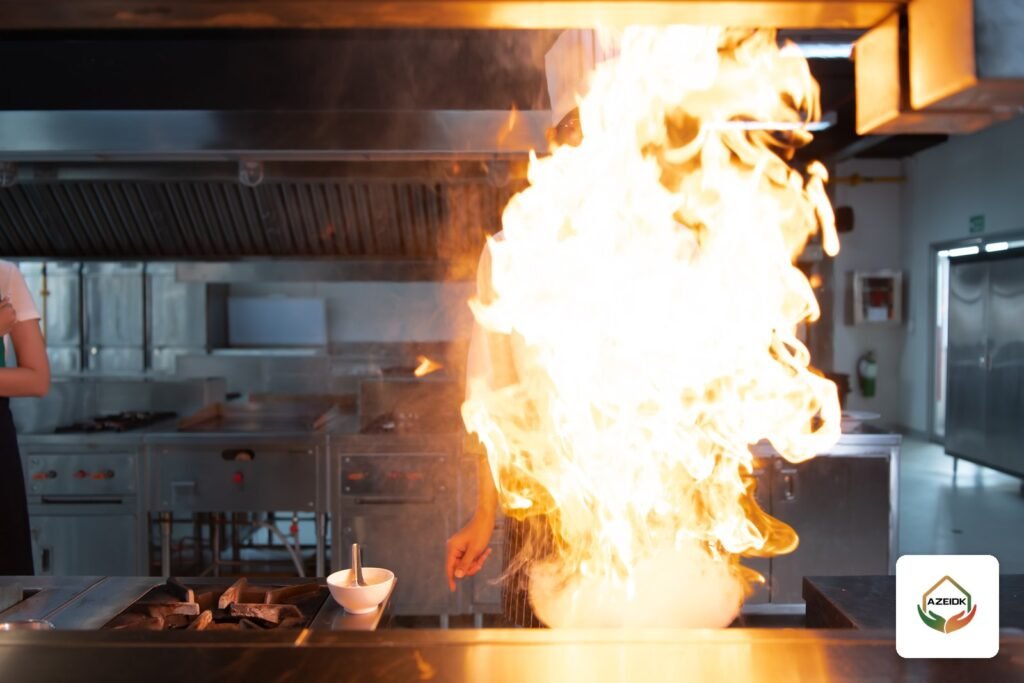
UL 300 is the UL fire test standard for pre-engineered extinguishing systems that protect commercial cooking equipment. Consultants ask for it because a system listed to it has put out real vegetable-oil fires on real appliances without re-ignition. NFPA 17A sets the rules for designing, installing and maintaining the wet chemical system itself, while NFPA 96 covers the hood, exhaust duct and fire protection of the whole kitchen.
This article explains what each reference means, how a consultant checks a listing before approving the submittal, and where these standards sit next to the Saudi Fire Code SBC 801 and Civil Defense requirements. For the systems AZEIDK supplies and installs, see kitchen fire suppression systems.
To see the other systems restaurants and commercial kitchens need and the steps to obtain the Salamah certificate, read our safety systems guide for restaurants and commercial kitchens.
Key takeaways
- UL 300 is a fire performance test for pre-engineered systems. It took effect on 21 November 1994, after cooking oils and appliances changed.
- UL 1254 covers how the system unit is built, marked and installed; UL 300 covers how it performs on a fire. NFPA 17A requires wet chemical systems to meet both.
- NFPA 17A deals with the wet chemical system; NFPA 96 covers the hood, duct, fan, cleaning and the links to gas and the fire alarm.
- A listing applies to one specific model and its design manual. Check it in UL Solutions’ Product iQ directory, not in a brochure.
- In Saudi Arabia the binding references are SBC 801 and Civil Defense requirements. NFPA and UL documents are technical references adopted by the designer and consultant.
In this article
- What is UL 300 and why was it introduced?
- Does a kitchen suppression system have to be UL 300?
- NFPA 17A vs NFPA 96: what is the difference?
- How does a hood system work and shut off the gas?
- How does a consultant verify a kitchen system’s listing?
- ANSUL R-102 and Hood Safer: what the manufacturers state
- UL 300 in Saudi Arabia: what Civil Defense and SBC 801 expect
- Common approval mistakes
- FAQ
- Summary
What is UL 300 and why was it introduced?
The full title is “Standard for Fire Testing of Fire Extinguishing Systems for Protection of Commercial Cooking Equipment”, currently in its 4th edition (2019). It defines the fire tests that pre-engineered units for restaurant and cafeteria kitchens must pass. Installation requirements are left to NFPA documents.
UL 300 took effect on 21 November 1994. Systems manufactured after that date had to comply to carry a UL listing. Two changes in commercial kitchens drove it:
- Oils: restaurants moved from animal fats to vegetable oils, which burn hotter and are harder to extinguish.
- Appliances: modern, well-insulated fryers hold heat longer, so oil can re-ignite after the flame is knocked down unless it is cooled.
According to FEMA (Fire Equipment Manufacturers’ Association), the test became much closer to real conditions:
| Item | Before UL 300 | Under UL 300 |
|---|---|---|
| Test appliance | Fabricated test pan | Commercially available gas fryer with set heat-up and cool-down rates |
| Pre-burn | One minute, heat source off | Two minutes, heat source on |
| Cooking medium | Less tightly defined | Vegetable shortening with auto-ignition of at least 685°F (363°C) |
| Splash test | Not required | Required for fryers, range tops and woks; a splash failure counts as a system failure |
FEMA notes that fryers now need about five times more wet agent on average, and that hood, plenum and duct test protocols did not change. It also states that no dry chemical system is UL 300 listed for cooking hazards, because dry chemical does not cool the oil and re-flash is likely.
Does a kitchen suppression system have to be UL 300?
On most Saudi projects whose specifications follow NFPA and UL references, yes. The requirement comes from three directions:
- NFPA 96: automatic extinguishing systems must comply with UL 300 or an equivalent standard and be installed per their listing.
- NFPA 17A: wet chemical systems must be listed and meet UL 1254 and UL 300.
- US International Fire Code (IFC): a model code that is not binding in Saudi Arabia on its own. Its 2015 edition (Section 904.12) requires pre-engineered dry and wet chemical systems to be tested to UL 300. SBC 801 follows the IFC arrangement, but the binding text is the Saudi edition.
The difference matters when reading certificates. UL 300 covers fire performance only. UL 1254 (pre-engineered dry and wet chemical extinguishing system units) covers construction, manufacturing tests, markings and installation instructions. “UL 300” printed in a catalogue is not enough; what counts is a current listing for the model.
Where a specification is based on a European reference such as EN 17446, acceptance is the consultant’s and the authority’s decision, and the supplier must prove compliance with the reference actually written in the specification.
NFPA 17A vs NFPA 96: what is the difference?
| Reference | Body | Type | Covers | Current edition |
|---|---|---|---|---|
| UL 300 | UL | Test standard | Fire performance on cooking appliances, hood and duct | 4th edition (2019) |
| UL 1254 | UL | Product standard | Construction, marking and installation instructions of the unit | Check the UL directory |
| NFPA 17A | NFPA | System standard | Design, installation, operation, testing and maintenance of wet chemical systems | 2027 (replaces 2024) |
| NFPA 96 | NFPA | Kitchen operations standard | Hoods, ducts, fans, clearances, cleaning and fire protection | 2027 (replaces 2024) |
NFPA 17A covers pre-engineered systems that discharge wet chemical through fixed piping and nozzles using an expellant gas. Work must be done by people trained and qualified on the specific system, and the installation must follow the listing and the manufacturer’s manual.
NFPA 96 treats the kitchen as one system: hood, duct, fan, grease filters and clearances to combustibles. It makes the automatic system the primary protection and portable extinguishers secondary. Where the building has a fire alarm system, system actuation must operate the alarm. Grease build-up of 2,000 µm on most surfaces, or 3,175 µm in a fan housing, triggers cleaning.
How does a hood system work and shut off the gas?
The system operates automatically or manually. Detection is by fusible links or thermal detectors, depending on the model, and nozzles discharge onto each appliance and into the plenum and duct. The wet agent reacts with hot oil to form a soap-like layer and cools it, which prevents re-ignition.
The US model code (2015 IFC, Section 904.12), not a Saudi text, requires actuation to shut off fuel or electric power to the cooking equipment automatically, with manual reset. It places the manual pull station at or near a means of egress from the cooking area, 10 to 20 ft (3 to 6 m) from the kitchen exhaust system and 42 to 48 in above the floor. The values that bind a project are those in SBC 801 and the manufacturer’s manual, so check them before installation.
How does a consultant verify a kitchen system’s listing?
A UL listing applies to a specific model together with its design and installation manual. UL Solutions publishes listings in its Product iQ directory, which it says more than 2,500 authorities and code officials consult each year. A practical review:
- Manufacturer and model: search Product iQ for the manufacturer and the model shown on the datasheet, and confirm the listing is current.
- Standard: confirm the listing references UL 300 (and UL 1254 where applicable), not just a single component.
- Design manual: ask for the manufacturer’s design and installation manual; coverage limits, nozzle counts and pipe lengths are part of the listing.
- Submittal vs site: compare appliance count and types and hood length with what the calculation covers.
- Agent: it must be the manufacturer’s listed agent, including at recharge.
- Installer: ask for proof of training on that system and a statement that the installation follows the listing.
For general guidance on reading product certificates, see UL, FM and LPCB certification.
ANSUL R-102 and Hood Safer: what the manufacturers state
- ANSUL R-102: the manufacturer states the system is UL and ULC listed, meets UL 300, and meets NFPA 96 and NFPA 17A. It uses ANSULEX Low pH agent and fusible-link detection rated 74 to 260°C, with appliance-specific or overlapping nozzle coverage. See ANSUL R-102 in Saudi Arabia.
- Hood Safer: made by a Turkish manufacturer in Antalya and certified under a BSI Kitemark to the European standard EN 17446, in models HS-4, HS-8 and HS-16. Where a specification names UL 300, acceptance is the consultant’s decision after reviewing its certificates against the reference written in the specification. See Hood Safer in Saudi Arabia.
UL 300 in Saudi Arabia: what Civil Defense and SBC 801 expect
The binding reference is the Saudi Building Code, including the fire code SBC 801, whose 2024 edition has been mandatory since 30 June 2025. It follows the IFC arrangement: commercial cooking systems fall under the building services chapter, and fire protection systems under Chapter 9. Designers must work from the Saudi text, not the US IFC.
The Ministry of Municipalities and Housing restaurant requirements (1446 AH / 2025) make Civil Defense approval a condition of the licence, require compliance with all SBC 801 requirements, and require ventilation design to follow the Saudi Building Code. The document does not name a kitchen system type; the approved design and the consultant set it under the code.
In practice the consultant asks for the datasheet, design manual, listing evidence, coverage calculation and nozzle layout. The kitchen system is then reviewed with the facility’s other safety systems when the file goes through the Salamah platform.
Common approval mistakes
- Submitting a generic brochure that says “UL 300” with no model number or verifiable listing.
- Adding a fryer or other appliance under the hood without recalculating. FEMA states that adding an appliance to an older non-UL 300 system requires upgrading the whole system.
- Mixing components or agent from different manufacturers, which voids the listing.
- No interlocked gas shut-off valve, or no connection to the fire alarm panel where one exists.
- Relying on a standard powder extinguisher instead of a Class K extinguisher next to the appliances.
- Letting duct grease pass the cleaning threshold or skipping periodic service. See kitchen suppression inspection and maintenance.
FAQ
What is UL 300 in short?
A UL fire test standard for pre-engineered systems protecting commercial cooking appliances, hoods and ducts, in effect since November 1994.
What does Civil Defense require for restaurant kitchens in Saudi Arabia?
Restaurant licensing requires Civil Defense approval and compliance with SBC 801. The protection required is set by the approved design under the code and confirmed with the consultant for each facility.
Are NFPA 17A and NFPA 96 the same?
No. NFPA 17A covers the wet chemical system; NFPA 96 covers ventilation control and fire protection of the whole commercial kitchen, including hoods, ducts and cleaning.
How do I confirm a system is really listed?
Search the manufacturer and model in UL Solutions’ Product iQ and match the listing with the datasheet and design manual in the submittal.
How much does a kitchen hood suppression system cost in Saudi Arabia?
Price depends on hood length, number and type of appliances, duct length and automatic gas shut-off. See kitchen suppression price factors.
Can a Class K extinguisher replace the system?
No. NFPA 96 makes the automatic system the primary protection; the extinguisher is secondary and used after the system is activated.
Summary
UL 300 shows the system put out a vegetable-oil fire on real appliances without re-flash, UL 1254 covers how the unit is built, and NFPA 17A and NFPA 96 define how it is designed, installed and maintained within the kitchen. In Saudi Arabia SBC 801 and Civil Defense remain the final reference, and consultants ask for these standards because they are the practical way to prove the submitted system will work as designed. For the full system overview, see commercial kitchen fire suppression in Saudi Arabia.
Preparing a kitchen suppression submittal? Send us the hood layout, appliance list and specification reference, and we will help you select the system and prepare the datasheets and approval documents. Contact the AZEIDK team
Related guides
- CCTV Camera Placement & Coverage
- Fire Sprinkler Pressure Gauges and Fire Pump Pressure Switches: Selecting WIKA 111.10SP, AGF 7500 and PSM-520
- Fire Safety Equipment List for Facilities in Saudi Arabia
- Salamah Certificate for Malls and Shopping Centres: Building Licence, Tenant Shops and Who Is Responsible