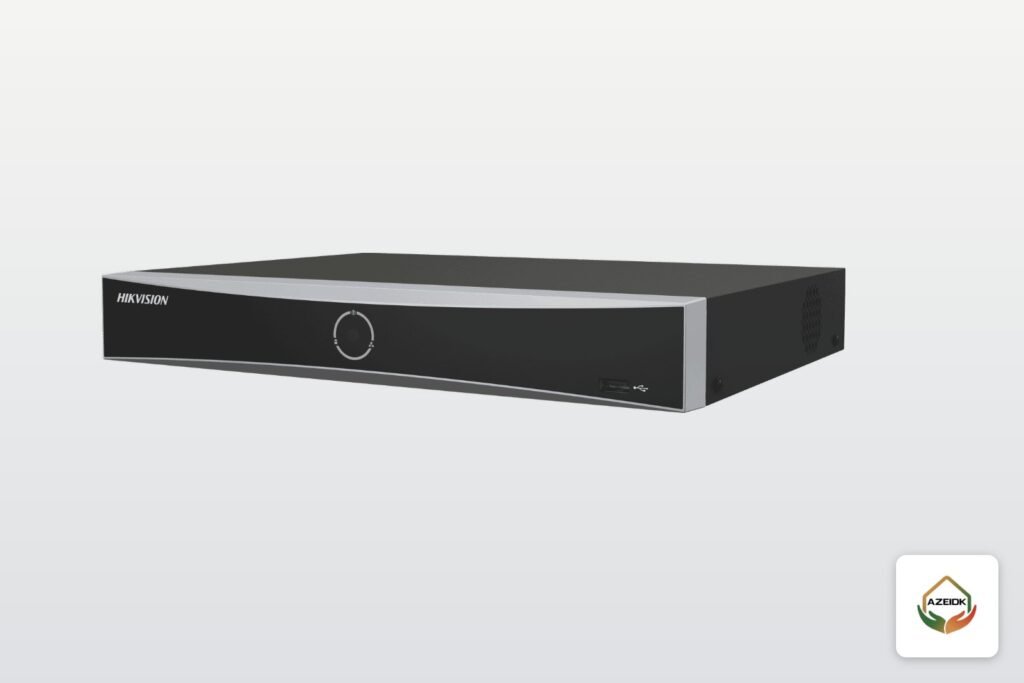
The Hikvision NVR 8 channel model AZEIDK supplies is the DS-7608NXI-K1(B) network video recorder from the K series. It records eight IP cameras at up to 12 MP, and the DS-7608NXI-K1/8P (B) version adds eight PoE ports that power the cameras directly, with a total PoE budget of up to 75 W. It takes one SATA hard drive up to 10 TB, has a 4K HDMI output and uses AcuSense to filter alerts to people and vehicles.
This guide covers the recorder itself: what the datasheet figures mean in practice, how many cameras the PoE ports can really carry, how many days one drive holds and when you need a bigger unit. For the general NVR vs DVR choice, see CCTV Recorder (NVR or DVR). All of it sits within AZEIDK’s security and surveillance solutions.
Key points
- 8 IP channels, 80 Mbps incoming bandwidth, recording up to 12 MP.
- The 8P version has 8 PoE ports (IEEE 802.3af/at) with a total of 75 W or less; a non-PoE version also exists.
- One SATA bay for a drive up to 10 TB, bought separately.
- 4K HDMI and 1080p VGA outputs; H.265 and H.265+ compression.
- AcuSense, Motion Detection 2.0 and perimeter protection with human and vehicle recognition.
In this article
- Hikvision NVR 8 channel DS-7608NXI-K1(B) specifications
- Recording and live display are different limits
- How many cameras can the PoE ports power?
- How many days does a 10 TB drive hold?
- What AcuSense on the recorder gives you
- When it is enough, and when to size up
- Installation tips from site work
- Frequently asked questions
Hikvision NVR 8 channel DS-7608NXI-K1(B) specifications
The figures below are taken from the AZEIDK product page, which quotes the official Hikvision datasheet for the DS-7608NXI-K1/8P (B) version. The unit is 1U high, so it fits a rack or a shelf in the network room.
| Item | Value |
|---|---|
| IP video input | 8 channels |
| Incoming / outgoing bandwidth | 80 Mbps / 80 Mbps |
| Recording resolution | Up to 12 MP, including 8, 6, 5, 4, 3 MP, 1080p and lower |
| Video output | 1 x HDMI 4K (3840 x 2160) at 30 Hz; 1 x VGA 1920 x 1080 at 60 Hz |
| Decoding (AI off) | 1 ch at 12 MP, 2 ch at 8 MP, 4 ch at 4 MP or 8 ch at 1080p (30 fps) |
| Compression | H.265, H.265+, H.264+, H.264 |
| Storage | 1 SATA, up to 10 TB |
| Network | 1 x RJ-45 10/100 Mbps |
| PoE | 8 x RJ-45 10/100 Mbps, IEEE 802.3af/at, total 75 W or less |
| Power | 48 VDC, 1.875 A; 10 W or less without HDD and with PoE off |
| Operating temperature | -10 °C to 55 °C |
Recording and live display are different limits
The question we hear most: can it show eight 4K cameras on screen at once? The answer is in the decoding line. Recording covers all eight channels at whatever resolution the cameras send, as long as the total stays within 80 Mbps. Decoding is what the recorder can display or play back at full resolution at the same moment, which tops out at one 12 MP channel, two 8 MP channels or four 4 MP channels.
In an eight-tile split screen the recorder normally uses each camera’s lighter sub stream, and switches to the main stream when you open one camera full screen. Setting the sub stream correctly on each camera matters; the steps are in Hikvision CCTV Settings.
How many cameras can the PoE ports power?
Eight PoE ports do not mean any eight cameras will run. The limit is 75 W across all ports, about 9.4 W per port on average with all eight in use. Add up each camera’s maximum consumption from its datasheet and compare it with 75 W.
An example from cameras on the AZEIDK catalogue: the Dahua IPC-HFW2531T-ZS-S2 is listed at under 9.9 W. Eight of them could reach about 79 W at full load, which is over the 75 W budget. Mix in lower-power cameras, feed some from a separate PoE switch, or use a 12 V adapter where the camera supports it. Keep a margin of 15 to 20 percent, because night illumination and motorised lenses raise consumption.
10/100 PoE port speed
The PoE ports run at 10/100 Mbps, which is plenty for a single camera stream at any common resolution. The real ceiling is the 80 Mbps total for the whole recorder.
The network port and remote viewing
The uplink port is also 10/100. If several users pull main streams from outside the site at once, this port or the upload speed of the internet line becomes the bottleneck. Mobile viewing on the sub stream is much lighter.
How many days does a 10 TB drive hold?
There is only one drive bay, so the drive size sets your retention. The formula: bitrate per camera in Mbps x 86,400 seconds / 8 = megabytes per day. The table assumes continuous 24-hour recording at a constant bitrate. It is an illustration, not a manufacturer figure.
| Cameras | Bitrate per camera | Per day | Approx. days on 10 TB |
|---|---|---|---|
| 8 | 2 Mbps | about 173 GB | about 57 days |
| 8 | 4 Mbps | about 346 GB | about 29 days |
| 8 | 8 Mbps | about 691 GB | about 14 days |
Usable capacity after formatting is a little below the label, so keep a margin. Motion-only recording and H.265+ stretch the days, but if the facility must keep footage for a set period, size for the worst case. See CCTV recording retention and CCTV storage and bandwidth calculation.
What AcuSense on the recorder gives you
The product page lists Motion Detection 2.0 and perimeter protection with human and vehicle recognition. In daily use, alerts and playback searches can be limited to people and cars rather than every movement such as tree shadows, cats or passing headlights. That cuts false alerts on the guard’s or owner’s phone and speeds up finding a clip.
Note that the decoding figures are stated with AI off. Running smart features on the recorder can change what it handles at the same time, so enable them per channel where they are needed rather than on every camera.
When it is enough, and when to size up
| Situation | Suitable choice |
|---|---|
| Shop, villa or small office with up to 8 IP cameras | DS-7608NXI-K1/8P (B) with PoE, after a power check |
| Cameras already fed by an existing PoE switch | The non-PoE version is enough |
| Long retention with 4K cameras | A recorder with more drive bays; this model has one |
| More than 8 cameras or planned expansion | A 16-channel or larger recorder from the start |
| Existing analog cameras on coax | A DVR, as in Hikvision DVR 4 channel |
Installation tips from site work
- Install it in a ventilated spot. The operating limit is 55 °C, and a closed guard room or roof room in summer can get close.
- Use a surveillance-rated drive built for 24-hour duty and format it from the recorder menu before recording starts.
- Put the recorder on a UPS; see recording during power or internet outages.
- Change the default password and update firmware only from Hikvision’s official source.
- Record channel names and camera locations in the handover sheet.
Frequently asked questions
Does the DS-7608NXI-K1(B) have PoE ports?
The DS-7608NXI-K1/8P (B) has 8 PoE ports with a total of up to 75 W. A non-PoE version also exists, so specify the version when ordering.
How many hard drives does it take?
One SATA drive, up to 10 TB per the datasheet.
Does it record 4K cameras?
Yes. Recording goes up to 12 MP, provided total incoming bandwidth stays within 80 Mbps.
Can it show 8 cameras at full resolution together?
No. Full-resolution decoding tops out at 4 channels at 4 MP or 8 channels at 1080p; split screens normally use sub streams.
Can I view the cameras on my phone?
Yes, through the Hikvision app once the recorder is online. Camera offline in Hik-Connect covers connection problems.
Is it enough for a large warehouse?
If you have more than eight cameras or need long retention, a recorder with more channels and drive bays fits better.
Planning an 8-camera system on a Hikvision recorder? Send the camera count, locations and required retention, and the AZEIDK team will size the PoE budget and drive, then supply and install. Contact AZEIDK
Related guides
- WATEX UL-Listed Foam Bladder Tanks: Capacities, Specifications, Ratio Controllers and Sizing
- General Contracting for Factories and Warehouses in Saudi Arabia: Structure, MEP and Fire Systems Under One Contract
- Water Mist Fire Suppression in Saudi Arabia: Applications and Technical Considerations
- FirePlus Fire Alarm Panel from Context Plus: ULP-CON Models from 1 to 6 Loops, Capacity, Batteries and Expansion Cards