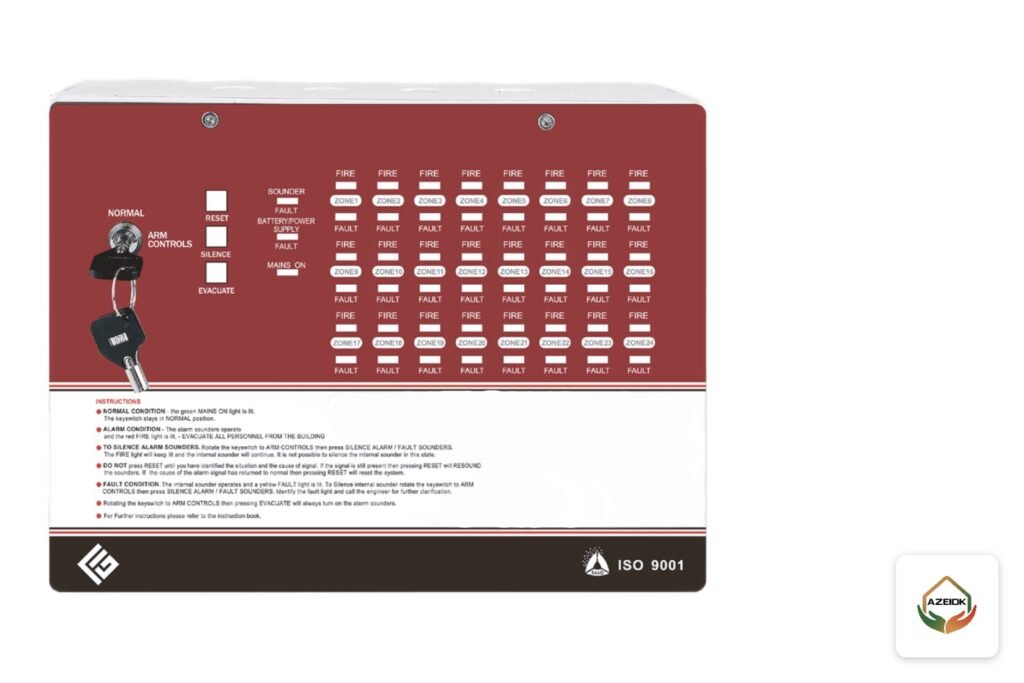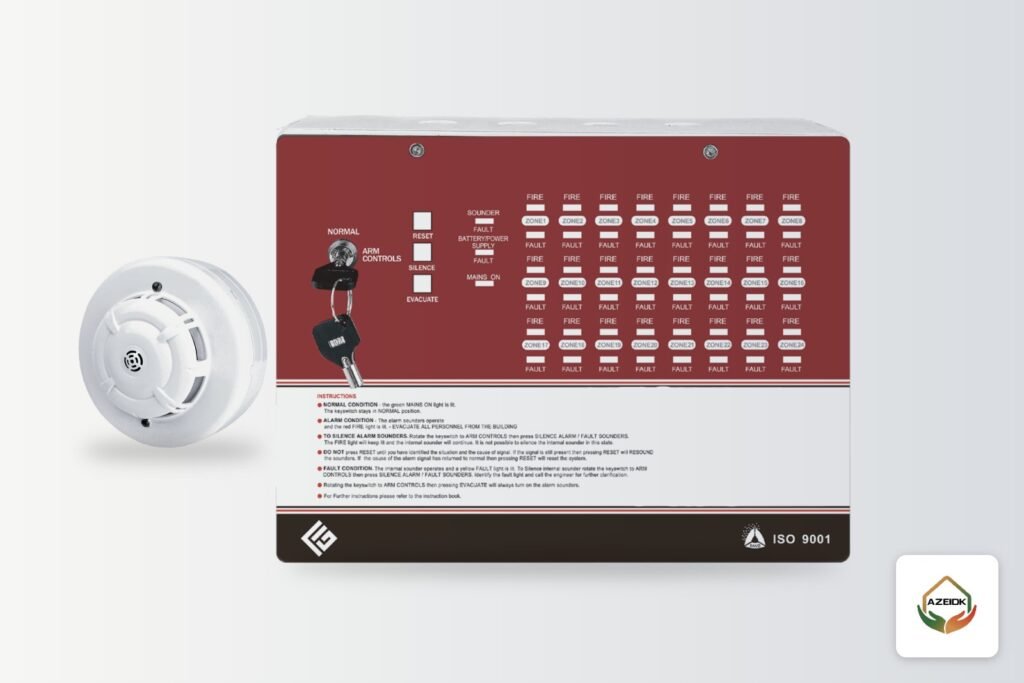
FG fire alarm is a complete conventional range that AZEIDK supplies in Saudi Arabia: FG-Z01, FG-Z02, FG-Z04 and FG-Z08 control panels with 1, 2, 4 and 8 zones, the FGS-604 photoelectric smoke detector, the FGH-504 heat detector, the FA-505 manual call point and the FA-400 fire bell. It suits shops, small warehouses and mid-size buildings where knowing the zone, not the exact device, is enough.
This guide brings together the datasheet figures published for each product on the FG brand page, explains how to choose the number of zones, what to check on voltage, current and operating temperature before supply, and when to move to an addressable system.
Key takeaways
- FG conventional panels come in four sizes (1, 2, 4 and 8 zones), all with a digital display, LED indicators and a 24 V relay output.
- The FGS-604 and FGH-504 detectors run on 9 to 35 V DC with standby current of up to 50 µA.
- The FGH-504 combines fixed temperature (57 °C ±3) with rate-of-rise detection (8 to 10 °C per minute).
- The published detector operating range is 0 to 50 °C, which needs checking in unconditioned spaces.
- UL or EN 54 approvals are not shown on the FG product pages, so request them from the datasheet and catalogue before the submittal.
In this article
- What is the FG conventional fire alarm system?
- FG-Z01, FG-Z02, FG-Z04 and FG-Z08 panels
- FG detectors: FGS-604 smoke and FGH-504 heat
- FA-505 call point and FA-400 bell
- Supporting FG products: SD-615 and RL-01
- What to check before approving an FG fire alarm system
- When to choose FG and when to move to Context Plus
- Frequently asked questions
- Summary
What is the FG conventional fire alarm system?
A conventional system splits the building into zones. Each zone is one cable circuit carrying a group of detectors and call points. When any device on the circuit operates, the panel shows the zone number only, not the individual detector. This works where searching inside a zone is quick: a shop, a single-hall warehouse, a two-storey office building or a large villa.
The FG products listed on the AZEIDK site cover the core of such a system: panel, smoke detector, heat detector, manual call point, fire bell, the RL-01 remote indicator and the SD-615 smoke detector with built-in sounder. For a full comparison of the two system types, see our conventional and addressable fire alarm guide.
FG-Z01, FG-Z02, FG-Z04 and FG-Z08 panels
The FG conventional fire alarm control panels receive signals from detectors and call points, display fire, fault and power conditions, sound the alarm and drive external equipment through a relay output. Published figures:
| Item | Published value |
|---|---|
| Zones | 1, 2, 4 or 8 depending on model |
| Mains supply | 220 to 230 V AC |
| Rated current | 130 mA |
| Standby battery | 24 V DC |
| Internal power supply | 27 V DC |
| Total output current | Up to 400 mA |
| Auxiliary outputs | 24 V relay and remote fire alarm output |
| Dimensions | 275 × 200 × 75 mm or 320 × 238 × 73.5 mm by model |
| Enclosure | Wall-mounted metal |
How many zones do you need?
Start from the approved drawing, not the price. A practical rule is that each zone should be an area the response team can search quickly: one floor, one compartment behind a fire wall, or one separate store. A two-storey building with a rear store may need three zones, which points to the FG-Z04 with one spare. The consultant sets the number and size of zones under the code adopted for the project, and the Saudi Fire Code SBC 801 decides when a fire alarm system is required at all.
Watch the total output current
The published total output current is 400 mA. Add up the alarm current of every bell, sounder and indicator the panel will feed and compare it with this figure and with the per-circuit limits in the catalogue. A simple example: an FA-400 bell draws up to 50 mA, so eight bells reach 400 mA, the whole published figure with no margin. The design then needs revisiting or a suitable power supply, as explained in our article on NAC booster power supplies.
FG detectors: FGS-604 smoke and FGH-504 heat
The FGS-604 photoelectric smoke detector uses a pair of infrared diodes inside a chamber that blocks outside light. Smoke scatters light onto the receiver, and once density reaches the operating point the detector signals an alarm and lights its red LED. Published sensitivity is 0.08 to 0.16 dB/m, and the catalogue lists 2-wire and 4-wire versions.
The FGH-504 heat detector uses an exposed thermistor under a vented cover. It responds to a fixed temperature of 57 °C (±3) and to a rate of rise of 8 to 10 °C per minute. Typical locations are kitchens, small generator rooms, enclosed car parks and any space where steam or dust would cause false alarms on a smoke detector.
| Item | FGS-604 (smoke) | FGH-504 (heat) |
|---|---|---|
| Operating voltage | 9 to 35 V DC | 9 to 35 V DC |
| Standby current | Up to 50 µA | Up to 50 µA |
| Alarm current at 24 V | 40 to 50 mA | 40 to 50 mA |
| Response | 0.08 to 0.16 dB/m | 57 °C ±3, rate of rise 8 to 10 °C/min |
| Operating temperature | 0 to 50 °C | 0 to 50 °C |
| Humidity | Up to 95% RH, non-condensing | Up to 95% RH, non-condensing |
| Size | 99 mm diameter × 43.5 mm | 99 mm diameter × 43.5 mm |
| Indication | Red LED + remote indicator output | Red LED + remote indicator output |
Operating temperature in the Saudi climate
The published upper operating limit for both detectors is 50 °C. That is fine in air-conditioned offices and shops, but needs checking under the metal roofs of unconditioned warehouses and in plant rooms near heat sources, where ceiling temperature can exceed it in summer. In such areas the consultant usually asks for a measured or estimated ceiling temperature and selects a detector rated for it. The 57 °C trip point of the FGH-504 is also close to some hot ceiling temperatures, which can lead to unwanted alarms. Compare heat detector types in our heat detector guide.
FA-505 call point and FA-400 bell
The FA-505 manual call point is a red square unit with a PRESS HERE area and a clear cover to reduce accidental operation. It runs on 24 V DC with standby current up to 100 µA, contact resistance up to 0.02 ohm and dimensions of 87 × 87 × 52.5 mm. It normally sits at exits, stairs and corridors.
The FA-400 fire bell is a round red bell in 6-inch and 8-inch sizes, running on 24 V DC, drawing no more than 50 mA and producing at least 95 dB. Quantity and placement are chosen so the alarm is clearly heard above normal noise in each zone; see fire alarm bells, sounders and strobes.
Supporting FG products: SD-615 and RL-01
The SD-615 smoke detector adds a built-in sounder of more than 80 dB at 1 m to photoelectric detection, useful where the owner wants an immediate local warning in the room as well as the signal to the panel. Standby current is up to 80 µA and alarm current up to 40 mA.
The RL-01 remote indicator is mounted outside closed rooms or above doors so the response team can see which room holds the detector in alarm without opening every door. It runs on 3.3 V or 24 V DC, draws 15 mA at 24 V and measures 85 × 85 × 31 mm.
What to check before approving an FG fire alarm system
- Approvals: obtain the official datasheet and catalogue and confirm the approval the project specification asks for (UL or EN 54) before submission.
- Compatibility: conventional detectors work with the panel through the zone circuit and end-of-line device, so confirm catalogue compatibility before mixing brands.
- Batteries: size the battery for the required standby and alarm times, as in our fire alarm battery calculation guide.
- Environment: compare ceiling temperature, humidity and dust in each zone with the published limits.
- Future growth: if the building will grow past 8 zones, or you need the location of every detector, an addressable system fits better.
When to choose FG and when to move to Context Plus
FG panels stop at 8 zones. For more conventional zones, the Context Plus FP, CFP and MFP panels cover wider ranges. For large or multi-storey buildings, or where lifts, HVAC and doors must be interfaced, an addressable system reports each device and shortens the search. The choice depends on building size and the approved design, and AZEIDK’s technical selection of systems and equipment team can compare both options on your drawings.
Frequently asked questions
How many zones do FG fire alarm panels have?
Four models: FG-Z01 with one zone, FG-Z02 with two, FG-Z04 with four and FG-Z08 with eight.
Does the FG panel take a standby battery?
Yes, a 24 V DC battery. Its capacity is calculated from the standby and alarm times required for the project.
What is the difference between the FGS-604 and SD-615?
Both are conventional photoelectric smoke detectors. The SD-615 adds a built-in sounder of more than 80 dB at 1 m; the FGS-604 relies on the system bells and sounders.
At what temperature does the FGH-504 operate?
At a fixed 57 °C (±3), or on a fast rise of 8 to 10 °C per minute.
Are FG products suitable for unconditioned warehouses?
The published detector operating range goes up to 50 °C, so check the ceiling temperature first. If it can exceed that, select a detector with a higher temperature rating.
How do I get a quotation for an FG system?
Send the drawing or BOQ and the number of zones, and the AZEIDK team will confirm models and quantities.
Summary
The FG range gives small and mid-size buildings a clear conventional solution, from a one-zone panel up to eight zones, with detectors, bells and call points from the same brand. The key checks are zone count, bell load against output current, ceiling temperature against operating limits, and the approval required by the specification. For complete solutions, see fire alarm systems.
Fitting out a shop, warehouse or small building? Send us the drawing and zone count and we will prepare the matching FG product list with datasheets. Contact the AZEIDK team
Related guides
- Fire Alarm Log Book and Inspection Report: What to Record and a Periodic Maintenance Report Template
- Fire System Maintenance Companies in Riyadh: How to Measure Performance and Switch Without a Gap
- OS&Y Gate Valves and Ball Valves for Fire Systems: United Brass Works and Apollo in Saudi Arabia
- AFFF Foam Concentrate Shelf Life: Storage, Annual Testing and Replacement