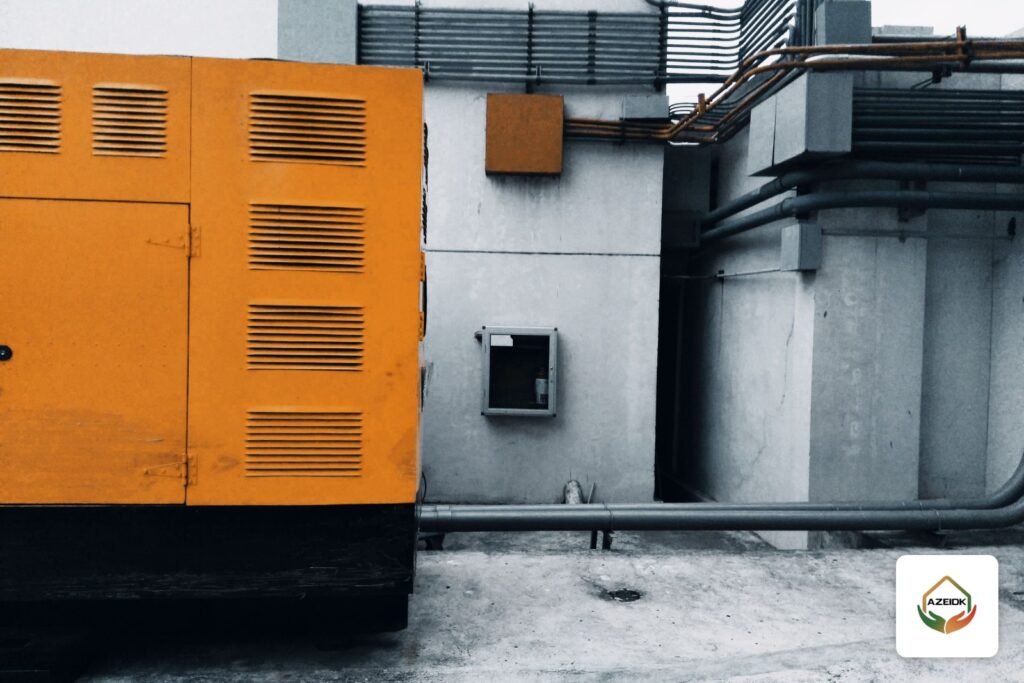
An emergency generator is installed to run when everything else fails, yet it puts liquid fuel, very hot exhaust surfaces, electrical panels and batteries in one room. Generator room and diesel tank fire protection therefore has to balance two goals: putting a fire out quickly, and not shutting the generator down at the moment the building needs it most.
This article covers the hazards in generator rooms, the reference standards, limits on diesel storage inside buildings, detection and suppression options, and the mistakes that keep recurring on site.
Key takeaways
- Diesel is a Class II combustible liquid under NFPA 30, with a flash point from 37.8 °C to below 60 °C. It ignites readily when it leaks onto a hot exhaust surface.
- NFPA 37 (2024 edition) governs the installation of stationary engines and their fuel tanks; NFPA 110 (2025 edition) governs the performance of emergency and standby power systems and their rooms.
- The amount of diesel kept inside the building drives the fire rating of the room and the containment and ventilation requirements.
- Suppression options include sprinklers, foam-water sprinklers, water mist, CO2 for unoccupied spaces and condensed aerosol, chosen to suit occupancy and room tightness.
- Fuel and ventilation shutdown on suppression discharge normally exempts emergency generators, so the cause-and-effect matrix must settle it.
In this article
- Fire hazards in generator rooms
- Reference standards on Saudi projects
- Room construction, ventilation and exhaust
- Diesel tanks inside the building
- Detection, alarm and interlocks
- Suppression options for generator rooms and diesel tanks
- Outdoor generators, enclosures and rooftops
- Common mistakes in generator room protection
- AZEIDK solutions for generator rooms
- Frequently asked questions
- Conclusion
Fire hazards in generator rooms
NFPA 30 classifies diesel as a Class II combustible liquid, meaning a flash point from 37.8 °C to below 60 °C. It does not ignite easily at normal room temperature, but conditions change in a closed room during a Saudi summer, or when fuel sprays from a loose fitting onto the exhaust manifold or turbocharger. Other hazards include:
- Exhaust manifolds, turbochargers and exhaust pipes, which run very hot in operation.
- Lube oil leaks collecting in the generator base.
- Flexible fuel hoses damaged by vibration or heat.
- Automatic transfer switches (ATS), control panels and batteries.
- Unrelated materials stored in the room, such as cardboard and oil drums.
Reference standards on Saudi projects
The binding framework in the Kingdom is the Saudi Fire Code SBC 801 together with Civil Defense requirements, while NFPA standards serve as technical design references. The most relevant are:
| Standard | Current edition | What it covers for a generator room |
|---|---|---|
| NFPA 37 | 2024 | Installation of stationary engines and gas turbines: room construction, fuel tanks and piping, exhaust and shutdown |
| NFPA 110 | 2025 | Performance of emergency and standby power systems, including generator location, room separation and fuel quantity |
| NFPA 30 | 2024 | Storage and handling of flammable and combustible liquids, including large tanks outside the building |
| Suppression standards | By system | NFPA 13 sprinklers, NFPA 16 foam-water sprinklers, NFPA 750 water mist, NFPA 12 carbon dioxide, NFPA 2010 aerosol |
A technical article on NFPA 110 Chapter 7 (Manufacturing.net) states that emergency power supply equipment installed indoors goes in a separate room with a two-hour fire resistance rating; confirm how this applies to each system level in the 2025 edition. For generators in high-rise buildings, check the room separation required by the Saudi code adopted for the project.
Room construction, ventilation and exhaust
A technical summary of NFPA 37 (2018 edition) notes that interior walls, floors and ceilings of engine rooms need at least a one-hour fire resistance rating, and that a top-floor room may have a noncombustible ceiling or one protected by an automatic suppression system. Where NFPA 37, NFPA 110 and the building code all apply to the same room, the most stringent requirement governs.
The room needs enough combustion and cooling air, with openings sized from the manufacturer’s data for the generator rating. Exhaust must terminate outside, away from openings, air intakes and combustibles, be insulated or kept at a safe clearance from combustible materials, and have drains at its low points. According to the same summary of the 2018 edition, NFPA 37 also requires engines of 10 hp or more to have a means of shutdown at the engine and from a remote location.
Diesel tanks inside the building
A day tank or a base tank built into the generator skid is usually fed from a larger main tank. NFPA 37 limits the fuel inside the building, summarised by the same source for the 2018 edition as follows:
| Aggregate fuel tank capacity (non-Class I) | Requirement |
|---|---|
| Up to 660 gal (about 2,500 L) | Permitted outside a dedicated room |
| 660 to 1,320 gal (about 2,500 to 5,000 L) | Dedicated room with a one-hour fire rating |
| Over 1,320 gal (about 5,000 L) | Dedicated room with a three-hour fire rating |
| Any size in the engine room or mechanical room | Permitted if designed to recognised practice with detection, suppression and containment |
Related requirements in the same summary include at least about 38 cm of clearance around each tank; for pump-filled tanks, an overflow line back to the main tank with no valves, a high-level alarm and an automatic high-level fill shutoff; and ventilation of tank rooms to keep vapour below 25% of the lower flammable limit. Confirm these values against the 2024 edition before relying on them.
Large main tanks outside the building, above or below ground, fall under NFPA 30 for separation distances, secondary containment or bunds, and emergency venting, in addition to Civil Defense site requirements.
Detection, alarm and interlocks
Smoke detectors in generator rooms are prone to false alarms from exhaust during running and testing, so heat detectors are widely used, with flame detectors added where a leaking fuel fire is the main concern. Detector type and spacing are set by the design. For the associated panels, see our article on electrical room fire protection.
The most delicate design point is the interlock. According to the summary of the 2018 edition, NFPA 37 requires suppression system discharge to close automatic fuel valves and stop mechanical ventilation, unless the engine serves emergency use or is constantly attended with operating procedures that direct operator action. A generator feeding fire pumps and emergency lighting should not shut down at the first signal, and this affects the choice of suppression system itself, because total flooding gas systems normally need a closed room with ventilation stopped.
Suppression options for generator rooms and diesel tanks
| System | Standard | When it fits | Points to watch |
|---|---|---|---|
| Automatic sprinklers | NFPA 13 | Usually where the whole building is sprinklered | Limited effectiveness on spreading fuel fires |
| Foam-water sprinklers | NFPA 16 | Tank rooms and areas where diesel may spill | Matching concentrate and proportioning equipment |
| Water mist | NFPA 750 | Engine rooms, with a system listed for that application | Do not transfer a design to an untested application |
| Carbon dioxide | NFPA 12 | Unoccupied rooms that can be sealed | Lethal concentration; personnel safety measures are mandatory |
| Condensed aerosol | NFPA 2010 | Generator enclosures and small engine compartments | Safety review for occupied spaces; clean-up after discharge |
| Foam for bunds and outdoor tanks | NFPA 11 | Main diesel tanks and their bunds | Concentrate type and ratio (3% or 6%) |
No single system suits every room. A generator that runs with open ventilation leans toward water-based solutions or listed water mist, while a small sealed outdoor enclosure may suit aerosol. For a wider comparison, see our guide to choosing special hazard suppression, our article on water mist systems and our article on foam suppression systems.
Outdoor generators, enclosures and rooftops
According to the same technical summary of the 2018 edition, NFPA 37 requires outdoor engines or their enclosures to be at least 1.5 m from wall openings and from structures with combustible walls, with a reduced distance allowed where the adjacent wall has a one-hour rating or the authority accepts it. On rooftops, a noncombustible surface must extend at least 30 cm beyond the engine and its containment. For sealed enclosures, consider summer heat and ventilation, the location of the control panel and the ability to shut off fuel from outside.
Common mistakes in generator room protection
- Placing a large day tank in an unrated room without containment or detection.
- Fitting smoke detectors near the exhaust outlet, leading to repeated alarms and a detector that ends up disabled.
- Interlocking suppression with emergency generator shutdown without studying the effect on fire loads and evacuation.
- Choosing a clean agent for a ventilated room that cannot hold concentration.
- Running exhaust pipes near combustibles without insulation or clearance.
- Turning the generator room into a store for oil drums and spare equipment.
- Omitting the overflow line and high-level alarm on a pump-filled tank.
AZEIDK solutions for generator rooms
As part of our special suppression solutions, AZEIDK supplies FirePro condensed aerosol systems, suited to generator enclosures and engine compartments once the approved model is confirmed, and SafeGuard AFFF foam concentrates at 3% and 6% for diesel tanks and bunds. We help assess the hazard, select the system and prepare a cause-and-effect matrix that keeps the emergency generator running, with the technical documents needed for approval.
Frequently asked questions
Are sprinklers enough for a generator room?
In many buildings sprinklers are what the code requires, but they are less effective on a spreading fuel fire. As fuel quantity grows, a foam-water or listed water mist system is worth considering.
Can FM-200 be used in a generator room?
A clean agent needs a sealed room with ventilation stopped while concentration is held, which often conflicts with keeping the generator running. It needs careful evaluation before selection.
What is the maximum diesel allowed in a generator room?
NFPA 37 allows any capacity in the engine room if it is designed with detection, suppression and containment, and sets limits for tanks outside that room. Confirm with the Saudi code and Civil Defense.
Must the generator stop when suppression discharges?
The general rule is to shut off fuel and ventilation, with exemptions for emergency engines or constantly attended engines. The approved design decides.
Which detector suits a generator room?
Heat detectors are the most common, with flame detectors where a fuel fire is the concern, as set by the approved design.
Conclusion
Protecting a generator room starts before the suppression system is chosen: with the fuel quantity allowed, the room’s fire rating, containment, exhaust and ventilation. Detection and suppression then follow from occupancy and room tightness, and the interlocks are set so that the fire is controlled without the building losing its standby power at the critical moment.
Planning a generator room or diesel tank on your project? Send us the generator rating, tank capacities and room layout, and we will propose suitable detection and suppression with the limits of each option. Talk to the AZEIDK team
Related guides
- Car Showroom Security and Fire Protection in Saudi Arabia
- FirePro in Saudi Arabia: Condensed Aerosol Fire Suppression
- CCTV Cybersecurity Certifications: IEC 62443, EUCC and ETSI EN 303 645, and How to Read Them in Hikvision and Dahua Offers for Saudi Projects
- PA System Price for Buildings: What Drives the Cost of Speakers, Zones, Amplifiers and Fire Alarm Integration