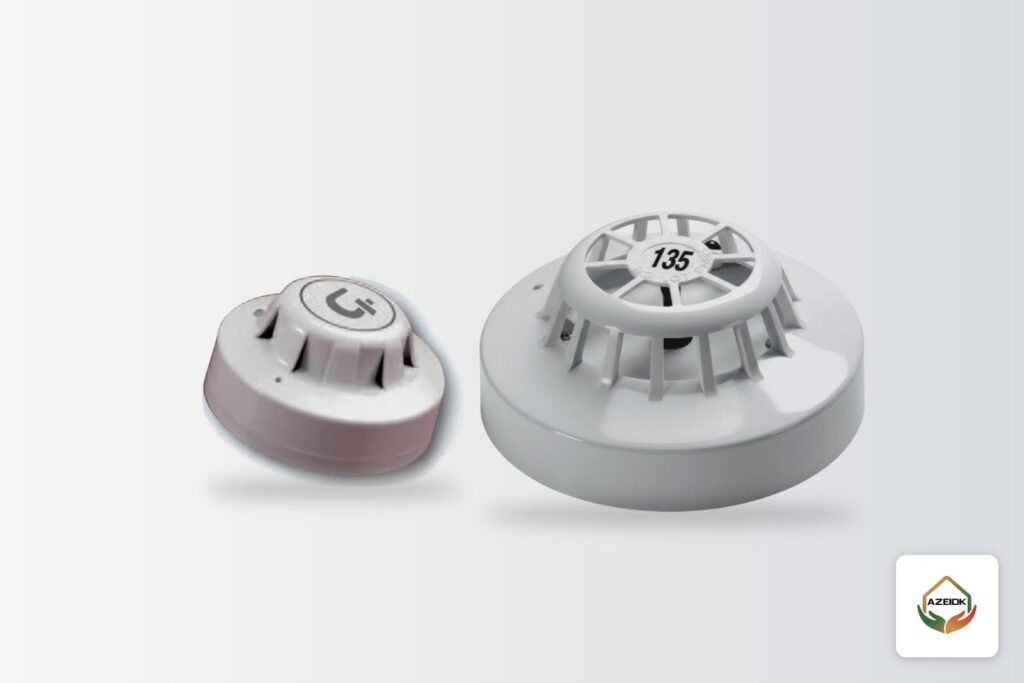
A conventional smoke detector from Context Plus comes in two ranges that AZEIDK supplies in Saudi Arabia: the UL-listed Series 65A for projects whose specification calls for UL, and the EN 54 Series 65E for projects referenced to European standards. Each range has an optical and an ionisation smoke detector, plus heat detectors and the shared 45681-200IMC and 45681-245 bases.
For how conventional and addressable systems compare, see our guide to choosing a fire alarm system for Saudi projects.
The difference is not only the approval. The product page figures reveal a practical gap that matters in the Saudi climate: the published ambient limit for the 65A smoke detector is 100 °F (about 38 °C), while the 65E goes up to 60 °C. This guide sets out these differences and how to choose for the conventional panel in your project.
Key takeaways
- Series 65A is UL listed and Series 65E is EN 54 compliant; do not mix the two approvals in one system without the consultant’s agreement.
- Each range has an optical and an ionisation smoke detector, all running on 9 to 33 V DC.
- Published ambient range is 32 to 100 °F (0 to about 38 °C) for the 65A and -20 to 60 °C for the 65E smoke detector.
- 65A heat detectors come in 135 °F and 200 °F; 65E heat detectors in four EN 54-5 classes: A1R, BR, CR and CS.
- The 45681-200IMC (standard) and 45681-245 (relay) bases suit both ranges and accept the BF318 remote indicator.
In this article
- What is a conventional smoke detector and how does it work with the panel?
- Series 65A UL-listed conventional smoke detectors
- Series 65E EN 54 conventional smoke detectors
- Conventional heat detectors in both ranges
- Shared bases: 45681-200IMC and 45681-245
- How to choose between 65A and 65E
- Frequently asked questions
- Summary
What is a conventional smoke detector and how does it work with the panel?
A conventional detector has no address. It shares a zone circuit with other devices, and in alarm it raises the circuit current so the panel knows there is a fire in that zone, without knowing which detector. That is why the detector’s red LED lights in alarm, and a remote indicator above the room door helps the team find it quickly.
The published alarm current for both ranges is 52 mA at 24 V. That figure, together with the end-of-line device, is what the panel uses to tell normal, alarm and fault apart, so confirm detector and panel compatibility in the catalogue before approval. For optical, ionisation and multisensor types in general, see our smoke detector guide.
Series 65A UL-listed conventional smoke detectors
The Series 65A smoke detectors are the 55000-326IMC optical and 55000-226IMC ionisation models, each with a flashing standby LED that turns red in alarm and an R- remote indicator output limited to 17 mA.
Published data for the 55000-326IMC optical model: 9 to 33 V, average standby current 45 µA at 24 V and 40 µA at 9 V, alarm current 52 mA at 24 V and 17 mA at 9 V, ambient temperature 32 to 100 °F.
Watch the 100 °F limit
100 °F is about 38 °C. In an air-conditioned office or shop that is not a problem. In an unconditioned warehouse, a service room or a ceiling under a metal roof, temperatures in many Saudi cities can exceed it in summer. Review the selection with the consultant before supply, either by choosing a detector with a higher temperature limit or by using a heat detector where the design allows.
Series 65E EN 54 conventional smoke detectors
The Series 65E smoke detectors are the 55000-316IMC optical and 55000-216IMC ionisation models. The page describes an EN 54-compliant range with a two-wire polarity-insensitive supply, flame-retardant polycarbonate housing, nickel-plated stainless-steel terminals and an IP23D rating. The status LED switches off during a fault, so the technician knows the detector is not working.
| Item | 65A (UL) optical 55000-326IMC | 65E (EN 54) optical 55000-316IMC |
|---|---|---|
| Operating voltage | 9 to 33 V DC | 9 to 33 V DC |
| Standby current at 24 V | 45 µA (average) | 30 to 50 µA |
| Power-up surge current | Not stated | 115 µA |
| Alarm current at 24 V | 52 mA | 52 mA |
| Operating temperature | 32 to 100 °F (0 to about 38 °C) | -20 to 60 °C |
| Humidity | Not stated | 0 to 95%, no condensation or icing |
| Protection | Not stated | IP23D |
| Approval | UL Listed | EN 54 compliant |
Conventional heat detectors in both ranges
Series 65A (UL)
The 65A heat detectors combine fixed temperature and rate of rise in two models: 55000-139IMC at 135 °F (about 57 °C) and 55000-145IMC at 200 °F (about 93 °C). Standby current is 55 µA at 24 V and alarm current 52 mA.
Series 65E (EN 54)
The 65E heat detectors are classified under EN 54-5, which sets the maximum application temperature and response limits. The suffix R means rate-of-rise is included; S means static (fixed) response only.
| Model | Class | Max application temperature | Max static response temperature |
|---|---|---|---|
| 55000-121IMC | A1R | 50 °C | 65 °C |
| 55000-126IMC | BR | 65 °C | 85 °C |
| 55000-131IMC | CR | 80 °C | 100 °C |
| 55000-136IMC | CS (no rate of rise) | 80 °C | 100 °C |
A practical rule: choose a class whose maximum application temperature is above the highest temperature expected in the space. A kitchen or boiler room may need CS, since rate-of-rise can cause false alarms with the normal fast temperature swings there. For a wider comparison see our heat detector guide.
Shared bases: 45681-200IMC and 45681-245
The Series 65A and 65E detector bases page lists the 45681-200IMC standard base and the 45681-245 relay base for applications needing an extra switching function. The bases are lockable, contain no electronics that could be damaged during installation, and let the detector be fitted without force, which helps on suspended ceilings. The compatible remote indicator is the BF318.
How to choose between 65A and 65E
- Project specification: UL-listed devices point to 65A, EN 54 to 65E. Above all, do not mix the two approvals in one system, as explained in UL or EN 54 in fire alarm systems.
- Space temperature: where temperatures may exceed 38 °C, the 65E smoke detector gives a wider margin on the published figures.
- Detection type: optical or ionisation depending on the expected fire and the consultant’s requirement.
- Panel: confirm compatibility with the chosen conventional panel, such as Context Plus FP panels, and the number of detectors allowed per zone.
- Connection to an addressable loop: if the detectors will be connected through the 55000-845IMC zone monitor, its page allows up to 20 Series 65 detectors per zone.
Frequently asked questions
What is the difference between a conventional and an addressable smoke detector?
A conventional detector works within a zone, so the panel knows the zone only. An addressable detector has its own address so the panel knows its exact location, as in Context Plus addressable smoke detectors.
Are Series 65A detectors UL listed?
Yes, the product pages describe the 65A smoke and heat detectors as UL Listed. Verify the model in the UL directory for the submittal.
Can 65A and 65E detectors use the same base?
The 45681-200IMC and 45681-245 bases are listed for both ranges, but UL and EN 54 approvals should not be mixed in one system without the consultant’s agreement.
Which heat detector class suits a kitchen?
Usually a fixed-temperature class without rate of rise, such as CS, with a limit suited to the space; the designer decides based on actual temperatures.
What is the 45681-245 relay base for?
It provides an extra switching function in alarm for applications that need to operate a local device, according to the product page.
How do I know which detector is in alarm inside a closed room?
Connect the BF318 remote indicator to the detector output and mount it above the room door.
Summary
Choosing a Context Plus conventional smoke detector starts with the approval in the specification: 65A for UL-referenced projects and 65E for EN 54 projects. Then comes the space temperature, where the 38 °C limit of the 65A smoke detector against 60 °C for the 65E becomes relevant. For heat detectors, select the class by the highest expected temperature. For complete solutions see fire alarm systems.
Related reading: Sounder Control Unit 55000-852IMC, Fire Alarm Break Glass and Conventional Beam Detector BeamRay RFX70.
Need a conventional detector list that matches your specification? Send us the specification and BOQ, and we will propose the right 65A or 65E models with datasheets. Contact the AZEIDK team
Related guides
- Relocate Sprinkler Heads During a Mall Shop Fit-Out: Detectors, Drawings and Approval
- Fire Protection for Textile and Garment Factories: Lint, Fibres, Fabric Stores and Sewing Halls
- CCTV Camera Cable: Coax RG59 or Cat6, Maximum Distances, PoE and When You Need Fiber
- CCTV Installation in Saudi Arabia: Step by Step from Survey to Handover