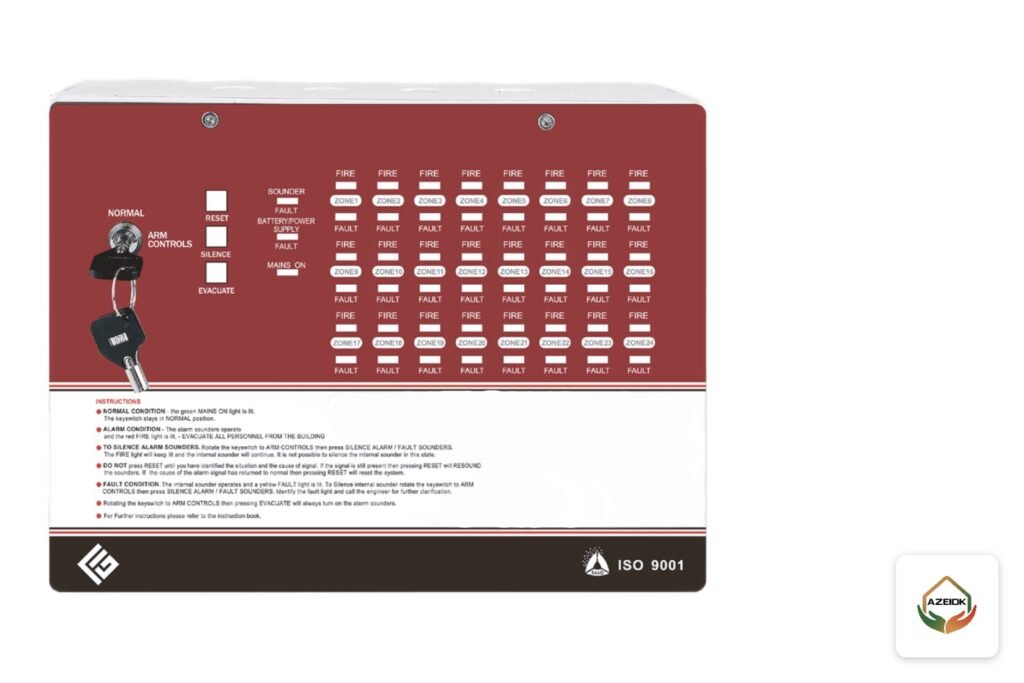
A firefighter smoke control panel (FSCS or FFCP) is a panel for fire service use during emergencies. It shows the status of every smoke control fan and device in the building and lets crews start or stop them manually with priority over any other system. It sits in the fire command center in high-rise buildings, or next to the fire alarm panel elsewhere.
This guide covers panel location, ON-AUTO-OFF switches, indicator colours, command priority, the link with the fire alarm panel and BMS, and what is tested before handover. The requirements quoted come from IBC Section 909.16 as adopted in the Massachusetts building code, a common technical reference; in Saudi Arabia the Saudi Building Code and Civil Defense requirements govern. AZEIDK delivers this work under its smoke extraction and emergency ventilation systems.
Key takeaways
- The panel is for emergency use only and provides manual control or override of automatic control for mechanical smoke control systems.
- It shows every fan, airflow direction and how components relate, with four status colours: white normal, red off or closed, green on or open, yellow/amber fault.
- ON-OFF commands from the panel have the highest priority in the building and override even duct smoke detectors and high-temperature cutouts.
- On projects that follow US practice, panels for these systems are typically UL listed under UUKL, the smoke control equipment category.
In this article
- What is a firefighter smoke control panel?
- What does the panel display?
- ON-AUTO-OFF switches: what does the panel control?
- Command priority: why the panel overrides everything
- How the panel relates to the fire alarm panel
- Dedicated and non-dedicated systems, and periodic testing
- What is tested before handover?
- Common mistakes
- Smoke control panels with AZEIDK
- Frequently asked questions
- Conclusion
What is a firefighter smoke control panel?
In a building with stair pressurization, smoke exhaust or lift shaft pressurization, these systems start automatically from fire alarm signals. Firefighters arriving on site may need something different: stop a fan pushing smoke towards a route they are using, or start exhaust on a floor once the fire is located. The panel is their tool for that.
Section 909.16 places the panel in the fire command center in high-rise buildings and buildings with smoke-protected assembly seating, and elsewhere in an approved location adjacent to the fire alarm control panel.
What does the panel display?
Section 909.16.1 requires all fans in the building to be shown, with a clear indication of airflow direction and how components relate, in effect a graphic of the building and its smoke zones. Status indicators cover all smoke control equipment, by fan and zone, using pilot lamps:
| Colour | Status |
|---|---|
| White | Fans and other operating equipment in normal status |
| Red | Off or closed |
| Green | On or open |
| Yellow / amber | Fault |
A technical article by a JENSEN HUGHES director notes that correct status display needs a proper end-of-line device, and real confirmation from the equipment itself, not just an echo of the command sent.
ON-AUTO-OFF switches: what does the panel control?
- ON-AUTO-OFF for each piece of operating equipment that can also be controlled from elsewhere in the building, including stair pressurization fans, smoke exhaust fans, supply, return and exhaust fans, and elevator shaft fans.
- OPEN-AUTO-CLOSE control for other smoke control devices that are also controlled from elsewhere.
- ON-OFF or OPEN-CLOSE for critical equipment controlled only from this panel.
Two exceptions apply to complex systems where approved: controls and indicators grouped so each smoke zone works as a unit, or control through a computer interface using plain English commands.
Command priority: why the panel overrides everything
- ON-OFF and OPEN-CLOSE actions from the panel have the highest priority of any control point; no other automatic or manual control may contradict them.
- Automatic devices that stop equipment in normal operation, such as duct smoke detectors, freezestats and high-temperature cutouts, must be capable of being overridden from the panel.
- The last action shown by the switch position prevails, and the system may never be asked to take more than one configuration at once.
- AUTO is the normal, non-emergency position; only AUTO allows control from other points, and actual device status keeps showing.
- Power disconnects required by NFPA 70 are the exception.
In practice a BMS or a VFD keypad must not be able to stop a fan a firefighter has started. The JENSEN HUGHES article notes that VFD off buttons should be disabled in smoke control mode. For duct detectors and AHU shutdown, see duct smoke detectors.
How the panel relates to the fire alarm panel
The fire alarm panel detects the fire, identifies the zone and sends automatic commands to smoke control equipment under the cause and effect matrix. The firefighter panel sits on top of that sequence to override it when needed. Typical arrangements:
- A separate graphic panel connected to the fire alarm panel or dedicated controllers.
- A module built into the fire alarm panel, offered by some manufacturers.
- A BMS listed for smoke control handling the commands, with a firefighter panel connected to it.
In every case the equipment needs suitable listing. The article explains that UL has listed smoke control equipment under UUKL since 1989 and added smoke control requirements to UL 864 in 1997, and that UUKL panels must be capable of running a weekly self-test of smoke control components. For programming fan and HVAC interfaces, see addressable fire alarm panel programming.
Dedicated and non-dedicated systems, and periodic testing
A dedicated system uses equipment that runs only for smoke control, such as stair pressurization fans. A non-dedicated system uses normal HVAC equipment switched into smoke mode. The article states that NFPA 92 recommends semi-annual testing for dedicated systems and annual testing for non-dedicated systems.
It also notes the weekly self-test is a component test, not a whole-system test, that the 2015 NFPA 92 removed the reference to it, and that the 2015 IBC kept it with an exception, subject to approval, for components that could disrupt building operation. As the article dates from 2016, check the edition adopted for each project.
What is tested before handover?
- Graphic matches the actual building, smoke zones and fans.
- Every switch in every position, confirming the real equipment responds, not only the indicator.
- Indicator colours in all four states, including a simulated fault.
- Priority: a panel command against a conflicting automatic command from the alarm or BMS.
- Override of duct detectors and high-temperature cutouts from the panel.
- Return to AUTO with actual status still displayed.
These steps are part of smoke control system testing and integrated systems testing.
Common mistakes
- Panel shows the command sent instead of the fan’s actual status, so a firefighter thinks a stopped fan is running.
- A VFD or BMS that can stop a fan in smoke mode.
- Graphic not updated after site changes.
- Panel in a location Civil Defense cannot reach easily.
- Unclear switch and zone labelling.
Smoke control panels with AZEIDK
AZEIDK connects smoke extraction and pressurization systems to the fire alarm under its smoke extraction and emergency ventilation systems and fire alarm systems, covering supply, installation, interfacing and testing. Panel type and interface follow the approved design and the fire alarm system on each project. For programming and interfaces between systems, see our programming and systems integration service.
Frequently asked questions
What is a firefighter smoke control panel?
A fire service panel showing the status of smoke control fans and devices and allowing manual control with the highest priority in the building.
Where is it installed?
In the fire command center in high-rise buildings; elsewhere in an approved location next to the fire alarm panel, per Section 909.16.
What do the indicator colours mean?
White normal, red off or closed, green on or open, yellow or amber fault.
Can the BMS stop a fan a firefighter has started?
No. Panel commands have the highest priority; other control points act only when the switch is in AUTO.
What does UUKL mean?
A UL listing category for smoke control equipment, typically required for panels controlling these systems on projects that follow US practice.
How often are smoke control systems tested?
A technical article states NFPA 92 recommends semi-annual tests for dedicated systems and annual for non-dedicated, plus what the authority requires.
Conclusion
The firefighter smoke control panel is the final decision point in a smoke control system. Its value rests on three things: real status for every device, priority no other system can cancel, and a genuine test of every switch before handover.
Need pressurization and smoke exhaust tied to the fire alarm and a firefighter panel? Send us the drawings and cause and effect matrix, and we will review supply, interfacing and testing with you. Talk to the AZEIDK team
Related guides
- WATEX Fire Pumps: The Complete Guide to WATEX Pumps in Saudi Arabia (Models, Approvals, Capacities)
- Hospital Fire Alarm Systems: Staged Horizontal Evacuation, Silent Staff Alarms and Zoned Voice Messages
- TP-Link CCTV Cameras: VIGI C340 Bullet, C440 Turret and the NVR2016H Recorder for Shops and Facilities
- Avaya IP Office PBX in Saudi Arabia: Editions, Support Status and What to Check Before Expanding