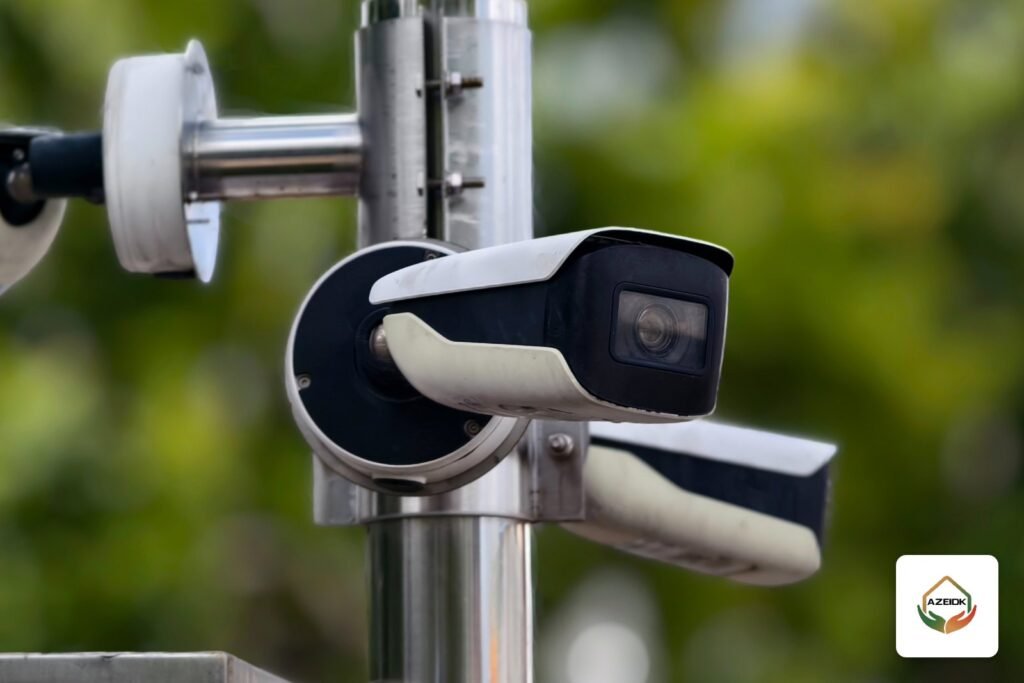
Dome vs bullet camera (and turret) is a question of body shape and mounting, and that decides where each one works best: bullets for entrances, fences and longer distances; domes for indoor ceilings and places where tampering is likely; turrets for corridors and close entrances where you want clean night images and easy aiming. Resolution, lens and sensor quality come from the model, not the shape.
For camera types, resolution, night vision and storage, see our CCTV cameras guide for Saudi Arabia.
This guide compares the three form factors using CCTV cameras AZEIDK supplies, explains when to pick each, and lists what to read in the datasheet.
Key points
- Bullet: a visible cylinder, suited to outdoor and long-range views, and a deterrent on sight.
- Dome: a camera under a half-sphere cover, suited to ceilings, hides the lens direction, often IK impact rated.
- Turret: an exposed eyeball on a base with no cover, so no IR reflection from a bubble, and easy to aim.
- IP rating covers water and dust; IK rating covers impact. Read both from the model’s datasheet.
- Start from the location and required distance, then the form factor, then the model.
Dome vs bullet camera vs turret: the shapes compared
| Item | Bullet | Dome | Turret (eyeball) |
|---|---|---|---|
| Shape | Cylinder on an arm | Half sphere with clear or smoked cover | Exposed ball on a base |
| Usual mounting | Walls and poles | Ceilings, sometimes walls | Ceilings or walls |
| Lens direction | Obvious | Usually hidden | Fairly visible |
| IR reflection | No cover in front of the lens | Possible if the cover is dirty or scratched | No cover in front of the lens |
| Tamper resistance | Lower; can be turned or covered | Usually higher, especially IK10 | Medium, model dependent |
| Best use | Outdoor entrances, fences, car parks | Indoor corridors, shops, public areas | Corridors, reception, close entrances |
The table describes the general form. The datasheet is what counts: some domes are rated for outdoors, and some turrets are IP67.
Bullet cameras: when they are the right choice
A longer body fits longer lenses and stronger IR, which is why bullets dominate outdoor, long-range positions. Example: the Bosch DINION 5100i IR series in 2, 5 and 8 MP, with a 3.2–10.5 mm motorized varifocal lens, IR to 60 m (2 and 5 MP) or 45 m (8 MP), IP66/IP67 and IK10, operating from -40 °C to 55 °C. A shop-level option is the TP-Link VIGI C340, 4 MP, fixed 2.8, 4 or 6 mm lens, IP67.
The weakness is exposure: mounted low, a bullet can be turned or covered. Mount it at a sensible height and enable video tampering alerts where the model supports them.
Dome cameras: ceilings and tamper-prone areas
A dome hides where the lens points and looks quieter in interiors. Many domes carry an IK impact rating under IEC 62262. Example: the Bosch FLEXIDOME indoor 5100i IR, 8 MP (3840 × 2160), 3.2–10.5 mm varifocal, 40 m IR, IK10 and IP54, designed for ceiling mounting in public indoor areas. From Hikvision, the DS-2CD1143G2-LIU is a fixed dome at 2560 × 1440 with a 2.8 or 4 mm lens, light up to 30 m, IP67, IK08 and a built-in mic.
The dome reflection problem
At night the IR LEDs shine through the clear cover. If dust builds up, the cover is scratched or the internal foam barrier is not seated properly, some light can bounce back into the lens and wash out the image. Clean covers with a soft cloth at every maintenance visit and keep the protective film on until the camera is closed. Our article on why CCTV footage is blurry covers other causes.
Turret cameras: the middle ground
A turret is compact like a dome but has an exposed lens like a bullet, so there is no cover to reflect IR and it is easy to aim. Available examples: the TP-Link VIGI C440 (4 MP, 2.8 or 4 mm), the Hikvision DS-2CE76K0T-LPFS 3K indoor dual-light fixed turret with built-in mic, and the Hikvision DS-2CE70DF0T-LMFS 2 MP ColorVu turret with built-in mic.
Note that Hikvision models starting DS-2CE are analog cameras for DVRs, while DS-2CD models are IP cameras for NVRs. Shape does not change that. See IP vs analog CCTV.
Choosing by location
| Location | Suggested form | Why |
|---|---|---|
| Outdoor gate or fence | Bullet | Longer range, varifocal lens, visible deterrent |
| Open car park | Bullet or outdoor turret | IP rating and night range |
| Shop floor or mall | Dome | Hidden direction, tamper resistance, discreet look |
| Hotel or hospital corridor | Dome or turret | Ceiling mount, view along the corridor |
| Reception or office | Turret or indoor dome | Short distance, clean night image |
| High-bay warehouse | Bullet or turret with a suitable lens | Narrower lens for long aisles |
In every case size the lens from the face or plate recognition distance (see CCTV field of view and DORI), and for heat and dust outdoors see our outdoor CCTV camera guide.
What to read in the datasheet
- IP rating: IP66 or IP67 for exposed positions; no stated rating means indoor use.
- IK rating: IK10 is higher than IK08; it matters within arm’s reach.
- Operating temperature: important on roofs and sun-exposed fences.
- Lens: fixed or varifocal, and horizontal field of view.
- Night illumination: IR or white light, and range.
- Power: PoE or 12 V and maximum draw, to size the switch or supply.
- Mounting: junction box or special bracket needs, covered in our CCTV brackets and housings guide.
Common mistakes
- Fitting an indoor dome in a sun- and rain-exposed spot because it looks better, without checking the IP rating.
- Mounting a bullet low at a shop entrance, where it can be turned or covered in minutes.
- Aiming a camera straight at a glass door with sunlight behind, so faces turn dark. Choose a WDR model or move the camera.
- Mixing analog and IP cameras in one order because they look alike, then finding the recorder accepts only one type.
- Leaving out junction boxes outdoors, so connections stay exposed to dust and humidity.
FAQ
Which is better, a dome or a bullet camera?
Neither in general. Bullets suit outdoor, long-range views; domes suit indoor ceilings and tamper-prone areas.
What is a turret camera?
A camera with an exposed ball lens on a base and no glass cover. It is compact like a dome but avoids IR reflection from a cover.
Can a dome camera be used outdoors?
Some can, if rated IP66 or IP67, such as the IP67 DS-2CD1143G2-LIU. The FLEXIDOME indoor 5100i is an indoor camera per the manufacturer.
Why is my dome camera hazy at night?
Usually a dirty or scratched cover or a badly seated internal barrier, so IR bounces into the lens. Cleaning and correct reassembly fix most cases.
Does the shape change image quality?
No. Sensor, lens, resolution and lighting decide quality; shape decides mounting, protection and appearance.
What does IK10 mean on a CCTV camera?
It is the impact protection rating under IEC 62262, and IK10 is the highest grade. It suits cameras within reach.
Not sure which form factor fits each position? Send us the layout or photos and we will propose the form, lens and model for each point with datasheets, as part of our security and surveillance solutions. Contact the AZEIDK team
Related guides
- Fire Pump Flow Testing to NFPA 25 with a GVI Test Meter in Saudi Arabia
- Manufacturer, Authorised Distributor, Supplier and Contractor: The Difference
- Compliance Statement for Fire and Security Bids: Proving Each Clause and Declaring Deviations
- Burglar Alarm System Price in Saudi Arabia: What Drives the Cost