Do CCTV cameras record during a power outage? No, unless the recorder, the cameras and the power equipment between them are on a backup source such as a UPS, or the camera runs on battery or solar power. If only the internet goes down, a local system with a recorder (NVR or DVR) normally keeps recording, but you lose remote viewing and alerts until the connection returns. This guide explains what happens in each case and how to protect recordings with a UPS, an SD card and the recorder.
Key takeaways
- A power cut stops recording on a standard system, because the cameras, recorder and switch all go down together.
- An internet outage does not stop local recording on the recorder, but it stops phone viewing and cloud recording.
- A UPS feeding the recorder, PoE switch and router keeps recording going for the battery runtime and bridges the gap until a generator starts.
- An SD card in the camera keeps recording when the network between camera and recorder drops, and a feature such as Hikvision ANR sends it back to the recorder when the network returns.
- Home Wi-Fi cameras depend on the router; if the router is off they rely only on their internal card, where the model supports it.
In this article
- Do CCTV cameras record during a power outage?
- Do CCTV cameras work without internet?
- Table: what happens to recording in each outage?
- How to choose a UPS for CCTV
- SD card storage and ANR: protecting recordings when the network drops
- Recorder and hard disk: how many days are kept?
- Practical steps for homes and shops
- Frequently asked questions
- Conclusion
Do CCTV cameras record during a power outage?
A CCTV system needs power at three points: the cameras, the recorder, and the power and network equipment in between. In IP systems the cameras usually take power from a PoE switch or from the recorder’s own PoE ports. In analog systems they take it from a central power supply. If any of these points loses power, recording stops for the cameras that depend on it.
So the direct answer is that standard cameras do not record during a power cut unless there is a backup source. The exceptions are:
- A system connected to a UPS that covers all of the components above.
- A building with a standby generator, plus a UPS that covers the changeover until the generator picks up the load.
- Battery or solar-powered cameras, which are a separate design for off-grid sites.
The cameras and recorders AZEIDK supplies from Hikvision, Dahua and EZVIZ are part of our security and surveillance solutions.
Do CCTV cameras work without internet?
Internet is not needed for local recording. The cameras send video to the recorder over the building’s local network (LAN), and the recorder saves it to the hard disk. That local network works without internet as long as the switch and cabling are up.
What stops during an internet outage:
- Live view and playback on your phone from outside the site.
- Notifications and app alerts.
- Cloud recording, if you rely on it.
Viewing remains available on the monitor connected to the recorder on site. When the internet returns, you can play back what was recorded during the outage from the app as usual.
The different case is home Wi-Fi cameras that rely on the app and cloud with no recorder. If the internet drops but the router stays on, some models keep recording to their internal memory card, depending on settings. If the router itself loses power, only the internal card remains, and only if one is fitted and enabled. Behaviour varies by model, so check the manufacturer’s user manual.
Table: what happens to recording in each outage?
| Situation | Recorder system without UPS | Recorder system with UPS | Wi-Fi camera with memory card |
|---|---|---|---|
| Internet outage only | Local recording continues; remote viewing stops | Local recording continues; remote viewing stops | May keep recording to the card, depending on model and settings |
| Power outage | Recording stops completely | Recording continues for the UPS battery runtime | Stops unless the camera is battery powered |
| Network loss between camera and recorder | That camera’s footage is lost | Lost, unless the camera records to a card and supports back-fill | Not applicable |
| After service returns | Recording restarts | No gap if the battery did not run out | Streaming and alerts resume |
How to choose a UPS for CCTV
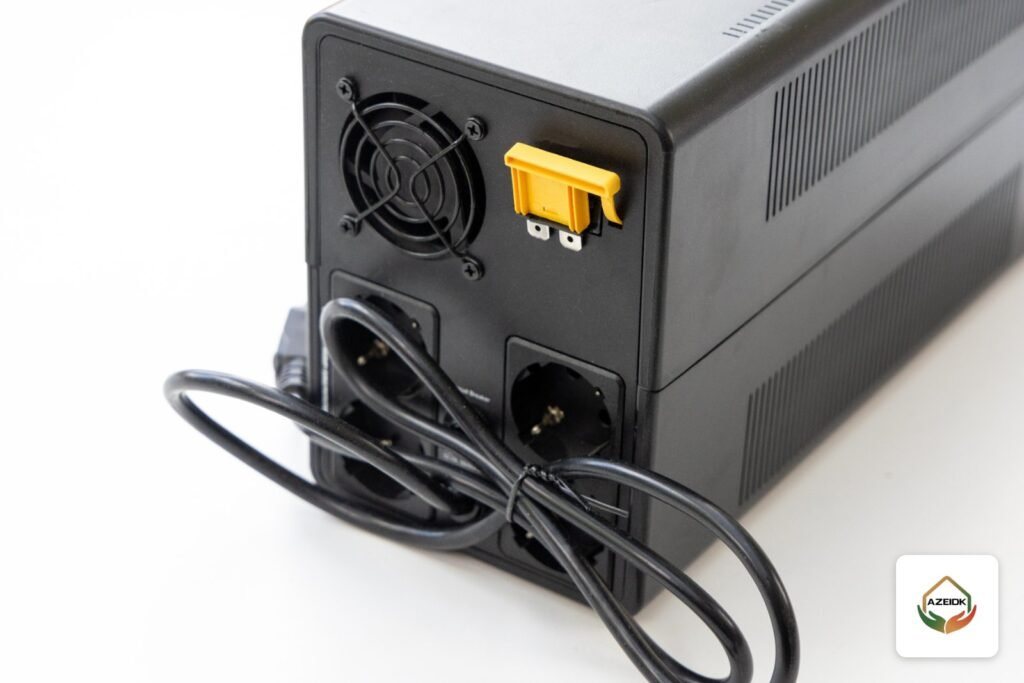
A UPS (uninterruptible power supply) has batteries that feed the equipment the moment mains power fails. To size one properly:
- Decide what must stay on: the recorder, the PoE switch that powers the cameras, the router or fibre terminal if you want remote viewing during the outage, and the central power supply in analog systems.
- Add up the load in watts from the datasheets: recorder consumption with hard disk, and camera consumption from the PoE budget. The product page for the Hikvision DS-7608NXI-K1/8P recorder, for example, lists up to 10 W without hard disk and with PoE off, and a total PoE budget of up to 75 W across its eight ports. For the PoE budget method, see our article on PoE switch power budget for CCTV.
- Set the runtime you need: minutes until the generator starts, or hours to cover a long outage? Runtime depends on load and battery capacity and is taken from the UPS manufacturer’s runtime tables.
- Leave a margin: do not load the UPS to its limit, since batteries weaken with age and heat.
Commercial sites and small server rooms often use a rack or tower UPS, such as the Legrand Keor SPE R/T 2200 VA, which according to its product page is a line-interactive unit with pure sine wave output that can be mounted in a 19-inch rack or stood as a tower.
A UPS has one more benefit: sudden shutdowns can cause hard disk faults or damage the most recent recording files, and a UPS reduces that risk.
SD card storage and ANR: protecting recordings when the network drops
Some IP cameras accept a microSD card. When the network between camera and recorder drops, because of a cut cable or a failed switch for example, the camera can record to the card as long as it still has power.
Hikvision calls this function ANR (Automatic Network Replenishment). According to Hikvision’s official technical bulletin, the camera records to its microSD card during the network outage, then sends the files to the recorder once the link is back, filling the gap. The bulletin states that transfer is capped at 10 Mb/s per channel, that one recorder can replenish up to two channels at a time, and that the function is enabled in the recorder’s recording schedule settings.
Note that the card does not solve a power cut, because a camera powered from a PoE switch shuts down when the switch does. The card protects against network loss; the UPS protects against power loss.
Recorder and hard disk: how many days are kept?
Retention depends on hard disk capacity, number of cameras, resolution, compression and recording schedule, not on power or internet. To calculate it, use the CCTV storage calculator, and see the method in our article on NVR storage and bandwidth calculation.
For older analog systems with a DVR the principle is the same: the recorder and the camera power supply both need backup power. For the difference between the two, see IP vs analog CCTV.
Practical steps for homes and shops
- Keep the recorder, switch and router together, close to one UPS, instead of spreading them out.
- Test the system by switching off mains power for a few minutes, confirm recording continues, then review the clip.
- Enable alerts for disk or camera connection loss in the app, where available.
- Replace UPS batteries as the manufacturer recommends and check them during routine maintenance.
- If the cameras support a memory card, fit a suitable card and enable recording to it, then enable ANR on the recorder where supported.
These items are normally checked under CCTV maintenance contracts, which AZEIDK offers as part of its security and surveillance solutions.
Frequently asked questions
Do CCTV cameras record during a power outage?
Standard systems do not, unless the recorder, switch and cameras are on a UPS or generator, or the camera is battery powered.
Do CCTV cameras work without internet?
Yes. Local recording on the recorder continues. Only phone viewing, alerts and cloud recording stop until the internet returns.
Do Wi-Fi cameras record without internet?
Some models record to their internal memory card during an internet outage, as long as they have power. This varies by model and settings, so check the user manual.
How many hours will a UPS run CCTV cameras?
It depends on the total load and the UPS battery capacity. Work out the load in watts from the datasheets, then use the UPS manufacturer’s runtime tables.
Can a sudden power cut damage the hard disk?
Frequent sudden shutdowns can cause faults or damage to the latest files. A UPS reduces that risk.
Are recordings deleted when the power goes off?
Footage already saved on the hard disk normally remains; the gap covers only the period without power.
Conclusion
An internet outage affects remote viewing, not local recording. A power outage stops recording unless a UPS feeds the recorder, switch and cameras. Add a memory card and back-fill where available to protect against network loss, and test the system regularly by cutting mains power.
Want to be sure your cameras record during outages? Send the number of cameras and your recorder type to AZEIDK and we will review power and storage and propose a suitable solution. Talk to the AZEIDK team
Related guides
- WATEX UL-Listed Foam Bladder Tanks: Capacities, Specifications, Ratio Controllers and Sizing
- Saudi Civil Defense Requirements for Buildings and Facilities
- Choosing Fire Detectors: Smoke, Heat, Beam and Flame
- Plumbing Contractor for Projects in Saudi Arabia: Scope, Codes and Plumbing Within an Integrated MEP Package