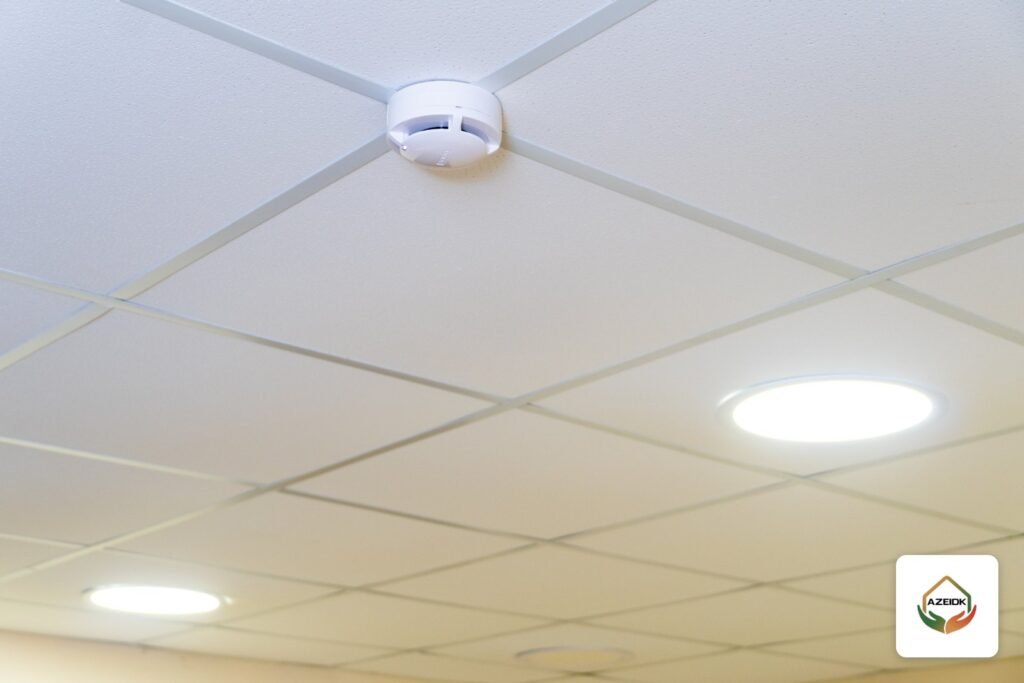
BS 5839 Part 1 (BS 5839-1) is the British code of practice for the design, installation, commissioning and maintenance of fire detection and fire alarm systems in non-domestic premises. The current edition is BS 5839-1:2025. It splits systems into a manual Category M, life protection Categories L1 to L5, and property protection Categories P1 and P2. In Saudi Arabia, the Saudi Fire Protection Code SBC 801 remains the legal baseline and refers installation to NFPA 72; BS 5839-1 enters a project through the consultant’s specification.
A single line in a specification, such as “BS 5839-1 Category L2”, decides where detectors go, how many there are and what ends up in the bill of quantities. This article explains each category, what changed in the 2025 edition, how this route differs from NFPA 72, and what to check before pricing. If your project is still at design stage, the AZEIDK GROUP engineering design and calculations team agrees the design route and category with the consultant from day one.
Key takeaways
- BS 5839-1:2025 was published on 30 April 2025 and replaced the 2017 edition, which was withdrawn the same day.
- Category M is manual with no automatic detection, L categories protect life, P categories protect property, and a specification can combine two.
- L1 means automatic detection in all areas, L4 covers escape routes only, and L5 is a non-prescriptive design for a defined objective.
- NFPA 72 does not use these categories; the extent of coverage comes from the building or fire code, which in the Kingdom is SBC 801.
- Pick one route for design and products. Do not mix BS 5839-1 and NFPA 72 within one system.
In this article
- What is BS 5839-1 and which edition is current?
- What do BS 5839 categories mean (L1 to L5, P1, P2 and M)?
- What changed in BS 5839-1:2025?
- Zoning and sound rules in BS 5839-1
- BS 5839-1 vs NFPA 72: where do the routes differ?
- How does BS 5839 relate to SBC 801 on Saudi projects?
- What to check when the specification says “BS 5839-1 Category L1”
- Common mistakes on BS 5839 projects
- Frequently asked questions
- Summary
What is BS 5839-1 and which edition is current?
The BS 5839 series is published by the British Standards Institution (BSI). Part 1 covers non-domestic buildings: offices, hotels, schools, hospitals, malls and factories. It is a code of practice, so its recommendations are written as “should”, not as the mandatory “shall” found in codes.
BSI announced the revised edition on 30 April 2025 as a revision of the guidance published in 2017. According to IET Wiring Matters, BS 5839-1:2017 was withdrawn on the same date. If a new specification still cites “BS 5839-1:2017”, ask the consultant whether the current edition is intended or whether the contract deliberately fixes the older one.
BS 5839-1 does not approve products. Detectors, panels and call points are approved to the European EN 54 series, covered in our EN 54 standard guide. The British standard governs the installed system; EN 54 governs the device.
What do BS 5839 categories mean (L1 to L5, P1, P2 and M)?
The category is the first design decision because it sets the system’s objective: warn people manually, protect life with early automatic detection, or protect the building and its contents. The definitions below follow Apollo’s summary of the 2025 edition:
| Category | Objective | Where automatic detection goes | Effect on quantities |
|---|---|---|---|
| M | Manual operation | No automatic detection; manual call points and sounders | Lowest device count |
| L1 | Life protection | All areas of the building | Highest, including small rooms and stores |
| L2 | Life protection | Defined areas in addition to L3 | Depends on the areas the specification names |
| L3 | Life protection | Escape routes plus rooms and areas opening onto them | Medium |
| L4 | Life protection | Escape routes only: corridors, stairways and circulation areas | Low |
| L5 | Specific, non-prescriptive objective | Wherever the design places it to meet the written objective | Depends on the objective |
| P1 | Property protection | All areas | High |
| P2 | Property protection | Defined areas only | Depends on the defined areas |
L2 versus L3 in practice
L3 protects the escape route: a detector in the corridor and in every room that opens onto it, so occupants are warned before smoke blocks their way out. L2 adds “defined” areas on top. That word causes most pricing disputes. If the specification says “L2” without listing the extra areas, get the list in writing before you build the bill of quantities.
When is a combined category such as L2/P2 used?
An owner may need life protection and protection of a high-value asset at the same time, such as a server room or a goods store. The specification then names two categories and the system is designed to meet both. Who chooses the category? The UK Fire Industry Association (FIA), in its guidance updated for the 2025 edition, places that responsibility on the fire safety specialist, not on the installer.
What changed in BS 5839-1:2025?
The main changes reported by BSI and IET Wiring Matters, and what each means for a Saudi project on this route:
- Sleeping rooms: in sleeping rooms within commercial and public buildings such as hotels, the new edition prefers smoke, multi-sensor or carbon monoxide detectors over heat detectors unless a fire risk assessment justifies otherwise. This directly affects hotel and serviced apartment projects.
- Variations: every variation must be recorded in the system logbook, and omitting a zone plan is now an unacceptable variation.
- Stairways: detector recommendations for Categories L1, L3 and L4 now extend to main access and egress stairways.
- Manual call points: centre of the element at 1.4 m with a +200 mm / −300 mm tolerance, and no call points on stair landings in multi-storey buildings with phased evacuation.
- Indicators and notices: any remote fire indicator should be red, and a false alarm notice is placed at control equipment that is automatically connected to the fire service.
- Terms: “handover” replaces “acceptance”.
Zoning and sound rules in BS 5839-1
These are the rules a consultant checks on the drawings, and they are worded differently from the NFPA 72 route. Per Apollo’s summary of the 2025 edition:
- A detection zone should not cover more than one storey unless the total floor area is under 300 m².
- A zone should not exceed 2,000 m², and the search distance within it should not exceed 60 m on the worst route.
- Stairwells and lift shafts are treated as separate zones.
- Short circuit isolators limit one fault to 2,000 m² and a single storey, and two simultaneous faults on a circuit should not disable protection over more than 10,000 m².
- Sound level of at least 65 dB(A), or 5 dB(A) above background noise louder than 60 dB(A), and at least 75 dB(A) at the bed-head with doors shut.
These figures drive the number of panels, loops and sounders, so they are fixed at design stage, not during installation.
BS 5839-1 vs NFPA 72: where do the routes differ?
NFPA 72 is the US National Fire Alarm and Signaling Code; its current edition is 2025, covered in our NFPA 72 guide. The key difference is that NFPA 72 does not decide by itself that a building needs a system; that comes from the building or fire code. It handles extent of coverage with concepts such as total coverage, partial or selective coverage, and non-required detection installed for a specific fire safety objective.
| Item | BS 5839-1:2025 | NFPA 72 (2025) |
|---|---|---|
| Type of document | Code of practice (“should”) | Code (“shall”) |
| Extent of coverage | Category M, L or P set by the fire safety specialist or enforcing authority | Building or fire code, then total, partial or selective coverage |
| Device approval | Usually EN 54 components | Usually listed equipment such as UL |
| Zoning | 2,000 m², 60 m search distance, one storey | Per the building or fire code and the authority having jurisdiction |
| Notification | 65 dB(A), 75 dB(A) at bed-head | Separate rules in the notification appliances chapter (Chapter 18) |
| Inspection and maintenance | Standard’s recommendations and system logbook | Chapter 14 of the code |
The practical consequence: a device approved to EN 54 does not become “listed” for NFPA 72, and the reverse also applies. Our article UL vs EN 54 fire alarm devices covers this in detail.
How does BS 5839 relate to SBC 801 on Saudi projects?
The order in the Kingdom is clear. First, SBC 801 (the 2024 Saudi Building Code edition, mandatory since 30 June 2025) sets in Section 907 when a fire alarm system is required by occupancy and refers installation to NFPA 72; see when a fire alarm is mandatory under SBC 801. Second, the General Directorate of Civil Defense requirements for drawing approval and licensing. Third, the consultant’s specification and contract documents.
BS 5839-1 sits at the third level. Some consultants write fire alarm specifications the British way, with EN 54 products and L and P categories to express coverage. That never lowers the minimum set by SBC 801: if the code requires automatic detection in a space, a category that leaves it out is not acceptable. Within what we reviewed, we found no Saudi text that names BS 5839-1 as a mandatory reference, so the route should be agreed with the consultant and approving authority before design starts.
What to check when the specification says “BS 5839-1 Category L1”
- Edition: 2025 or 2017? The difference shows up in sleeping rooms, stairways and the variations log.
- Full category: L1 alone, or combined such as L2/P2? For L2 or P2, where is the list of defined areas?
- SBC 801 minimum: does the chosen category cover everything the code requires for the occupancy?
- Product approval: panel to EN 54-2, power supply to EN 54-4, smoke and heat detectors to EN 54-7 and EN 54-5, with each model’s certificate on its datasheet.
- Zones and loops: do the drawings respect 2,000 m², 60 m and isolator limits?
- Handover documents: zone plan, system logbook and the agreed variations record.
For British-route projects AZEIDK GROUP supplies the Context Plus range. Context Plus is a UK company that manufactures in the United Kingdom. The range covers addressable and conventional panels, detectors, call points and sounders, including the 65E conventional detector series offered to EN 54. Each model’s certificate is checked on its datasheet before the submittal goes in. The full solution scope is on our fire alarm systems page.
Common mistakes on BS 5839 projects
- Pricing L2 as if it were L3 because the specification did not name the extra areas, then finding the quantity gap at approval.
- Zoning to NFPA 72 while submitting EN 54 devices, or the reverse, and getting the submittal rejected for incompatibility.
- Using heat detectors in hotel rooms to save cost without a risk assessment that justifies it under the 2025 edition.
- Handing over without a zone plan at the panel, now an unacceptable variation.
- Treating BS 5839-1 as a substitute for SBC 801, when it is a design route inside the framework the code sets.
Frequently asked questions
What is the difference between L1 and L2 in BS 5839?
L1 puts automatic detection in all areas of the building. L2 covers escape routes and the rooms opening onto them, plus defined areas named in the specification or risk assessment.
Is BS 5839 accepted in Saudi Arabia?
The legal baseline is SBC 801, which refers installation to NFPA 72. BS 5839-1 is used when the consultant adopts it in the project specification, provided it does not fall below code and Civil Defense requirements.
What is the latest edition of BS 5839-1?
BS 5839-1:2025, published by BSI on 30 April 2025, replacing the 2017 edition.
Does NFPA 72 have an equivalent to L and P categories?
Not by those names. NFPA 72 talks about total, partial or selective coverage, and the building or fire code decides where detection is required.
What is Category M in fire alarm systems?
A manual system with no automatic detectors, relying only on manual call points and sounders.
Summary
The BS 5839-1 category in a specification is not a formality. It sets detector numbers and locations and zoning, and therefore cost and the approval file. Start from SBC 801 requirements for the occupancy, agree route, edition and category with the consultant, then choose products that match that one route only.
Your specification names a BS 5839 category and you need it interpreted before pricing? Send us the drawings and specification, and we will review the required category, SBC 801 requirements and suitable devices. Contact the AZEIDK GROUP team
Related guides
- CCTV Camera Tester: Checking Video, PoE and IP on Site, and When a Technician Needs One
- Salamah Certificate for Malls and Shopping Centres: Building Licence, Tenant Shops and Who Is Responsible
- Gym Fire Safety Requirements in Saudi Arabia: Alarm, Extinguishers, CCTV and Member Access Control
- Contractor Classification in Saudi Arabia vs Muqawil Membership: How to Verify a Fire Systems Contractor