Fire pump questions and answers collected from what owners, consultants and maintenance teams in Saudi Arabia ask about the fire pump set: what each pump does, how the pump is sized, how the pump room is laid out, how often the pumps are run and what moves the price. Each answer is short and links to the detailed article.
AZEIDK supplies and installs fire pump sets as part of its fire fighting systems; see the fire pumps on the Saudi product pages.
Key takeaways
- A typical set is a main electric pump, a diesel standby pump, a jockey pump and a controller for each pump.
- The pump is chosen from the approved hydraulic calculations, then checked against the NFPA 20 curve limits.
- Figures here come from NFPA 20 and NFPA 25 as explained in the linked articles; the approved design and Civil Defense requirements are the final reference.
Basic fire pump questions
1. What does a fire pump do?
It raises water pressure and flow from the tank to the sprinklers and hose cabinets as the design requires. Saudi owners often call it the civil defense pump. See fire pump types and selection.
2. Electric or diesel fire pump?
Both deliver the same flow and pressure. An electric pump depends on a reliable, protected power supply; a diesel pump carries its own fuel but needs a larger room, batteries, cooling, an exhaust and more frequent maintenance. Compare them in electric vs diesel fire pumps.
3. What is the jockey pump for?
It is the smallest pump in the room and does not fight fire; it holds network pressure and makes up small losses so the main pump does not start without need. Its start and stop settings are referenced to the main pump’s churn pressure. See jockey pump sizing and pressure settings.
4. What is NFPA 20?
The Standard for the Installation of Stationary Pumps for Fire Protection, which sets how fire pumps are selected and installed so sprinkler, standpipe and hydrant systems get a reliable supply. The current edition is 2025. See the NFPA 20 guide.
Sizing and selection questions
5. How is a fire pump sized?
Start from the demand point in the approved hydraulic calculations, subtract the lowest available suction pressure, then choose a rated capacity whose curve covers that point. The pump must deliver 150% of rated flow at no less than 65% of rated pressure, and shutoff pressure must not exceed 140%. See fire pump calculation and sizing.
6. What does a 500 GPM fire pump mean?
A pump rated to deliver 500 US gallons per minute, about 1,893 litres per minute, at a rated pressure set by the designer. It is one of the standard rated capacities, which run from 25 to 5,000 GPM. See fire pump sizes in GPM.
7. When is a vertical turbine pump needed?
When the water source sits below the pump, such as a well or a ground tank where a positive suction is not available. See the vertical turbine fire pump.
8. How are fire pumps arranged in a high-rise building?
The pump types are the same, but height adds static pressure on lower floors, so designers use pressure zones, pumps in series or pressure control to reach the top without over-pressurising the bottom. See high-rise building fire pumps.
9. How do I verify that a fire pump is UL listed or FM approved?
A logo in a catalogue is not proof. Ask for the certificate naming the manufacturer, pump type and exact model, and check the model in the certifier’s directory before signing the order. See how to check fire pump UL and FM approval.
Pump room and controller questions
10. What goes into a fire pump room?
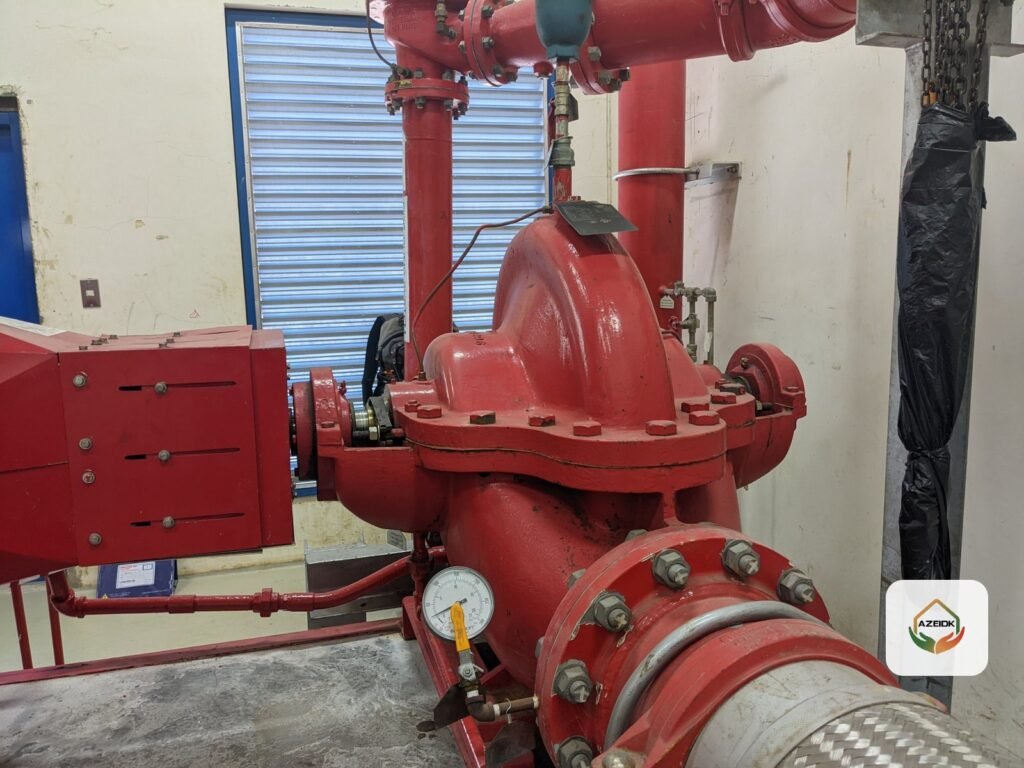
Equipment arranged along the water path from the tank to the system, so each pump can be run, tested, serviced and removed without obstruction, then checked against the approval. See fire pump room components and design.
11. Why does a fire pump need a special controller?
A fire pump controller starts the pump and keeps it running through faults that would trip an ordinary motor starter, so it is not chosen from the bill of quantities by horsepower alone. See fire pump controller types and selection.
Testing, maintenance and cost questions
12. What is the fire pump acceptance test?
The field test before handover that proves the installed pump, driver and controller deliver rated flow and pressure. Under NFPA 20 it covers flushing, hydrostatic testing and flow testing at several points of the curve. See fire pump testing and commissioning.
13. How often should fire pumps be run?
Under NFPA 25 a diesel pump gets a weekly no-flow run of at least 30 minutes. An electric pump generally gets a monthly no-flow run of at least 10 minutes, and a weekly run in specific cases such as high-rise buildings. See diesel fire pump maintenance and electric fire pump maintenance.
14. What are the most common fire pump faults?
Four groups: the pump does not start when pressure drops, the jockey pump cycles every few minutes, discharge pressure is low, or the controller shows alarms. Owners can record symptoms, while settings and controller work stay with a qualified technician. See fire pump faults and troubleshooting.
15. What sets the price of a fire pump?
Five things, not the brand alone: rated flow and pressure, the driver (electric or diesel), UL listing or FM approval, the pump type, and the scope of supply from controllers and the jockey pump to the pump room works. See fire pump price factors in Saudi Arabia.
Frequently asked questions
Can the pump be chosen without hydraulic calculations?
No. Without the demand point from approved calculations, any pump is a guess that may be too small or over-pressurise the network. AZEIDK can help through technical selection of systems and equipment.
Who tests the pump after handover?
The owner remains responsible for weekly or monthly runs and the annual flow test, usually through an annual maintenance contract with recorded readings.
Need a fire pump set for your project? Send the approved hydraulic calculations or the required flow and pressure, and the AZEIDK team will propose a matching set and handle supply, installation and testing. Request a quote from AZEIDK
Related guides
- Context Plus XFP Addressable Fire Alarm Panel: XFP501E vs XFP501 vs XFP502, Batteries, Networking and When It Is Enough
- Fire Rated Doors in Makkah: Doors for Hotels, Pilgrim Housing and Towers, Supplied and Installed by AZEIDK
- 16-Zone Conventional Fire Alarm Panel Expandable to 28: Context Plus MFP, Extender Cards, Repeater and Battery Standby
- Fire System Maintenance Companies in Dammam and Al Khobar: Contracts for Industrial Facilities and Warehouses