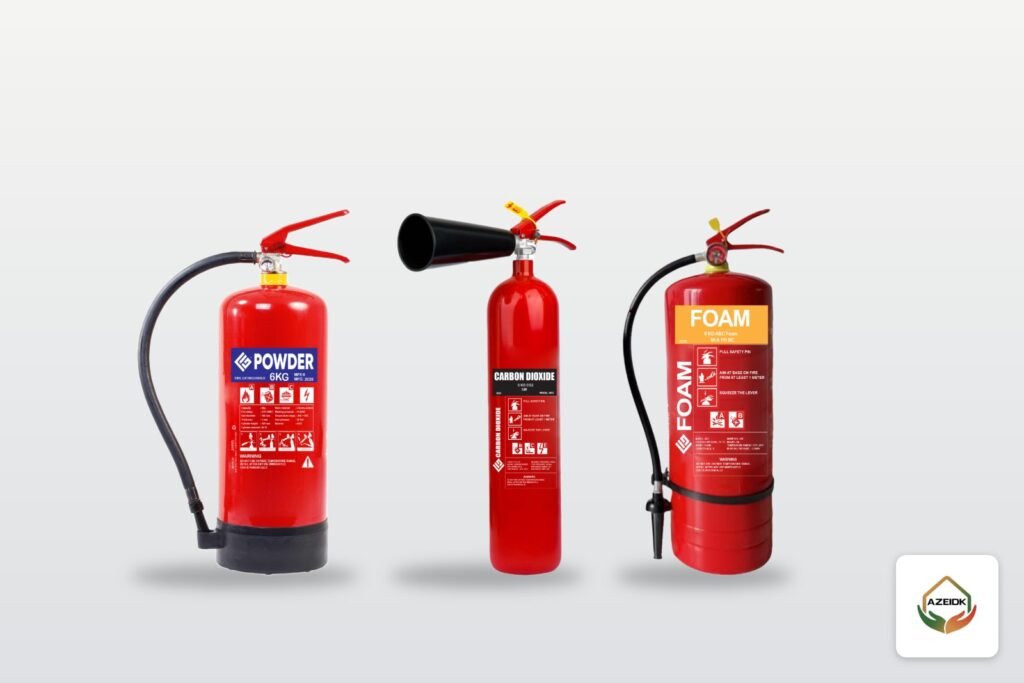
Fire extinguishers in schools are chosen by the type of fire expected in each space: a unit for paper and furniture fires in classrooms and corridors, CO2 for computer labs and electrical rooms, wet chemical for the canteen, and specific provision for science labs. Quantities are then set so the travel distance to an extinguisher stays within the limit, and units are mounted where they are visible but out of reach of student tampering.
To compare extinguisher types and choose the right one for each hazard, see our fire extinguishers selection guide for facilities in Saudi Arabia.
This is a practical guide for school administrations, safety officers and contractors, and it complements our school and educational facility fire safety guide. AZEIDK supplies Falcon Gold and FG extinguishers of all types as part of its fire fighting systems; sector services are on the schools and universities page.
Key takeaways
- Classrooms are typically light hazard under NFPA 10, with a minimum extinguisher rating of 2-A.
- Under NFPA 10, maximum travel distance to a Class A extinguisher is 75 ft (about 23 m).
- The canteen needs a wet chemical (Class K) extinguisher within 30 ft (about 9 m) of cooking appliances.
- Extinguishers of 40 lb or less are mounted with the top no higher than 5 ft (about 1.5 m) and the bottom at least 4 in above the floor.
- Monthly checks, annual maintenance and periodic tests are recorded for each unit.
In this article
- Fire extinguishers in schools: which type for which space?
- How many extinguishers does a school need? NFPA 10 placement rules
- Where to mount extinguishers and how to protect them from misuse
- Labs and canteens: more than an extinguisher
- Monthly checks and annual maintenance
- Common mistakes with school extinguishers
- Frequently asked questions
- Conclusion
Fire extinguishers in schools: which type for which space?
A single school contains spaces with different hazards, so not every extinguisher should be the same type. The table summarises the usual choice; the final selection is set in the design and by Civil Defense requirements.
| Space | Expected fire | Usual extinguisher |
|---|---|---|
| Classrooms, corridors, administration | Paper, furniture, textiles (A) | ABC multipurpose powder or foam |
| Computer lab and server room | Electrical equipment (C) | Carbon dioxide (CO2) |
| Electrical and generator rooms | Electrical and oils | CO2 and ABC powder as designed |
| Canteen and kitchen | Cooking oils and fats (K) | Wet chemical, with a fire blanket |
| Science labs | Chemicals, solvents, equipment | CO2 and ABC powder, plus specific provision for stored materials |
| Sports hall and theatre | Furniture, equipment, lighting electrics | ABC powder or foam, with CO2 near lighting and sound panels |
| Stores and library | Paper, cardboard, furniture (A) | Larger ABC powder or foam units |
Powder is effective and versatile, but it spreads through a classroom, is hard to clean and harms electronics. Many schools therefore prefer foam in classrooms and corridors and CO2 in computer labs. For what each type contains, see what is in a fire extinguisher.
How many extinguishers does a school need? NFPA 10 placement rules
The binding reference in Saudi Arabia is the Saudi Fire Code SBC 801 together with Civil Defense requirements; NFPA 10 is used here as the technical reference for the values below (as in the 2022 edition). NFPA 10 sets quantities by two tests together: the floor area each extinguisher may cover for its rating and hazard level, and the maximum travel distance from any point to the nearest unit. Classrooms are an example of light hazard; labs, kitchens and stores may rate higher depending on contents.
| Rating | Max area per extinguisher, light hazard | Ordinary hazard |
|---|---|---|
| 2-A | 6,000 sq ft (about 557 m²) | 3,000 sq ft (about 279 m²) |
| 3-A | 9,000 sq ft (about 836 m²) | 4,500 sq ft (about 418 m²) |
| 4-A | 11,250 sq ft (about 1,045 m²) | 6,000 sq ft (about 557 m²) |
Alongside area, the actual travel distance to a Class A extinguisher must not exceed 75 ft (about 23 m), measured along the walking path, not in a straight line through walls. In the canteen, the distance to a Class K unit must not exceed 30 ft (about 9 m). For flammable liquid (Class B) hazards the distance is 30 to 50 ft depending on hazard severity and rating.
In practice, in a school with long corridors, travel distance drives the count more than area, so units go at every exit, every stair and midway along long corridors. To understand ratings such as 2-A:10-B:C and compare them with EN 3, see UL listed fire extinguisher ratings, and for placement rules in detail our NFPA 10 guide.
Where to mount extinguishers and how to protect them from misuse
Extinguishers must be visible and easy for teachers and guards to reach, yet out of the way of young students. The NFPA 10 height rules:
- Extinguishers with a gross weight of 40 lb (about 18 kg) or less: top no more than 5 ft (about 1.5 m) above the floor.
- Heavier units: top no more than 3.5 ft (about 1.07 m).
- In all cases the bottom at least 4 in (about 10 cm) above the floor.
In primary schools and busy corridors, the Falcon Gold recessed extinguisher cabinet solves two problems: the unit does not project into the corridor where children bump into it, and it is harder to tamper with. The cabinet must not be locked in a way that prevents opening in a fire, and it needs clear signage above it. For outdoor locations such as open courtyards, see fire extinguisher covers for outdoor use.
Labs and canteens: more than an extinguisher
In a chemistry or biology lab an extinguisher handles a small incipient fire, but provision is completed by a fire blanket near the benches for small fires or burning clothing, and by storing chemicals in dedicated cabinets away from heat sources. In university labs that use combustible metals, a special extinguisher is specified with the lab supervisor based on the actual materials.
In the canteen, the wet chemical extinguisher sits close to fryers and hobs, with a fire blanket, and a hood suppression system is preferred where the kitchen is commercial; see kitchen fire suppression systems. Units available from AZEIDK include the FG 6 kg wet chemical extinguisher and the Falcon Gold 6 kg CO2 extinguisher.
Monthly checks and annual maintenance
A school extinguisher faces things an office unit does not: being moved, tampered with, and losing its seal. Its programme starts with a monthly visual check that the unit is in place, the seal and pin are intact, the gauge is in the green and there is no visible damage. Then annual maintenance by a qualified technician, and longer periodic tests by type, with these NFPA 10 intervals:
| Type | Visual check | Maintenance | Hydrostatic test |
|---|---|---|---|
| Stored pressure powder | Monthly | Annual, internal examination every 6 years | Every 12 years |
| Carbon dioxide | Monthly | Annual | Every 5 years |
| Wet chemical | Monthly | Annual | Every 5 years |
| Stored pressure water | Monthly | Annual | Every 5 years |
An extinguisher is recharged after any use, even partial. To read the gauge correctly see the fire extinguisher pressure gauge, and for the seal see the safety pin and tamper seal. AZEIDK maintains extinguishers with its own maintenance team under its annual maintenance contracts.
Common mistakes with school extinguishers
- Powder units only, throughout the building, including the computer lab and canteen.
- Extinguishers kept in a locked store or office to prevent tampering.
- Units behind classroom doors or curtains where nobody can see them.
- No Class K unit in a canteen with oil fryers.
- Expired service tags, or gauges in the red with no follow-up.
Frequently asked questions
Which fire extinguishers are suitable for schools?
ABC powder or foam for classrooms and corridors, CO2 for computer labs and electrical rooms, wet chemical for the canteen, with specific provision for labs. The layout is approved in the safety design.
How many extinguishers does a classroom need?
They are not necessarily counted per classroom but for the whole building, so travel distance to the nearest unit is within 75 ft (about 23 m) and each unit covers no more than its rated area.
At what height should a school extinguisher be mounted?
For units of 40 lb or less, the top no higher than about 1.5 m and the bottom at least 10 cm above the floor, per NFPA 10.
Can extinguishers be locked away to stop students tampering?
Not in a way that prevents use in a fire. Use recessed cabinets or covers that do not obstruct opening, placed where teachers can see them.
How often should school extinguishers be checked?
A monthly visual check, annual maintenance by a qualified technician, and internal examinations and hydrostatic tests at intervals that depend on the type.
Which extinguisher suits a school lab?
Usually CO2 and ABC powder with a fire blanket; a university lab may need a special extinguisher depending on the materials, specified with the lab supervisor.
Conclusion
Fire extinguishers in schools are not a number spread evenly; they are a choice for each space, a calculated travel distance, the right mounting height and protection from tampering, followed by monthly checks that never stop. That way the extinguisher is in place and ready when a teacher needs it in the first minute.
Need extinguishers for a school or a review of their layout? Send us the building plan and list of spaces, and the AZEIDK team will propose types and quantities with the datasheet for each unit. Contact the AZEIDK team
Related guides
- Isolating Fire Detectors During Hot Work and Maintenance: Preventing False Alarms Without Leaving the Building Unprotected
- Low Current Systems for Hospitals: Network, CCTV, Access Control, PA and Fire Alarm as One Package
- Preventive vs Corrective Maintenance for Fire Systems
- Fire Pump Control Panel Wiring Diagram: Electric and Diesel Controllers, Pressure Switch and Alarm Signals