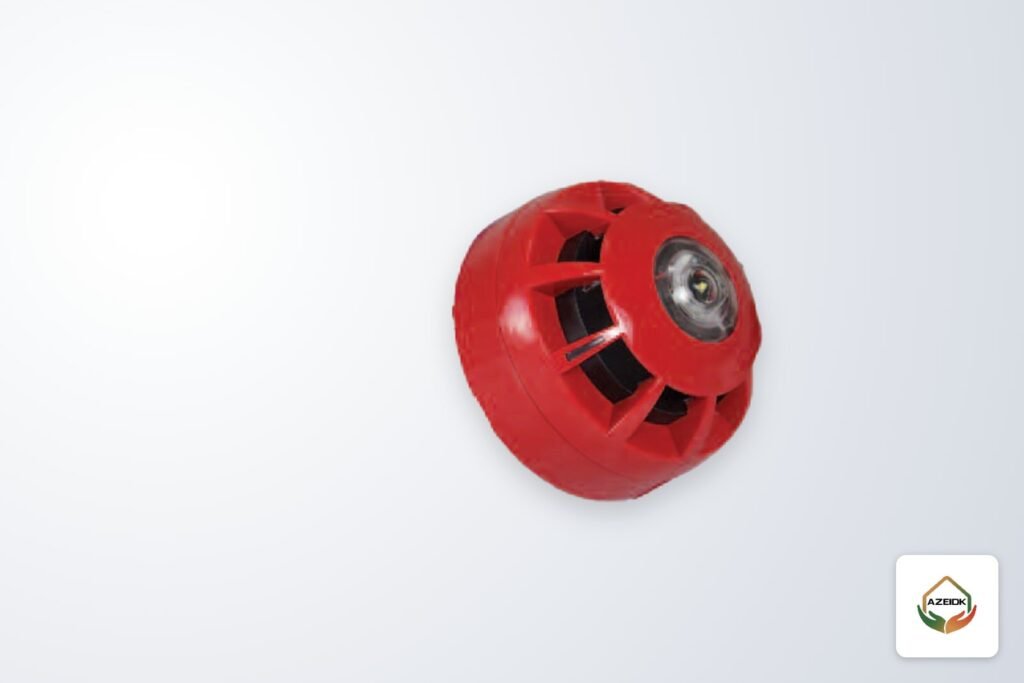
A voice sounder is an addressable alarm device on the fire alarm loop that plays a pre-recorded spoken message instead of, or alongside, a tone, so people understand what to do and not only that an alarm is sounding. AZEIDK supplies four Context Plus models in Saudi Arabia: the CON446A/CX/DR wall voice sounder, the CON447A/CX/DR wall voice sounder beacon, the CON454A/CX/W voice base sounder and the CON457A/CX/W voice base sounder beacon.
For how conventional and addressable systems compare, see our guide to choosing a fire alarm system for Saudi projects.
This guide compares the four models using the figures published on their pages, explains when a voice sounder helps more than a standard sounder, where it stops short of a full voice alarm system, and what the designer checks on loop loading and message language.
Key takeaways
- All four models are powered directly from the addressable loop, so no separate sounder power cabling is needed.
- All offer three selectable voice message pairs, 7 volume levels, a built-in short-circuit isolator and group addressing.
- Alarm current is 10 mA for the voice sounders and 19.5 mA for the models with a beacon, at 24 V DC.
- The wall models have a deep base and IP33C rating; the base models mount under a detector and are rated IP21C.
- A voice sounder plays recorded messages and does not replace a microphone-and-amplifier voice alarm system when the design calls for one.
In this article
What is a voice sounder and why use one?
A standard sounder produces a pulsing or continuous tone. In a building whose occupants know the system, such as a factory with regular drills, a tone may be enough. In public spaces, hotels and schools, some people hesitate when they hear a tone they do not recognise, or assume it is a test. A spoken message removes that hesitation by stating clearly that there is a fire and they must leave.
In a Context Plus addressable system the voice sounder is a loop device like any other sounder: it takes an address, is programmed in the cause and effect matrix and is supervised by the panel. No amplifiers, 100 V speaker lines or audio equipment room are needed.
Context Plus voice sounder models
| Item | CON446A/CX/DR | CON447A/CX/DR | CON454A/CX/W | CON457A/CX/W |
|---|---|---|---|---|
| Type | Wall voice sounder | Wall voice sounder beacon | Voice base sounder under detector | Voice base sounder beacon |
| Colour and base | Red, deep base | Red, deep base | White | White |
| Protection | IP33C (Type B) | IP33C (Type B) | IP21C | IP21C |
| Light coverage | None | W-2.4-8.2 (wall) | None | C-3-8 (ceiling) |
| Quiescent current | 550 µA | 550 µA | 550 µA | 550 µA |
| Alarm current at 24 V | 10 mA | 19.5 mA | 10 mA | 19.5 mA |
| Tones | Up to 15 pairs | Up to 15 pairs | Not stated | Not stated |
Common to all four: three selectable voice message pairs, 7 volume levels, a built-in short-circuit isolator, and group addressing so several devices operate together. The product pages state that they share electronics with Context Plus sounders certified to EN 54-3 (audible alarm devices) and EN 54-17 (short-circuit isolators), and to EN 54-23 for the beacon models. For the submittal, request the certificate for the exact model, not a similar one.
Wall or base: which one?
Wall voice sounders (CON446A and CON447A)
Wall mounted on a deep base for surface wiring, rated IP33C. The CON446A page lists offices, schools and public buildings, corridors, stairwells and covered plant areas. It suits places where the message must carry across an open area or a long corridor. The CON447A adds a beacon rated W-2.4-8.2: wall mounted at 2.4 m, delivering at least 0.4 lux throughout a coverage volume with an 8.2 m square base. It suits areas used by people with hearing impairment.
Voice base sounders (CON454A and CON457A)
Fitted under a Context Plus detector and base on the ceiling, they add the spoken message at the detector position without extra wall devices. The pages list hotel rooms, offices, apartments and healthcare buildings. The CON457A adds a C-3-8 beacon: ceiling mounted up to 3 m, delivering at least 0.4 lux within an 8 m diameter coverage cylinder. Both can be used stand-alone without a detector using the optional BF330CTLIDW (white) or BF330CTLIDR (red) cap. More on beacon ratings in fire alarm beacons to EN 54-23.
Voice sounder or voice alarm system?
Both deliver a spoken message, but they are different systems:
| Item | Voice sounder on the loop | Voice alarm system |
|---|---|---|
| Message source | Recorded messages inside the device | Recorded messages in the amplifier plus live microphone paging |
| Power and cabling | From the addressable loop | Separate amplifiers and speaker lines |
| Live fire brigade announcements | Not available | Available |
| Typical scale | Small and mid-size buildings or defined areas | Large buildings and assembly spaces set by the design |
If the consultant or the adopted code requires live announcements or complex phased evacuation, a voice sounder does not replace the full system. See voice evacuation systems.
What the designer checks before approving voice sounders
- Loop loading: 10 or 19.5 mA alarm current per device is higher than a tone sounder of the same family; the CON430A/CX/DR wall sounder page, for example, lists 5 mA. Add up every device that operates together in alarm and check panel limits and cable length.
- Message language and content: the pages mention three selectable message pairs without giving their text or language. If Arabic or bilingual messages are required, confirm this from the catalogue or manufacturer before approval.
- Volume: 7 levels allow tuning per area; a message that is too loud in a small room can become unintelligible.
- Synchronisation: group addressing makes devices operate together so neighbouring messages do not overlap.
- Environment: IP33C and IP21C are indoor ratings. For outdoor or wet areas, choose devices with a higher rating.
Common mistakes with voice sounders
- Selecting messages without reviewing their wording with the owner and consultant, so an unsuitable message ends up on site.
- Mixing voice and tone sounders in one area without coordination, so people hear two conflicting signals.
- Setting maximum volume everywhere, so the message echoes in hard corridors and loses clarity.
- Calculating loop load with standard sounder current, then swapping in voice sounders at supply stage.
- Fitting a base sounder under a detector it is not designed for; the pages specify a Context Plus detector and base.
Where voice sounders fit in Saudi projects
- Hotels and serviced apartments: a voice base sounder in the room wakes guests with a clear message, as covered in hotel room fire alarms.
- Schools, offices and public buildings: wall voice sounders in corridors and stairwells.
- Healthcare: beacon models where audible and visual signals are both needed, within the specific hospital design requirements.
- Residential towers: voice base sounders in apartments where the design does not include a full voice alarm system.
Frequently asked questions
Does a voice sounder need an amplifier?
No. All four models are powered from the addressable loop and store their messages internally, so no amplifiers or speaker lines are needed.
How many messages does a Context Plus voice sounder hold?
Three selectable voice message pairs according to the product pages. Message wording and language should be confirmed from the catalogue.
What is the difference between the CON454A and CON457A?
Both are white voice base sounders under a detector. The CON457A adds a C-3-8 beacon, and alarm current rises from 10 to 19.5 mA.
Can a voice sounder replace a voice alarm system?
Not in every case. It offers no live microphone announcements, so where the design requires them a full voice alarm system is needed.
Can a voice base sounder be fitted without a detector?
Yes, with the optional BF330CTLIDW (white) or BF330CTLIDR (red) cap for stand-alone use.
Does it work with any addressable panel?
The product pages state compatibility with Context Plus addressable panels. Any other panel needs protocol compatibility confirmed by the manufacturer.
Summary
A voice sounder sits between a standard sounder and a full voice alarm system: an understandable message from a loop device, with no amplifiers or extra cabling. Use wall models for corridors and open areas, base models for rooms, add a beacon where a visual signal is required, and check loop loading and message language. For complete solutions see fire alarm systems.
Need a clear evacuation message in your project? Send us the drawings and occupancy type, and the AZEIDK team will propose voice sounder locations and calculate loop loading. Contact the AZEIDK team
Related guides
- Hikvision CCTV Settings: NVR Activation, Recording Schedule, HDD and Retention
- Idle Pallet Storage in Warehouses: Why Empty Pallets Are a High Hazard and How Sprinklers Protect Them
- ZKTeco InBio and C3 Access Control Panels: Doors, Readers, Software and Fire Release
- Small Fire Extinguisher, 1 kg and 2 kg: Where It Fits and When It Is Not Enough