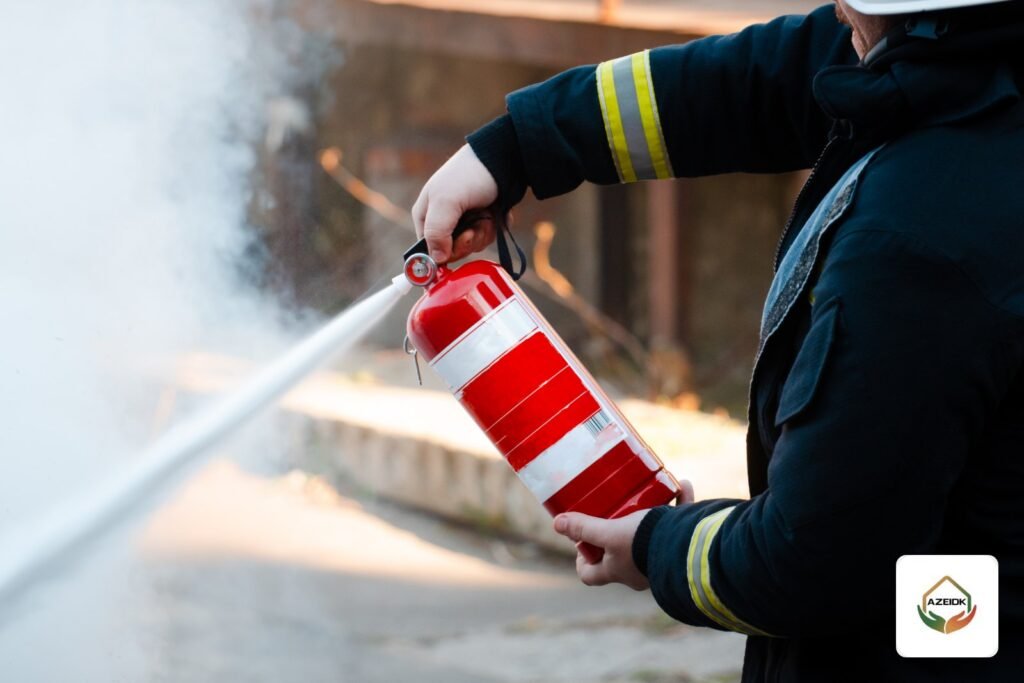
What is in a fire extinguisher? Every extinguisher holds one extinguishing agent, and most also hold a gas that pushes that agent out. An ABC powder unit contains a dry chemical based on monoammonium phosphate, a CO2 unit contains carbon dioxide itself, a foam unit contains an AFFF solution, and a kitchen unit contains a solution of potassium salts. This guide sets out what each type contains according to the safety data sheets (SDS) and official datasheets from Falcon Gold, SFFECO and Amerex, how each agent puts out a fire, and what it leaves behind.
Key Points
- ABC powder is based on monoammonium phosphate; the percentage varies by formulation, and Amerex ABC powders are light yellow.
- BC powder is based on sodium bicarbonate and is white.
- A CO2 extinguisher holds 100% carbon dioxide under high pressure and leaves no residue.
- Falcon Gold powder and foam units operate at 15 bar, and the Falcon Gold BSI foam datasheet names dry nitrogen as the propellant.
- When refilling, use only the agent named on the extinguisher label, and never mix powder types.
In this article
- What Are Fire Extinguishers Made Of? Cylinder, Agent and Propellant
- What Is in a Fire Extinguisher, Type by Type?
- Which Powder Is Used in a Fire Extinguisher?
- Which Gas Is Inside a Fire Extinguisher?
- Foam Fire Extinguisher Contents (AFFF)
- Wet Chemical (Kitchen) Extinguisher Contents
- What the Contents Mean After Use
- Refilling Fire Extinguisher Powder: Keep the Same Agent
- Ask for the Datasheet and SDS When You Buy
- Frequently Asked Questions
- Summary
What Are Fire Extinguishers Made Of? Cylinder, Agent and Propellant
Every portable extinguisher has three parts: the cylinder, the agent inside it and a way of expelling that agent. Falcon Gold powder and foam cylinders are cold rolled steel, with a 15 bar operating pressure and a 30 bar test pressure. A CO2 unit needs a much stronger cylinder: the Falcon Gold FCD6 datasheet gives 70 bar operating and 250 bar test pressure, and SFFECO states that its CO2 cylinders are made without a welded seam, extruded from chrome molybdenum, manganese or carbon steel.
The valve, handle, safety pin, hose and horn are broadly the same across types, and you will find their Arabic and English names in our fire extinguisher glossary. What really separates one extinguisher from another is the agent inside.
What Is in a Fire Extinguisher, Type by Type?
| Extinguisher | Main agent | Composition per source | What it leaves behind |
|---|---|---|---|
| ABC powder | Monoammonium phosphate | Amerex: monoammonium phosphate with attapulgite clay, mica, silicone oil and a yellow pigment | Light yellow powder that must be cleaned up |
| BC powder | Sodium bicarbonate | Amerex: sodium bicarbonate above 92% with clay, mica and silicone oil | White powder |
| CO2 | Carbon dioxide | Amerex: 100% carbon dioxide | No residue |
| AFFF foam | AFFF foam solution | Falcon Gold (BSI version): 3% AFFF, dry nitrogen propellant | Foam and water-based solution |
| Wet chemical (kitchen) | Potassium salts in water | Amerex: water and potassium acetate (40 to 60% each), potassium citrate below 8% | Liquid to be cleaned with water and detergent |
| FM-200 (clean agent) | HFC-227ea | Falcon Gold: heptafluoropropane | No residue |
The percentages above come from the SDS for specific Amerex products. Every manufacturer has its own formulation, so ask for the SDS of the exact extinguisher you buy if you need precise figures.
Which Powder Is Used in a Fire Extinguisher?
Multi-purpose ABC powder is the agent in every Falcon Gold powder extinguisher listed by AZEIDK, from the FDP1 up to the FDP50 wheeled unit. The Amerex SDS for ABC dry chemical (CH555) lists monoammonium phosphate at 80 to 98% by weight, with attapulgite clay, mica and small amounts of silicone oil, calcium carbonate, silica and a yellow pigment, which is why the powder is light yellow. Another Amerex ABC formulation (CH550) lists monoammonium phosphate at 55 to 77%.
That explains what you see on some labels. The Falcon Gold datasheet for its FDP1 to FDP12 range names the agent as “ABC 70% Dry Chemical Powder”. The percentage is part of the powder specification set by the manufacturer, and the right place to check what it covers is the SDS for that powder.
BC powder, which Amerex calls Regular Dry Chemical, is based on sodium bicarbonate at more than 92%. It is white and is meant for flammable liquid, gas and electrical fires, not solid materials. For a usage comparison, see our ABC vs BC dry powder guide.
How does the powder put out a fire?
Amerex explains that ABC powder removes oxygen and coats the burning material with a protective barrier, melting over the hot surface to prevent reignition. That is why it works on wood and paper (class A) as well as liquids and gases.
Which Gas Is Inside a Fire Extinguisher?
There are two answers, because the gas can be the extinguishing agent itself or simply the gas that pushes the agent out.
CO2 extinguishers: the gas is the agent
The Amerex SDS for carbon dioxide lists a single ingredient at 100%. SFFECO describes the discharge as a white cloud of snow that smothers the fire by removing oxygen, which suits flammable liquid, gas and electrical fires. Because CO2 is non-conductive and leaves no residue, it is installed in switch rooms, server rooms and control panels, for example the Falcon Gold 6 kg CO2 extinguisher or the SFFECO portable CO2 range, where SFFECO states that models CD5G, CD6G and CD5L are SASO approved.
The gas has hazards that the SDS spells out: it displaces oxygen and can cause asphyxiation in enclosed spaces, and contact with skin or eyes can cause cold burns. Hold the horn by its insulated grip and ventilate the room after use.
The propellant in powder and foam units
Stored pressure powder and foam extinguishers contain an inert gas that drives the agent out when the handle is squeezed. The Falcon Gold BSI foam datasheet names the propellant as dry nitrogen, and the page for the FFMA6 automatic unit also lists nitrogen. Amerex SDS documents describe the expellant as a non-flammable, non-toxic inert gas. The Falcon Gold standard powder datasheet gives the 15 bar operating pressure without naming the gas, so ask the supplier if you need confirmation.
FM-200 extinguishers: a clean agent
FM-200 units contain HFC-227ea (heptafluoropropane), a clean agent that leaves no residue. The Falcon Gold FFMA6 automatic extinguisher holds 6 kg of it with nitrogen as the expellant.
Foam Fire Extinguisher Contents (AFFF)
AFFF stands for Aqueous Film Forming Foam. The datasheet for Falcon Gold portable foam extinguishers says AFFF seals the burning surface against reignition, and the BSI version lists the agent as 3% AFFF for models FF6L and FF9L. The cylinders are coated internally against rust and corrosion.
Because the agent is water-based, the datasheet temperature range starts at +5°C for the standard range and 0°C for the BSI version, against -30°C for powder units. Foam units are rated for classes A and B only. For foam vs powder, see our foam extinguisher guide.
Wet Chemical (Kitchen) Extinguisher Contents
The Amerex SDS for its CH530/CH660 wet agent lists water at 40 to 60%, potassium acetate at 40 to 60% and potassium citrate below 8%, with a pH of about 8.5. The agent is designed for cooking oil and fat fires (class K or F). The page for the FG 6 kg wet chemical extinguisher notes that it cools the oil and forms a sealing layer, with a 13A 75B rating per the datasheet. Placement and the link with the hood system are covered in our kitchen extinguisher guide.
What the Contents Mean After Use
- Powder: the Amerex SDS classes it as an eye, skin and respiratory irritant. Clean up with a vacuum or wet sweeping, then wash the area, wearing safety glasses, gloves and a dust mask. The Amerex owner’s manual adds that dry chemical is not recommended for delicate electronic equipment, which it may damage.
- CO2: no clean-up, but ventilate before re-entering, especially small rooms.
- Foam: dry and wash down with water, and check the product SDS for disposal of the solution.
- Wet chemical: the SDS recommends soaking up the liquid with absorbent material, then cleaning with detergent and water.
These differences are why CO2 or FM-200 is the usual choice for server rooms, and ABC powder the general choice for offices, shops and warehouses.
Refilling Fire Extinguisher Powder: Keep the Same Agent
A powder extinguisher is refilled with the same powder named on its label and datasheet. The Amerex manual describes ABC powder as acidic and regular BC powder as alkaline, and the ABC SDS lists other extinguishing agents, particularly sodium and potassium bicarbonate, among incompatible materials, so the two must never be mixed in one cylinder. Fill weight and operating pressure must also match the datasheet, or the unit’s performance and rating will change.
The refill process and how to accept the unit back are covered in our extinguisher refilling guide, and extinguisher maintenance is part of our periodic maintenance contracts for fire and alarm systems.
Ask for the Datasheet and SDS When You Buy
The datasheet gives you capacity, rating, pressure and temperature range; the SDS gives you the agent’s composition, hazards and handling. AZEIDK publishes Falcon Gold datasheets on its product pages, such as the FDP6 6 kg powder extinguisher, and the full range is in our fire extinguishers category. Through our technical supply service you can order extinguishers together with their technical documents for a project file or a facility.
Frequently Asked Questions
Does a fire extinguisher contain gas or powder?
It depends on the type. A powder unit contains dry chemical plus an inert propellant, a CO2 unit contains only carbon dioxide, and an FM-200 unit contains a clean agent gas.
What is the fire extinguisher powder called?
In ABC units it is monoammonium phosphate; in BC units it is sodium bicarbonate.
Is fire extinguisher powder toxic?
The Amerex manual calls dry chemicals non-poisonous, but the SDS classes them as eye, skin and respiratory irritants. Rinse eyes with water if exposed, and see a doctor if irritation persists.
Which gas pushes the powder out?
An inert, non-flammable gas. Falcon Gold datasheets name dry nitrogen for the BSI foam units and nitrogen for the FFMA6 automatic unit.
Can an ABC extinguisher be refilled with BC powder?
No. Refill only with the agent named on the label; the two powders are chemically different and must not be mixed.
Where can I find an ABC fire extinguisher SDS?
From the manufacturer. Amerex publishes its SDS documents on its website, and for other brands ask the supplier for the SDS of the exact model.
Summary
What is inside the extinguisher decides almost everything: the fires it can fight, where it belongs, what you clean up afterwards and what it is refilled with. ABC powder for general use, CO2 or FM-200 for sensitive electrical equipment, foam for flammable liquids and wet chemical for kitchens. When in doubt, the manufacturer’s SDS and datasheet are the reference.
Need extinguishers for your facility with their datasheets and SDS? Send us your activity and floor areas and our team will propose suitable Falcon Gold and SFFECO types and sizes. Contact the AZEIDK team
To buy an extinguisher or book its maintenance, see AZEIDK fire extinguishers.
Related guides
- Explosion Proof Smoke Detector: Ex and ATEX Detectors for Zone 1 and Zone 2
- Fiber Optic Backbone in Buildings: Types and Testing
- Fire System Maintenance Contracts for Apartment Buildings and Residential Compounds: What Owners and Owners Associations Need (Alarm, Sprinklers, Pumps, Extinguishers, CCTV)
- Ceiling Speakers for PA Systems: Wattage, 100 V Line and Layout