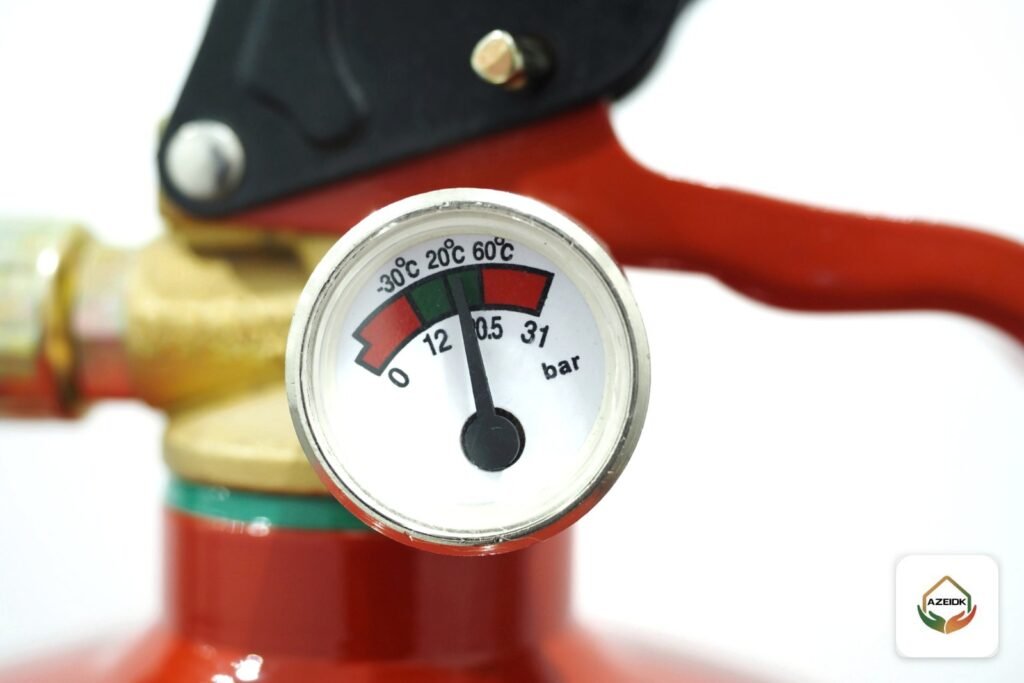
A fire extinguisher pressure gauge answers one question: is the pressure inside the extinguisher within its operating range? A needle in the green zone means the unit is charged. Left of the green means pressure is low; right of the green means it is too high, and either way the unit needs a technician. Pressure in bar varies by type and manufacturer, so the nameplate is the reference. CO2 extinguishers carry no gauge at all because they are checked by weight. AZEIDK provides fire extinguisher maintenance with its own team as part of its preventive and periodic maintenance service.
Key takeaways
- A needle in the green means the unit is charged across its rated temperature range. It does not mean everything else on the unit is fine.
- Operating pressure differs between manufacturers. Falcon Gold dry powder units, for example, are listed at 15 bar operating and 30 bar test pressure.
- Ambient temperature moves the needle: cold pulls it towards the left edge of the green, heat pushes it to the right.
- CO2 units have no gauge because the agent expels itself under its own vapour pressure, so pressure says nothing about quantity. They are checked by weight.
- A damaged gauge is replaced with one matched to the agent, the charging pressure and the valve body material, not with any gauge that fits the thread.
In this article
- Fire extinguisher pressure gauge: what the green zone and either side of it mean
- What is fire extinguisher pressure in bar?
- Why does the needle move with temperature?
- Why does a CO2 extinguisher have no gauge?
- How to check a fire extinguisher without a pressure gauge
- Gauge outside the green: recharge or replace?
- When is the gauge itself replaced?
- Where the gauge fits in monthly and annual checks
- Frequently asked questions
- Conclusion
Fire extinguisher pressure gauge: what the green zone and either side of it mean
The round gauge on the valve is fitted to stored-pressure extinguishers such as dry powder, water, foam and wet chemical units, where an expellant gas (nitrogen or dry air) is stored with the agent in the same cylinder. US manufacturer Amerex explains that the green area of any gauge is intended to show a charged condition, and that gauges are calibrated to show normal charged pressure at the temperature extinguishers are filled at, about 20 to 21°C (68 to 70°F).
| Needle position | What it means | What to do |
|---|---|---|
| In the green zone | Pressure within the operating range | Finish the check: pin, tamper seal, tag and cylinder condition |
| Left of the green (“gauge in the red”) | Undercharged: the unit may have been used or may be leaking | Take it out of service, put an equivalent unit in its place and have it leak-tested and recharged |
| Right of the green | Overcharged, or exposed to high temperature | Do not rely on it until a technician checks it; an overcharged unit is depressurised and recharged |
The University of Nebraska-Lincoln safety guidance notes that an undercharged extinguisher may have been discharged or be leaking and may not put out a fire, while an overcharged one releases agent at higher velocity and could spread the fire. A needle outside the green in either direction is enough reason to call for a check.
What is fire extinguisher pressure in bar?
There is no single figure for every extinguisher. The manufacturer sets the charging pressure for each model and prints it on the nameplate, and NFPA 10 states that a rechargeable stored-pressure unit is pressurised only to the charging pressure on its nameplate. The table brings together values published on official datasheets and product pages:
| Extinguisher and source | Operating pressure | Test pressure | Notes |
|---|---|---|---|
| Falcon Gold dry powder, 1, 6 and 50 kg (FDP1, FDP6, FDP50) | 15 bar | 30 bar | AZEIDK product pages |
| SFFECO stored-pressure dry powder (PD series) | 12 to 15 bar | 30 bar | Nitrogen or dry air expellant per datasheet |
| SFFECO cartridge dry powder (PC, PDC) | 12 to 15 bar | 30 bar shell, 250 bar cartridge | CO2 cartridge released by striking the knob |
| Falcon Gold CO2, 6 and 10 kg (FCD6, FCD10) | 70 bar | 250 bar | High-pressure cylinder, no gauge |
| SFFECO CO2 | Not stated on the datasheet | 250 bar | Checked by weight |
For comparison, the Amerex parts book lists 195 psi (about 13.4 bar) gauges for its standard dry chemical units, 100 psi (about 6.9 bar) gauges for water, foam and wet chemical units, and 240 psi (about 16.5 bar) gauges for its high-performance dry chemical models. Those figures apply to Amerex models only, and they show why a pressure value cannot be carried over from one extinguisher to another. Read the gauge against the nameplate on the same unit.
Falcon Gold data is on the 6 kg dry powder extinguisher and 6 kg CO2 extinguisher pages.
Why does the needle move with temperature?
The gas inside expands with heat and contracts with cold, so pressure changes while the amount of agent stays the same. Amerex explains that a unit exposed to cold reads between the left edge of the green and the upright charged position, and one exposed to abnormal heat reads to the right of upright. When the reading is in doubt, it recommends conditioning the unit at about 21°C for several hours and reading it again.
That matters in unconditioned warehouses, outdoor positions and vehicles. It does not justify leaving a needle outside the green: if the reading is still out of range after the unit returns to room temperature, the problem is the pressure itself. For vehicle units, see our car fire extinguisher guide.
Why does a CO2 extinguisher have no gauge?
NFPA 10 defines a self-expelling extinguisher as one in which the agent has sufficient vapour pressure at normal operating temperatures to expel itself. CO2 is stored as a liquid under its own pressure, which is why the cylinder runs far higher than a powder unit: 70 bar operating and 250 bar test on Falcon Gold CO2 units, against 15 and 30 bar for the same manufacturer’s dry powder.
As long as liquid remains in the cylinder, pressure stays close to the vapour pressure of CO2 at the surrounding temperature, whether the cylinder is full or half empty. A gauge would give much the same reading in both cases, so it would not tell you how much agent is left. That is why NFPA 10 requires fullness of self-expelling units to be confirmed by weighing or hefting at monthly inspection, and its annex guidance for annual maintenance calls for weighing a CO2 unit against the weight on its nameplate. The Amerex parts book reflects the same practice: its CO2 pages list no gauge.
The key visual check on a CO2 unit is therefore the pin seal. If it is broken, part of the charge may be gone however the unit looks. Use, hazards and test intervals are covered in our CO2 extinguisher guide.
How to check a fire extinguisher without a pressure gauge
- CO2: weigh it and compare with the gross weight on the nameplate or cylinder. If it is below the marked weight, send it for recharging.
- Cartridge-operated dry powder: the shell is not pressurised and the gas sits in a separate cartridge, so there is no pressure for a gauge to read. NFPA 10 lists cartridge-operated units among those whose fullness is checked by weighing or hefting.
- Non-rechargeable units: some have a push-to-test pressure indicator, which is checked at monthly inspection.
- All types: check the pin, seal, tag, cylinder and hose too. Weight alone will not reveal corrosion or a blocked nozzle.
Gauge outside the green: recharge or replace?
Amerex instructions for dry chemical units are direct: if pressure is low, check for leaks; if the unit is overcharged, depressurise it and follow the recharge instructions. The work is done by a certified maintenance technician, not by the user, and NFPA 10 requires a replacement suitable for the hazard and of at least equal rating while the unit is away.
Whether to recharge or replace depends on the unit’s condition, not on the gauge alone:
| Condition | Usual action |
|---|---|
| Rechargeable, cylinder sound, hydrostatic test in date | Leak test, then recharge and pressurise to the nameplate |
| Hydrostatic test overdue | Not recharged until it has been tested |
| Non-rechargeable unit | Replaced, never refilled |
| Cylinder exposed to fire, severe heat or visible corrosion | The technician decides whether it is serviceable; it may be condemned |
The workshop steps and how to accept a unit back are covered in our guide to fire extinguisher refilling in Saudi Arabia.
When is the gauge itself replaced?
NFPA 10 requires a gauge to be replaced when it is broken, cracked, illegible, damaged, not working or contaminated with water. The replacement must show the correct charging pressure, be marked for use with the agent in the extinguisher and be compatible with the valve body material. The annex adds that gauges intended for aluminium valve bodies carry a line above the gauge manufacturer’s code letter, so the dial face is read before fitting.
Amerex adds practical detail: avoid a gauge stem of a different metal from the valve body, and use a stainless steel or oil-filled Bourdon tube gauge on water units, because a corroded tube can leak or make the extinguisher inoperable. It also says never to set the charging regulator more than 25 psi above the operating pressure, and NFPA 10 guidance notes that this prevents gauge damage and loss of calibration.
In the workshop, the gauge is never trusted to show whether a cylinder is still pressurised before the valve is removed, because gauges can fail. The unit is vented first.
Where the gauge fits in monthly and annual checks
At monthly inspection, at intervals not exceeding 31 days under NFPA 10, the gauge or indicator only has to read in the operable range, alongside the other items. At annual maintenance the technician checks that the gauge matches the nameplate and replaces it if needed. What goes on the inspection tag at each level, and the internal examination and hydrostatic intervals, are explained in our fire extinguisher maintenance and recharging guide.
The NFPA 10 edition that applies to a project follows the Saudi Fire Protection Code (SBC 801) and Civil Defense requirements; the standard is a technical reference rather than a stand-alone rule.
Frequently asked questions
What does it mean when a fire extinguisher gauge is in the red?
Left of the green means low pressure, usually because the unit was used or is leaking. Right of the green means overpressure. Either way, do not rely on it until a technician has checked it.
What is the pressure of a 6 kg powder extinguisher in bar?
It depends on the manufacturer. The Falcon Gold 6 kg dry powder unit (FDP6) is listed at 15 bar operating and 30 bar test pressure, and SFFECO powder units at 12 to 15 bar. The figure that counts is the one on your unit’s nameplate.
Why does a CO2 extinguisher have no gauge?
Its pressure comes from the vapour of the liquid CO2 and follows temperature, not quantity, so a gauge would not show a partial loss. It is checked by weighing against the nameplate.
Does a needle in the green mean the extinguisher is fine?
It means the pressure is right, nothing more. Also check the pin, seal, tag, hydrostatic test date, cylinder and hose.
Can I top up the pressure myself?
No. Recharging needs a leak test, dry expellant gas and pressure set to the nameplate, and is done by a certified maintenance technician.
My new extinguisher reads near the edge of the green. Is it faulty?
Temperature may be the cause. Leave it in a room at moderate temperature for several hours and read it again; if it is still outside the green, return it to the supplier.
Conclusion
A fire extinguisher pressure gauge is a quick check, not a complete one. Green means correct pressure; anything outside it calls for an inspection. Pressure in bar comes from the unit’s own nameplate rather than a general figure, and CO2 units are weighed because their pressure does not reflect their contents. Since temperature moves the needle, re-read at moderate temperature before deciding.
If you are considering a fire extinguisher ball instead of a portable extinguisher, see fire extinguisher ball and Civil Defense rules.
Extinguishers reading outside the green, or not checked for a while? Send us the number, types and location of your units, and our maintenance team will arrange the inspection and any recharging needed. Talk to the AZEIDK team
AZEIDK supplies fire extinguishers of all common types and sells them to individuals and businesses from its branches in Saudi Arabia.
Related guides
- Potter Waterflow and Supervisory Switches (VSR, OSYSU, PS40) for Sprinkler Systems in Saudi Arabia
- CCTV Recorder Error Messages on Hikvision and Dahua: HDD, Network, Login and Video Exceptions
- Night Vision CCTV Cameras: ColorVu, Starlight and EXIR Compared
- Salamah Technical Report (Civil Defense Technical Report): When a Facility Needs It, What It Covers and Who Issues It