Perfume shop fire safety differs from any other retail unit for one reason: the shop stores flammable liquids and burns incense in the same space. Alcohol-based perfume usually relies on ethyl alcohol, whose flash point is about 13°C, so its vapour can ignite at any normal shop temperature, and a lit incense burner on the counter is the ignition source. Protection starts by separating the two, then adding fire extinguishers suited to liquid fires and a fire alarm that incense smoke does not defeat.
For the steps to obtain the Salamah certificate from Civil Defense on the Salamah platform, see our guide; our page on Saudi Civil Defense requirements covers the general requirements for buildings and facilities.
This article is for perfume, oud and bakhoor shops in souqs and malls and their back stores. It belongs to our malls and commercial buildings sector page and complements our article on fire safety in traditional souqs and adjoining shops.
Key Points
- Ethyl alcohol has a flash point of about 13°C (55°F) and is a Class IB flammable liquid under the NFPA classification.
- Alcohol vapour is heavier than air, sinks and collects near the floor, and flame can flash back along the vapour trail.
- The most dangerous situation in a perfume shop is a lit burner or hot coals near alcohol-based perfume shelves or the filling counter.
- The shop falls under the Saudi Fire Code (SBC 801) and needs a Salamah certificate within its municipal licence; quantities and storage are reviewed in the approved design.
- Dry powder and CO2 extinguishers suit small liquid and electrical fires, and detectors are placed so incense smoke does not disable them.
In this article
Why is alcohol-based perfume a hazard?
NFPA classifies flammable liquids by flash point and boiling point. Class IB covers liquids with a flash point below 23°C and a boiling point of 38°C or above, and ethyl alcohol is a standard example. NOAA’s CAMEO Chemicals database gives ethanol’s flash point as 55°F (about 13°C), notes that its vapours are heavier than air, that flashback along the vapour trail may occur, and that vapour may explode if ignited in an enclosed area.
In shop terms: room temperature is always above the flash point, so any open or spilled bottle gives off flammable vapour. That vapour sinks to the floor and under counters and low shelves, where it may meet an ignition source: a burner on the floor, a socket or a heater.
| Item in the shop | Nature of the hazard | Note |
|---|---|---|
| Alcohol-based perfume sprays | Flammable liquid; vapour collects low | Greatest risk during filling and spills |
| Drums and bottles of alcohol for blending and filling | Large quantities of flammable liquid | Belong in the store, not the sales floor |
| Body sprays and fabric fresheners | Pressurised cans that may contain flammable propellant | Burst when heated |
| Oud oil and perfume oils | Less volatile than alcohol but combustible | Keep away from burners |
| Bakhoor and raw oud wood | Combustible solids whose embers stay hot | Risk lies in lighting and putting out |
| Cartons and packaging | Combustible solids | Pile up in the back store |
Perfume shop fire safety: the burner is the danger point
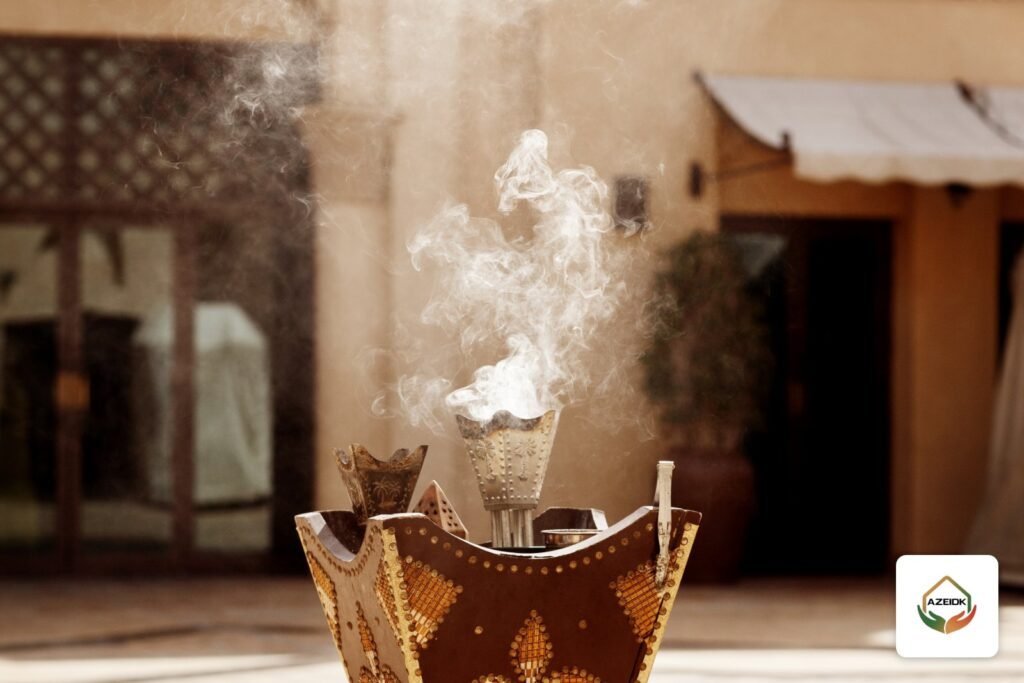
Offering bakhoor to customers is part of buying oud. But a lit burner, charcoal or electric, is the only constant ignition source in a shop full of flammable vapour. Practical rules:
- Fix one burning spot away from alcohol perfume shelves and the filling counter, on a non-combustible surface.
- Do not perfume a customer with smoke while they test an alcohol spray at the same moment.
- Do not light charcoal openly in the shop, and never leave embers unattended, especially at closing.
- Put ash and used embers in a lidded metal container, not the waste bin.
- Unplug electric burners at closing and never run them from a power strip shared with other devices.
Filling and storage: where spills happen
- Large alcohol containers stay in the store; the sales floor holds one day’s working quantity.
- Containers are closed tightly after each use.
- The filling area is ventilated and away from sockets, appliances and the burner.
- Spill absorbent is ready, and perfume-soaked tissues go into a closed container.
- Pressurised cans are kept away from heat sources and hot display lighting.
The Saudi Fire Code (SBC 801) has a full chapter on flammable and combustible liquids (Chapter 57 in the 2018 edition, per the ICC study companion contents), covering their storage and quantities. The quantities allowed and the storage method required for your shop are set by the engineering office in the design and reviewed by Civil Defense for the Salamah certificate, so tell the designer your real stock level, not just what is on display.
The right extinguishers for a perfume shop
| Area | Expected fire | Usual extinguisher |
|---|---|---|
| Sales floor and perfume shelves | Flammable liquids and solids | Multi-purpose ABC dry powder |
| Filling and blending area | Spilled flammable liquid | ABC dry powder or CO2 |
| Cashier, lighting and screens | Electrical fire | CO2 |
| Back store | Cartons and bottles | ABC dry powder; a wheeled unit for large stores if the design calls for it |
AZEIDK supplies Falcon Gold dry powder extinguishers of 1, 2, 3 and 6 kg, CO2 units of 2, 6 and 10 kg and wheeled units. For more on powder units and their limits see our dry powder extinguisher guide. Place the extinguisher near the filling area, not inside it, so staff can reach it without passing through the fire.
Fire alarm in a shop that burns bakhoor
A smoke detector above the burning spot will alarm repeatedly, which leads to the common mistake of covering or disconnecting it. The right fix starts in the design:
- Mark the burning spot on the drawing before detectors are laid out.
- Smoke detectors in the store, filling room, office and sales floor, away from the burning spot.
- Near the burning spot, the designer chooses a suitable detector type, which may be a heat detector.
- In mall units, detectors are part of the building system; any change is coordinated with mall management and the system owner.
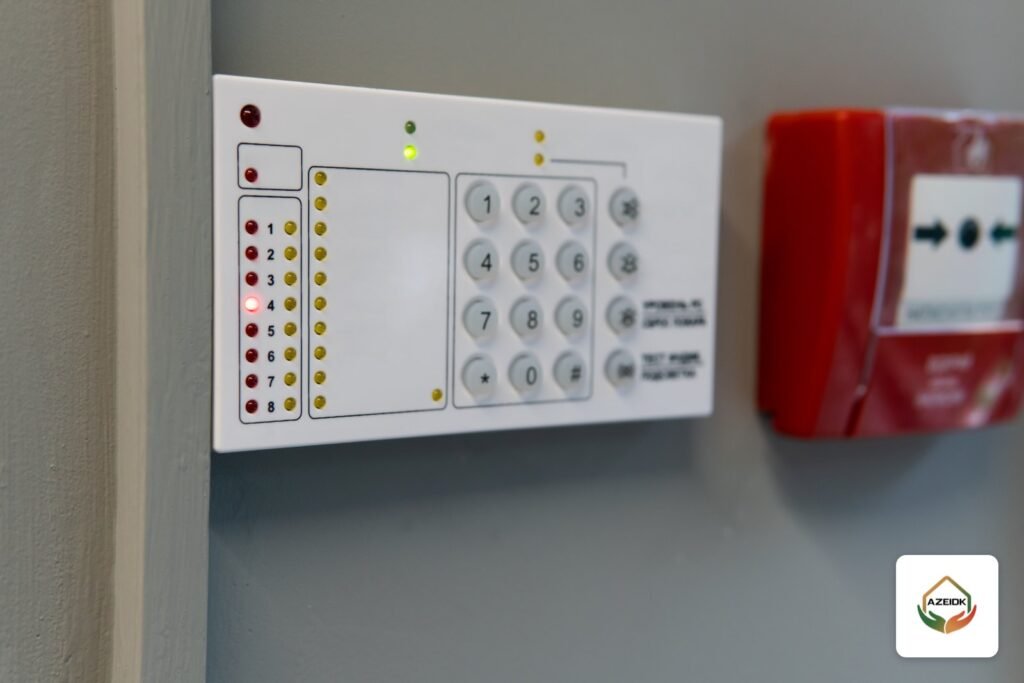
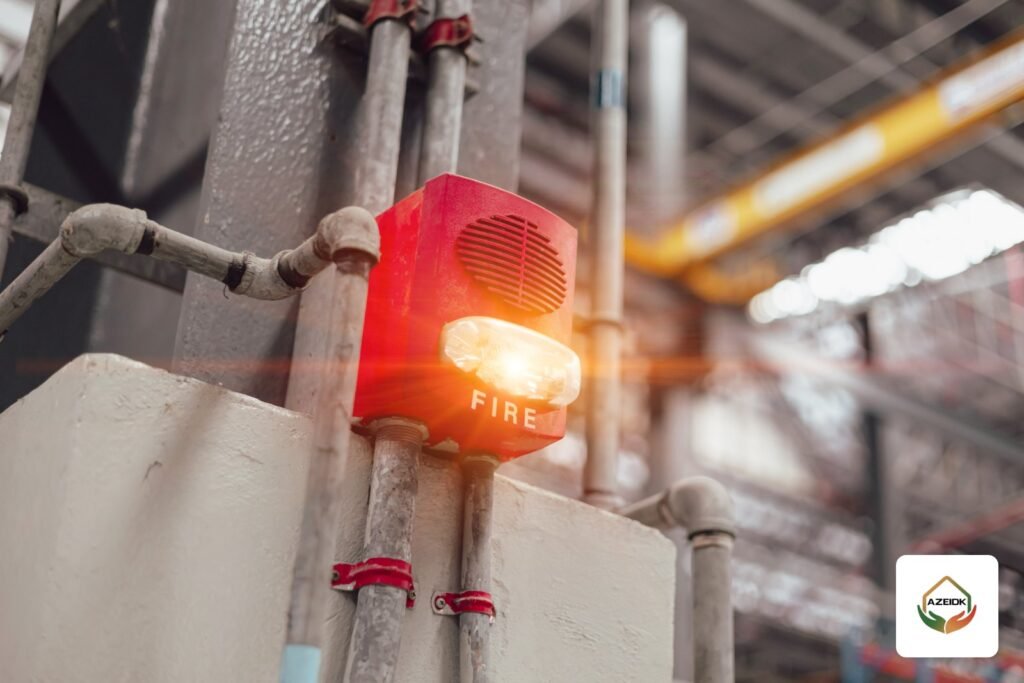
A small standalone shop is usually served by a small Context Plus or FG conventional panel with a manual call point at the door and a sounder. If the shop closes at night, sending the alarm signal to the owner’s phone or a monitoring company needs an interface designed with the system.
CCTV in perfume shops
Perfume and oud are small, high-value goods, so cameras at the cashier, shelves, entrance and store protect stock and record any incident; coverage is discussed in our retail shop CCTV guide. AZEIDK supplies Hikvision, Dahua and EZVIZ cameras and recorders through its security and surveillance systems.
Daily checklist
- Burning spot fixed and away from perfume shelves and the filling counter.
- No embers or burner running at closing.
- Alcohol containers closed; surplus stock in the store.
- Extinguishers in place and visible, gauges in the green.
- Detectors uncovered; alarm panel fault-free.
- No daisy-chained power strips behind shelves.
- Exit route clear of cartons.
Safety certificate and maintenance
A Salamah certificate is required to issue and renew the shop licence through Balady; see the Salamah certificate for shops. AZEIDK provides Civil Defense approval support and periodic maintenance contracts for alarms and extinguishers with its own team, with a visit log ready for inspection.
FAQ
Is perfume flammable?
Alcohol-based perfume is. It usually relies on ethyl alcohol, with a flash point of about 13°C, so its vapour can ignite at normal shop temperature.
Which extinguisher suits a perfume shop?
ABC dry powder for the floor and store and CO2 for electrical equipment and the filling area; the design sets numbers and positions.
Can a burner be used inside a perfume shop?
Oud shops do, but the burning spot must be fixed and away from alcohol perfumes and the filling counter, and a burner must never be left unattended.
Why does the fire alarm go off when we burn bakhoor?
The smoke detector senses the incense smoke. The fix is for the designer to plan the burning spot and the detector type near it, not to cover the detector.
Where should large alcohol containers be kept?
In the store, away from heat and electrics, with only a day’s quantity on the sales floor, as the approved design sets.
Does a perfume shop need a Salamah certificate?
Yes. A Civil Defense safety certificate is required to issue and renew the shop licence.
Summary
Perfume shop fire safety rests on one rule: keep the ignition source away from the vapour. Fix the burning spot away from alcohol perfumes, move bulk stock to the store, provide powder and CO2 extinguishers and design the alarm so incense smoke does not disable it.
Opening a perfume shop or fitting out a new branch? Send us the layout with the filling and burning areas and we will propose extinguishers, fire alarm and cameras with datasheets. Contact the AZEIDK team
AZEIDK supplies fire extinguishers of all common types and sells them to individuals and businesses from its branches in Saudi Arabia.
Related guides
- Workplace Safety Rules for Offices, Warehouses and Kitchens: A Practical Checklist
- Dome vs Bullet Camera vs Turret: Which CCTV Form Factor Fits Indoors, Outdoors and Entrances
- Fire Pump Calculation: Flow, Pressure, the 150%/65% Curve and Jockey Pump Sizing per NFPA 20
- CCTV and Access Control Brands in the Saudi Market