Choosing TYCO sprinklers for a project starts with a practical question: where will each sprinkler be installed? The right head for an exposed pump room ceiling is not the right head for a hotel lobby with a gypsum ceiling, a long hospital corridor, an MRI room or a freezer. A model that does not suit its location may be rejected at submittal or end up working outside its listing.
AZEIDK supplies six TYCO sprinkler families in Saudi Arabia as part of its fire fighting systems offering. This guide matches each family to the space it was designed for, using each model’s official datasheet values and limits. For K-factor, temperature ratings and response types, see our guide to sprinkler head types; for the brand itself, see TYCO in Saudi Arabia.
Key takeaways
- Series TY-B covers general areas, with upright, pendent and recessed models in K5.6 or K8.0.
- Royal Flush II suits architectural ceilings: TY3531 quick response, TY3551 standard response (UL).
- For light hazard corridors up to 28 ft × 10 ft per head, EC-8C needs 12.3 psi and the concealed RFII-C needs 25 psi at the largest area.
- RFII-MRI (TY3537) serves MRI rooms with static fields up to 7 Tesla, never inside the scanner.
- DS-1 dry sprinklers protect freezers, each made to a length measured on site.
In this article
- Three questions before choosing a model
- Quick selection table: TYCO sprinklers by location
- General areas and exposed ceilings: Series TY-B
- Architectural ceilings: Royal Flush II TY3531 or TY3551?
- Corridors: EC-8C or RFII-C?
- MRI rooms: RFII-MRI TY3537
- Freezers and cold rooms: Series DS-1 dry sprinklers
- Common mistakes when selecting TYCO sprinklers
- How AZEIDK helps with TYCO selection
- FAQ
- Conclusion
Three questions before choosing a model
- What is the hazard classification? Corridor sprinklers and RFII-MRI are listed for light hazard only; TY-B covers light, ordinary and extra hazard.
- What is the ceiling, and what does the architect want? Exposed, suspended with visible heads, or flat with none visible.
- What is the environment? Ceiling temperature, freezing risk, a strong magnetic field, or a corrosive atmosphere.
The legal framework is the Saudi Fire Protection Code SBC 801, whose 2024 edition has been mandatory since 30 June 2025, as explained in our SBC 801 guide, and drawings are approved by the General Directorate of Civil Defense. NFPA 13 is the technical reference the designer adopts for sprinkler details, and the datasheets for these models refer to it for many installation rules.
Quick selection table: TYCO sprinklers by location
| Location | Candidate model from AZEIDK | Key datasheet characteristics | Main condition |
|---|---|---|---|
| Pump rooms, car parks, warehouses, exposed ceilings | TY-B upright: TY3151 or TY4151 | Standard response, K5.6 or K8.0 | K-factor and temperature per hydraulic design |
| Offices and shops with suspended ceilings that accept a visible head | TY-B pendent or recessed: TY3251 or TY4251 | Recessed with Style 10 or Style 40 escutcheon | Response type required for the space |
| Hotel lobbies, meeting rooms, reception areas | Royal Flush II: TY3531 or TY3551 | Concealed, K5.6, light and ordinary hazard | Not where air pressure above the ceiling exceeds the room |
| Long, narrow light hazard corridors | EC-8C or RFII-C | Quick response, up to 28 ft × 10 ft | Flat, smooth ceiling, pitch no steeper than 1 in 6 |
| MRI scanner rooms | RFII-MRI (TY3537) | Non-magnetic, extended coverage up to 20 ft × 20 ft | Static field of 7 Tesla or less |
| Freezers, cold rooms, areas exposed to freezing | DS-1: TY3255, TY3155 or TY3355 | Dry type, K5.6, standard response | Exposed barrel length and fitting type |
General areas and exposed ceilings: Series TY-B
Datasheet TFP151 (June 2026) describes Series TY-B as standard response, standard coverage sprinklers for light, ordinary and extra hazard commercial occupancies such as banks, hotels, factories and refineries.
Upright, pendent or recessed?
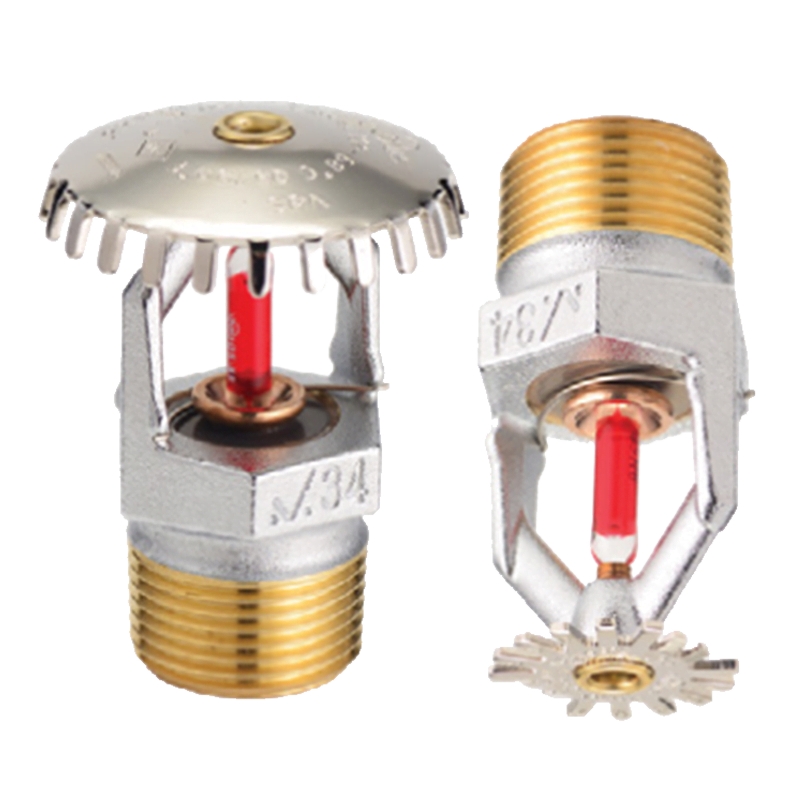
- Upright: TY3151 (K5.6, ½ in. NPT) and TY4151 (K8.0, ¾ in. NPT), for exposed piping.
- Pendent and recessed pendent: TY3251 (K5.6) with the Style 10 recessed escutcheon, and TY4251 (K8.0) with the Style 40. The escutcheons give ½ in. of recessed adjustment and up to ¾ in. of total adjustment.
When K8.0?
The K-factor comes from the hydraulic calculation. TY4851 and TY4951 are K8.0 heads with ½ in. threads. The datasheet states they are for retrofit in existing systems only, because NFPA 13 does not permit ½ in. NPT sprinklers with a K-factor above 5.6 in new construction.
Ratings run from 135°F to 360°F (57°C to 182°C), with polyester and wax corrosion-resistant finishes on some models. Approvals vary: TY4251 at 175°F (79°C) is not FM Approved, so check the table when FM is specified.
Architectural ceilings: Royal Flush II TY3531 or TY3551?
Where the architect wants no visible heads, the RFII (Royal Flush II) concealed pendent hides behind a flat cover plate that drops away in a fire. TYCO’s product page classifies it for light and ordinary hazard, with a K-factor of 5.6.
The two models differ in bulb and response. Per datasheet TFP181 (September 2026), TY3531 has a 3 mm bulb and is quick response under the UL and C-UL listings, while TY3551 has a 5 mm bulb and is standard response. As MeyerFire explains, NFPA 13 requires that where quick response sprinklers are installed, all sprinklers in the compartment be quick response, except where the standard permits otherwise. Do not mix the two models in one room without checking the edition adopted for the project.
- Maximum working pressure is 250 psi under UL and C-UL, and 175 psi under FM, VdS and LPCB.
- A 155°F (68°C) sprinkler pairs with a 139°F (59°C) cover plate, and a 200°F (93°C) sprinkler with a 165°F (74°C) plate. Only the listed, factory-finished plate may be used.
- Do not use it where the air pressure above the ceiling is higher than below, because downdrafts can delay operation. Coordinate with HVAC where the ceiling void is a plenum.
- An optional Air and Dust Seal is listed with TY3551 only.
Corridors: EC-8C or RFII-C?
In long, narrow corridors, a corridor sprinkler covers up to 28 ft × 10 ft (8.5 m × 3.1 m), so fewer heads are needed. AZEIDK offers two models, both quick response and UL Listed for light hazard:
| Item | EC-8C (TY4282) | RFII-C (TY3582) |
|---|---|---|
| Datasheet | TFP226 | TFP263 |
| Appearance | Pendent or recessed pendent | Concealed behind a flat cover plate |
| K-factor | 8.0 | 5.6 |
| Thread | ¾ in. NPT | ½ in. NPT |
| 28 ft × 8 ft (8.5 × 2.4 m) | 23 gpm at 8.3 psi | 23 gpm at 16.9 psi |
| 28 ft × 10 ft (8.5 × 3.1 m) | 28 gpm at 12.3 psi | 28 gpm at 25 psi |
| Maximum working pressure | 250 psi | 250 psi |
| Temperature ratings | 155°F and 200°F | 155°F and 200°F (plates 139°F and 165°F) |
The decision is appearance versus pressure. At the largest area, RFII-C needs 25 psi against 12.3 psi for EC-8C, which matters when the corridor is remote in the system or on an upper floor. If a recessed head is acceptable, EC-8C lowers the pressure; if the architect insists on a flat ceiling, choose RFII-C and confirm the pressure in the hydraulic calculations.
Conditions common to both
- Unobstructed, flat, smooth ceilings, including bar joists, with a pitch no steeper than 1 in 6.
- At least 12 ft (3.7 m) between sprinklers in the 28 ft throw direction, to prevent cold soldering.
- Never point one sprinkler’s short throw towards the short throw of another corridor sprinkler.
MRI rooms: RFII-MRI TY3537
RFII-MRI is a non-magnetic concealed sprinkler. Datasheet TFP262 states it is acceptable in a static magnetic field of 7 Tesla or less, based on non-clinical testing to ASTM F2052-15. It is fitted at the room ceiling near the scanner, never inside the scanner or its bore.
It is quick response, K5.6, extended coverage, and UL and C-UL Listed for light hazard. The datasheet gives:
- 16 ft × 16 ft: 26 gpm at 21.6 psi.
- 18 ft × 18 ft: 33 gpm at 34.7 psi.
- 20 ft × 20 ft: 40 gpm at 51 psi.
Maximum working pressure is 175 psi, with 155°F and 200°F ratings. Coordinate locations and pipe routes with the MRI supplier from the design stage. For healthcare requirements in general, see our guide to hospital fire protection.
Freezers and cold rooms: Series DS-1 dry sprinklers
In a DS-1 dry sprinkler, water is held back by a plug at the inlet while a dry barrel extends into the freezer. Datasheet TFP500 (January 2025) covers use on dry pipe systems and on wet pipe systems protecting unheated areas such as freezers.
Choosing the orientation
- TY3255 pendent: drops through the freezer ceiling from a branch line in a heated space above.
- TY3155 upright: where an upright deflector is needed.
- TY3355 horizontal sidewall: passes through a wall from a heated space into the cold one. The datasheet limits some of its listings to light hazard, or to light and ordinary hazard.
What defines the order
- Exposed barrel length: for wet pipe systems, a datasheet table gives a recommended minimum based on the heated-area temperature at the fitting and the cold-side temperature, from 0 to 20 in.
- Order length: measured on site and rounded to the nearest ¼ in. UL, C-UL and FM listings are limited to a 48 in. maximum.
- Fitting: 1 in. NPT into the outlet of a threaded tee to ANSI B16.3 Class 150 or B16.4 Class 125. Never into an elbow, where the inlet can contact the fitting wall.
- Pressure and temperature: 175 psi maximum working pressure; ratings from 155°F to 360°F (68°C to 182°C).
The designer identifies every space in the project that may fall to freezing temperatures and checks the site’s minimum design temperature. See cold storage fire protection and the comparison of wet and dry systems.
Common mistakes when selecting TYCO sprinklers
- Exceeding a corridor sprinkler’s listed area (28 ft × 10 ft per head), or using it outside light hazard.
- Specifying TY4851 or TY4951 on a new project; they are for existing systems only.
- Mixing TY3531 and TY3551 in one compartment without checking response requirements.
- Installing a concealed sprinkler where the ceiling void is at a higher pressure than the room.
- Ordering DS-1 sprinklers to estimated lengths before site measurement, or installing them in elbows.
How AZEIDK helps with TYCO selection
Our technical selection service matches each space to the right TYCO model and prepares the submittal with official datasheets. All six models are in AZEIDK products.
FAQ
Which TYCO sprinkler suits hotel corridors?
EC-8C (recessed) or RFII-C (concealed), provided the corridor is light hazard with a flat, smooth ceiling no steeper than 1 in 6. Both cover up to 28 ft × 10 ft; they differ in appearance and required pressure.
Can TY4951 be used on a new project?
No. The datasheet limits it to retrofit in existing systems, because NFPA 13 does not allow ½ in. NPT sprinklers above K5.6 in new construction. TY4251 with a ¾ in. thread is the alternative.
Is RFII-MRI installed inside the scanner?
No. It goes at the ceiling of the scanner room near the unit and is acceptable up to a 7 Tesla static field, but it is not intended for installation inside the scanner or its bore.
Why is each dry sprinkler ordered to its own length?
Each DS-1 is supplied to an order length based on the fitting-to-surface distance and the exposed length the temperatures require. The datasheet states that sprinklers must not be altered after leaving the factory and that modified sprinklers must be replaced.
Conclusion
Selecting TYCO sprinklers is a decision made space by space: TY-B for general areas, Royal Flush II for architectural ceilings, EC-8C or RFII-C for corridors, RFII-MRI for MRI rooms and DS-1 for freezers. Applying each model’s datasheet limits at design stage costs far less than finding them at submittal review or handover.
Does your project combine corridors, architectural ceilings and special rooms? Send us the drawings and hazard classification, and we will propose the right TYCO model for each space, with datasheets and approvals. Contact the AZEIDK team