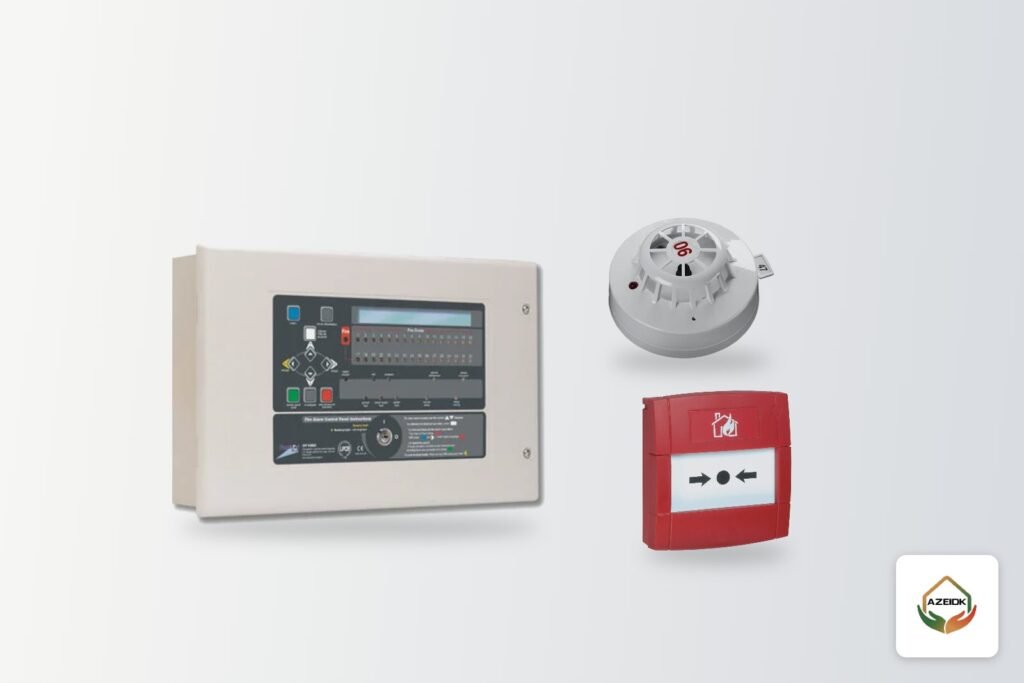
A fire system maintenance contract for government buildings differs from a commercial one in two ways: the building runs and receives visitors all day, and the entity holds the contractor to written reports and records it can audit at any time. This guide covers scope, scheduling visits without disrupting service, and the records the entity must keep.
AZEIDK provides preventive and periodic maintenance contracts for fire and alarm systems in the government entities sector.
Key takeaways
- The fire contract covers alarm, fire fighting, pumps, extinguishers and related systems; CCTV and low current are a separate contract.
- Tests that sound the alarm are scheduled outside visitor hours or with prior coordination.
- Any impairment during maintenance is notified in advance with interim protection.
- NFPA 25 and NFPA 72 set inspection and test intervals; the report after each visit is what the entity audits.
- Records belong to the entity and are handed over in full when the contract ends.
In this article
- What a fire system maintenance contract for government buildings covers
- Baseline survey at contract start
- Scheduling visits in an occupied building
- Impairments and interim protection
- Inspection and test intervals
- Reports and records kept by the entity
- Response times, spare parts and penalties
- Etimad tenders and contractor documents
- End of contract and handover to a new contractor
- Common mistakes
- Frequently asked questions
- Conclusion
What a fire system maintenance contract for government buildings covers
At AZEIDK one safety maintenance contract covers fire, safety and alarm systems; CCTV, access control, networks and intercom sit in a separate low-current contract. This keeps responsibility clear.
| System | Examples of work |
|---|---|
| Fire alarm | Detector, call point and sounder tests; panel and battery checks; interface tests with lifts, HVAC and doors |
| Sprinklers and hose cabinets | Valve position checks, main drain test, hose and cabinet checks |
| Fire pumps | Routine runs, controller and pressure checks, jockey and diesel pump follow-up |
| Gas suppression in server rooms and archives | Cylinder pressure checks, release panel and logic tests without discharge |
| Fire extinguishers | Monthly checks and periodic servicing by AZEIDK’s maintenance team |
| Emergency lighting and exit signs | Where included in scope |
For what any maintenance contract should contain, see fire system maintenance contracts in Saudi Arabia; this article focuses on what a government building adds.
Baseline survey at contract start
Many government buildings are old and have had several maintenance contractors. A good contract starts with a baseline survey of each system before taking over: faulty or isolated detectors, partly closed valves, gas cylinder pressures, pumps, batteries and expired extinguishers. The report tells the entity what routine maintenance covers and what needs separate repair orders, and protects the contractor from inheriting old faults. See assessment of existing systems.
Scheduling visits in an occupied building
- Run alarm-sounding tests early morning before visitors arrive or after hours.
- Split detector testing by floor across several visits.
- Notify security and building management before every test, with a PA announcement where available.
- Use work permits for server rooms and archives, with an escort if required.
Impairments and interim protection
A repair may need a valve closed or a panel isolated. In a government building this never happens without the entity knowing: the safety officer is told in writing, a return time is set, interim measures such as patrols or extra extinguishers are put in place, and the return to service is tested and recorded. See corrective maintenance and technical support.
Inspection and test intervals
The usual technical references are NFPA 25 for water-based systems and NFPA 72 for fire alarm, together with manufacturer instructions and the authority’s requirements. Examples, as summarised by QRFS, NFSA and Inspect Point (check the edition adopted in the specification):
| Item | Action | Interval |
|---|---|---|
| Electrically supervised control valve | Inspect position and condition | Quarterly (NFPA 25) |
| Control valves | Operate through full range | Annually (NFPA 25) |
| Main drain | Test and compare with previous | Annually (NFPA 25) |
| Smoke detectors | Functional test | Annually (NFPA 72) |
| Smoke detector sensitivity | Sensitivity test | First year, then every alternate year (NFPA 72) |
| Control panel and notification appliances | Test | Annually (NFPA 72) |
Full schedule: fire protection maintenance checklist.
Reports and records kept by the entity
After each visit a report lists the systems checked, test results, faults, repairs and items needing parts or approval. NFPA 72 says inspection and test records are kept until the next test of the same kind plus one year, and original system documents for the life of the system. The same records are requested at Civil Defense inspection and licence renewal; see fire safety log book and records. An asset register of every device and location, updated on replacement, is worth including.
Response times, spare parts and penalties
The service level agreement sets emergency and routine response times, repair times and delay penalties; see SLA in fire system maintenance contracts. The contract should state whether spare parts are included or quoted separately, and that replacements are compatible and approved.
Etimad tenders and contractor documents
Government maintenance contracts are usually tendered on Etimad; see Etimad fire system tenders. Our document library holds the annual maintenance contracts file and the company profile. AZEIDK holds the Saudi Local Content certificate and ISO 9001, ISO 14001 and ISO 45001 certificates whose scope includes preventive and corrective maintenance of fire fighting and fire alarm systems.
End of contract and handover to a new contractor
When the contract ends or is awarded to a new contractor, the outgoing contractor hands the entity the latest report for each system, the open faults log, the updated asset register, a copy of the alarm panel program and the panel passwords. This avoids a gap with no one following the systems, and lets the new contractor start from a documented baseline.
Common mistakes
- One contract mixing fire with CCTV and networks.
- Alarm tests at peak visitor time without notice.
- Generic “checked, system OK” reports without results.
- No copy of the alarm panel program held by the entity.
- Records not handed to the next contractor.
Frequently asked questions
Does the fire maintenance contract cover CCTV?
Not at AZEIDK. CCTV, access control and networks have a separate low-current contract.
When are alarm tests done in a government building?
Before visitor hours or after hours, coordinated with security and building management, floor by floor.
How often are smoke detectors tested?
Functional test annually under NFPA 72; sensitivity in the first year, then every alternate year, unless shorter intervals apply.
What if part of the system is out of service during maintenance?
The safety officer is notified in writing, interim protection is set, and return to service is tested and recorded.
Does AZEIDK maintenance include extinguishers?
Yes, AZEIDK’s maintenance team services fire extinguishers within maintenance contracts.
Who owns maintenance records at contract end?
The entity; they are handed over in full because inspections and licence renewals need them.
Conclusion
A good maintenance contract for a government building defines scope clearly, schedules visits around visitor hours, controls impairments, and produces reports and records the entity can show at any inspection.
Preparing a fire maintenance tender for a government building? Send the system list and area, and we will propose scope and visit schedule. Talk to the AZEIDK team
Related guides
- ISO Certification for Fire and Security Contractors: What ISO 9001, ISO 14001 and ISO 45001 Mean and How to Verify Them
- Voice Evacuation Commissioning: PA Zoning, Wiring and STI Testing
- Fire Systems Cost in Saudi Arabia: What Drives the Price
- Safety Companies in Saudi Arabia: Types and How to Verify an Approved Safety Establishment