Data center fire systems maintenance differs from maintaining an office building in one key way: the facility does not stop while you work. The technician tests detectors, hold and abort switches and a release panel connected to gas cylinders and to the power shutdown for the servers, and an isolation mistake before testing can mean an agent discharge or an outage. The maintenance plan is therefore written as an operating procedure agreed with the IT team, not just a routine inspection visit.
For what any contract should cover before you sign, see our fire system maintenance contract guide for Saudi Arabia.
This guide explains what a data center fire systems maintenance contract covers: fire alarm, clean agent suppression, sprinklers and pre-action systems, room integrity, and interfaces with HVAC and power, together with what NFPA 2001 says about cylinder checks. AZEIDK delivers this through its preventive and periodic maintenance contracts and corrective maintenance and technical support for the data centers and server rooms sector.
Key points
- The fire systems contract covers alarm, gas suppression, sprinklers and related equipment; CCTV and access control sit in a separate low current maintenance contract.
- Per NFPA 2001 (2015 edition, as summarised by Koorsen), agent quantity and container pressure are checked at least twice a year.
- A liquefied halocarbon container is refilled or replaced if it loses more than 5% of agent or more than 10% of pressure.
- The protected enclosure is inspected at least annually, unless a documented administrative control program covers barrier changes.
- Before any test, release outputs and power and HVAC interfaces are isolated under a permit agreed with the operator.
In this article
- What a data center fire maintenance contract covers
- Clean agent maintenance under NFPA 2001
- Room integrity: the item that changes with every expansion
- Data center fire systems maintenance without downtime: step by step
- Smoke detectors in data halls
- What to write into the contract
- Fire contract separate from CCTV and access control
- Frequently asked questions
- Summary
What a data center fire maintenance contract covers
| System | What is checked | Data center specific point |
|---|---|---|
| Fire alarm | Panel, detectors, call points, sounders, batteries | Detectors below raised floors and above ceilings |
| Gas release panel | First and second stage alarms, hold and abort switches, release timer | Tested only after the release output is isolated |
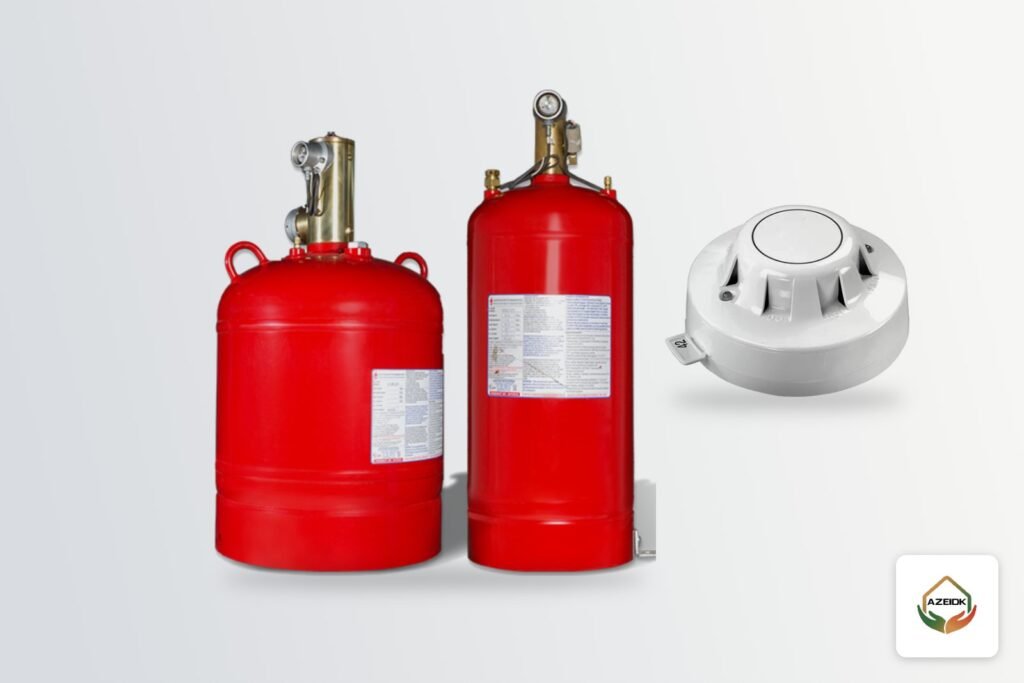
| Clean agent cylinders | Quantity and pressure, hoses, solenoids, nozzles | Results recorded on each cylinder tag |
| Room integrity | New openings and penetrations in walls, ceiling and floor | Every new cable run can open a leak |
| Sprinklers or pre-action | Valves, supervisory switches, air pressure, sprinklers | Coordinate before any flow test |
| Interfaces | HVAC shutdown, power disconnect, control room signals | Signal tested without actual shutdown unless the operator approves |
| Extinguishers | Pressure, date and location | Units suitable for electrical equipment near racks |
Clean agent maintenance under NFPA 2001
NFPA 2001 is the technical reference for maintaining clean agent systems such as FM-200 and FK-5-1-12. As summarised by Koorsen from the 2015 edition:
- At least twice a year: check agent quantity and container pressure on all systems.
- Replacement limits: for liquefied halocarbon agents with a pressure indicator, refill or replace on a loss of more than 5% of agent or more than 10% of pressure; for inert gases, more than 5% pressure loss after temperature correction.
- Annually: visual inspection of hoses, and inspection of the protected enclosure unless a documented administrative control program is in place.
- Every 5 years: complete external visual inspection of containers in continuous service, and hydrostatic testing of hoses.
- Records: a tag on each container after every inspection, with inspection reports kept for the life of the system.
Details follow the edition named for the project and the manufacturer’s manual. For FM-200 specifically see our article on FM-200 system maintenance, and for commissioning see FM-200 testing procedure.
Room integrity: the item that changes with every expansion
Server rooms change constantly: new racks, cables through walls, extra cooling openings, a replaced door. Each change can open a path for agent to leak after discharge, dropping the concentration before the required hold time ends. That is why NFPA 2001 requires an annual enclosure inspection, or a documented administrative program that prevents unsealed penetrations and records every change.
Where the visual inspection finds major changes, or after large expansion works, consider repeating the room integrity test to confirm the room still holds the agent.
Data center fire systems maintenance without downtime: step by step
- Permit to work: agree the visit time, test scope and systems to be isolated with the facility manager and IT team.
- Notify the control room and linked parties: so test signals are not treated as a real fire.
- Isolate the release: disconnect the cylinder actuation output or fit the isolation means specified in the system manual, and verify it before touching any detector.
- Isolate critical interfaces: power disconnect and HVAC shutdown are tested up to the signal point; actual shutdown only with the operator’s written approval.
- Test: ceiling and underfloor detectors, first and second stage alarms, hold and abort switches and the release timer.
- Return to service: reconnect release and interfaces and confirm the panel is fault-free before leaving site.
- Report: results per item, faults, recommendations and updated cylinder records.
Our article on the gas suppression release sequence explains the alarm stages and hold and abort switches tested on these visits.
Smoke detectors in data halls
Strong airflow from cooling units carries dust onto detectors, and underfloor detectors are hard to reach. Plan them into the visit schedule, with floor tiles lifted in coordination with the operator. Detector sensitivity testing and cleaning follow NFPA 72 and the manufacturer’s instructions, as explained in our article on smoke detector sensitivity testing and cleaning.
What to write into the contract
- Systems and rooms: each gas-protected room with its cylinder count and agent, and every alarm and release panel.
- Visit schedule: periodic visits and what each covers, including semiannual and annual checks.
- Isolation procedure: who signs the permit for the operator, and what is isolated on each visit.
- Emergency calls: how faults are reported and the agreed response time.
- After a discharge: refill and return-to-service steps, and who handles cylinder transport.
- Reports: the report format after each visit and how cylinder records are kept.
Fire contract separate from CCTV and access control
In a data center the systems overlap on site, but maintenance contracts are not combined. The fire systems contract covers alarm, suppression, sprinklers, extinguishers and their interfaces; CCTV, access control and networks go into a separate low current maintenance contract. This keeps responsibility, technician qualifications, spare parts and response times clear for each group. For cameras, see our article on CCTV maintenance.
Frequently asked questions
How often are FM-200 cylinders checked in a server room?
Under NFPA 2001 (2015 edition, as summarised by Koorsen), agent quantity and pressure are checked at least twice a year, with annual hose and enclosure inspections and an external container inspection every 5 years.
Can a gas suppression system be maintained while servers run?
Yes, provided the release output and power disconnect signals are isolated under an agreed permit before testing, and the system is returned to service and verified afterwards.
When must a clean agent cylinder be replaced?
For halocarbon agents with a pressure indicator: on a loss of more than 5% of agent or more than 10% of pressure, per NFPA 2001 (2015 edition).
Must the room integrity test be repeated every year?
NFPA 2001 (2015 edition) requires at least an annual enclosure inspection unless a documented administrative program exists; a repeat fan test is considered after major changes.
Does the fire maintenance contract include CCTV?
No. CCTV, access control and networks are covered by a separate low current maintenance contract.
What does the maintenance report contain?
Results for each system, cylinder readings, faults and recommendations, what was isolated and returned to service, and updated cylinder records.
Summary
Data center fire systems maintenance works when it combines a clear schedule based on NFPA 2001 and NFPA 72, a written isolation procedure that protects operations, room integrity follow-up after every expansion, and a clean split between the fire contract and the low current contract.
Need a fire systems maintenance contract for a data center or server room? Send us your list of systems, rooms and gas cylinders, and we will prepare a suitable visit scope and reporting plan. Contact the AZEIDK team
Related guides
- Fire Protection and Safety Companies in Dammam and Al Khobar: A Practical Guide
- Fire Protection Check Valves Compared: AFC, Shurjoint and United Brass Works by Type, Size and Approval
- Fire Protection Piping and Fittings: Selection and Installation Guide for Saudi Projects
- Cinema Fire Safety: Voice Evacuation, Smoke Control and Alarms for Dark Auditoriums