A fire alarm system for fuel stations is a stated requirement in Saudi Arabia’s Fuel Stations and Service Centers Requirements (1445 AH), which call for a fire alarm system inside the station in line with Chapter 9 of the Saudi Fire Protection Code (SBC 801). The system covers the buildings, not the open forecourt: the convenience store, offices, electrical room, store room, restaurant, vehicle service bays and the mosque.
For how conventional and addressable systems compare, see our guide to choosing a fire alarm system for Saudi projects.
This guide explains where detectors and call points go in each building, when a conventional panel is enough and when an addressable one pays off, and what an owner should check before handover. It complements our article on fuel station safety requirements, which covers extinguishers, foam and Salamah licensing.
Key takeaways
- The requirements (clause 4.7.1) call for a fire alarm system inside the station and an approved fire suppression system, both per Chapter 9 of SBC 801.
- Design comes from a fire protection engineering consultancy; installation is carried out by a contractor approved by Civil Defense.
- A fire alarm system is also required inside the station mosque.
- A small single-building station usually works well with a conventional panel; a multi-building service complex benefits from an addressable panel.
- Any device inside a classified hazardous area around dispensers and fill points must be suitable for that area.
In this article
- What do the requirements say about a fire alarm system for fuel stations?
- Where do detectors go in station buildings?
- Manual call points and sounders
- Conventional or addressable panel for a fuel station?
- Hazardous areas around dispensers and fill points
- Standby power and monitoring
- What should the owner check before handover?
- Common mistakes
- How AZEIDK helps
- FAQ
- Conclusion
What do the requirements say about a fire alarm system for fuel stations?
The reference document is the Fuel Stations and Service Centers Requirements issued by the Permanent Executive Committee for Service Centers and Fuel Stations and published by the Ministry of Municipalities and Housing. Its fire protection clause (4.7.1) requires protection systems to be designed by a fire protection engineering consultancy and installed by a Civil Defense approved contractor, with a fire alarm system inside the station and an approved suppression system, both per Chapter 9 of SBC 801.
The document does not set detector counts or panel types. Those come from the approved design, based on each building’s area and use, so the right starting point is the station’s architectural layout rather than a ready-made quotation.
Where do detectors go in station buildings?
| Building or room | Typical device | Design note |
|---|---|---|
| Convenience store | Smoke detectors, call points at exits, sounders | High shelving and false ceilings affect layout |
| Offices and cashier room | Smoke detectors | Small rooms full of equipment and paper |
| Electrical room | Smoke detector | Electrical fires usually start with smoke |
| Restaurant or cafe kitchen | Heat detector | Smoke detectors in kitchens cause false alarms |
| Oil change and tyre bays | Usually heat detectors, per design | Exhaust fumes and dust affect smoke detectors |
| Store room | Smoke or heat, per contents and height | Stored oils and combustibles raise the hazard |
| Mosque | Smoke detectors and call point | Explicitly required |
The open forecourt under the canopy is not normally covered by smoke detectors, because smoke disperses outdoors. Protection there relies on extinguishers, emergency electrical disconnects and dispenser shut-off valves, as the requirements set out.
Manual call points and sounders
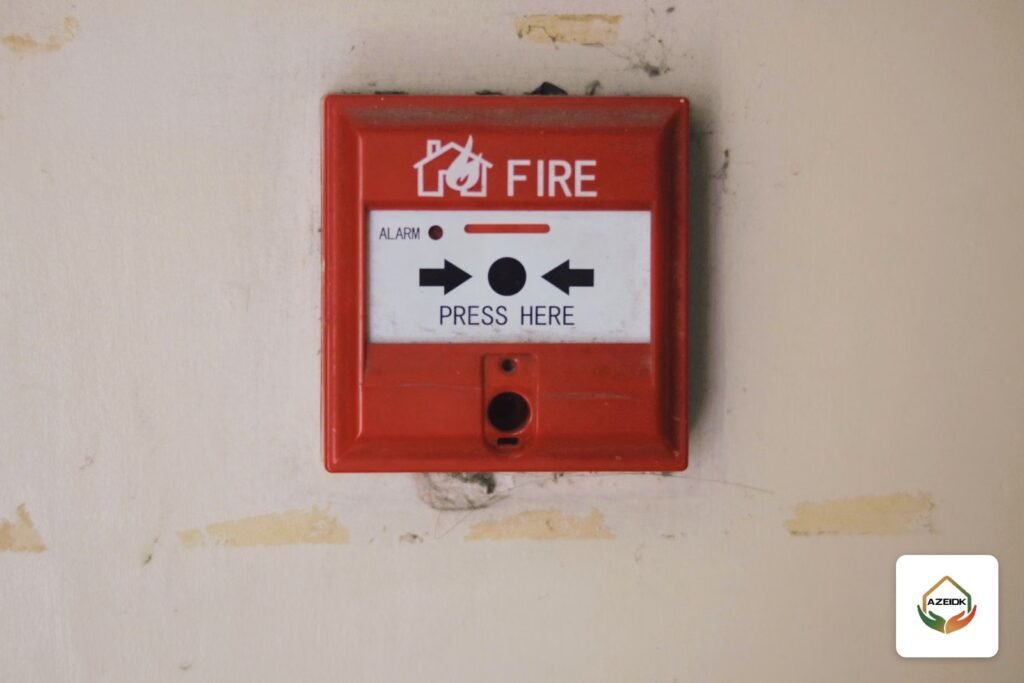
Manual call points sit at building exits and along escape routes. At a fuel station the attendant is usually the first to see a fire, and the requirements include training staff to raise internal and external alarms. Sounders and strobes are laid out so they are heard in every building; strobes are added in the store and restaurant per the design.
Conventional or addressable panel for a fuel station?
Conventional
The building is split into zones and the panel shows the zone, not the device. This suits a small station with a store, office and electrical room. AZEIDK supplies Context Plus FP conventional panels.
Addressable
Every device has an address, so the panel names the exact room and device. This suits service complexes with a store, restaurants, a mosque and service bays, and input/output modules can link the panel to other systems such as the kitchen suppression release signal. See our addressable fire alarm comparison.
| Item | Small station | Service complex |
|---|---|---|
| Buildings | One or two | Several separate buildings |
| Usual panel | Conventional | Addressable |
| Alarm location | By zone | By device and room |
| Interfaces | Limited | Easier through I/O modules |
Hazardous areas around dispensers and fill points
The area around dispensers and tank fill points can be classified as hazardous because of fuel vapour. Any electrical device inside it, alarm devices included, must suit the area classification. Setting the boundaries is the designer’s job under the project’s references, such as NFPA 30A for motor fuel dispensing facilities. See our article on explosion-proof smoke detectors. In practice, keep standard devices out of the dispenser area, and where the drawing places one inside it, ask for a model rated for that area with its datasheet.
Standby power and monitoring
The panel runs on standby batteries during a power cut, sized in the design. Routing alarm and fault signals to the supervisor’s office or CCTV room helps a station that runs shifts with few staff. Since the requirements call for colour CCTV covering the whole station, having the monitor and the alarm in one place speeds up response. See CCTV for petrol stations.
What should the owner check before handover?
- Shop drawings that match the approved design and cover every building, including the mosque.
- Datasheets for every device and panel.
- Commissioning tests of every detector, call point and sounder, with recorded results.
- The safety equipment installation certificate as part of the Civil Defense approval file.
- Staff training on reading the panel, silencing and resetting.
- A maintenance schedule, since the requirements call for monthly checks and periodic tests of all fire protection systems, with records kept.
Common mistakes
- Covering the store only and forgetting the electrical room, store room and mosque.
- Smoke detectors in the restaurant kitchen, causing repeated false alarms until staff disable them.
- Adding a restaurant or service bay after opening without extending the system and updating the drawings.
- A panel in a locked store room where nobody sees alarms or faults.
- No monthly inspection log, although the requirements call for inspection and maintenance records to be kept for at least three years.
How AZEIDK helps
AZEIDK supplies conventional and addressable fire alarm systems from Context Plus and handles supply, installation, programming and testing, including the safety equipment installation certificate. See the full sector offer on our fuel stations page.
FAQ
Is a fire alarm system mandatory at a fuel station?
Yes. The Fuel Stations and Service Centers Requirements call for a fire alarm system inside the station per Chapter 9 of SBC 801.
Are smoke detectors installed above the dispensers?
Usually not, because the forecourt is open and smoke disperses. Protection there relies on extinguishers and emergency disconnects; the designer decides on any extra device.
Does the station mosque need a fire alarm?
Yes, the requirements call for a fire alarm system inside the mosque.
How much does a fuel station fire alarm system cost?
It depends on the number of buildings and devices, the panel type and the wiring. Send us the layout and we will price it item by item.
Who designs the station’s fire alarm system?
The requirements state that a fire protection engineering consultancy designs it and a Civil Defense approved contractor installs it.
Which detector suits the station restaurant kitchen?
A heat detector is the usual choice, because cooking fumes cause false alarms on smoke detectors.
Conclusion
A fuel station fire alarm protects the buildings where people work, shop and pray, and it is an explicit requirement. List the buildings and rooms, size the panel to the station, keep standard devices away from the dispensers, and set up maintenance and records from day one.
Building or upgrading a fuel station? Send us the layout and building list, and we will propose the right system with quantities and datasheets. Contact AZEIDK
Related guides
- CCTV Cameras (Security Surveillance Cameras): A Guide to Types, Resolution, Night Vision, Storage and the Saudi Law
- Hikvision Camera Activation with SADP: Password, IP and Detection Fixes
- How to Stop a Fire Alarm Safely: Silence vs Reset and What to Do Before Silencing the Bell
- Fire Blanket: When to Use It, Where to Mount It in Kitchens and Facilities, and How It Differs From an Extinguisher