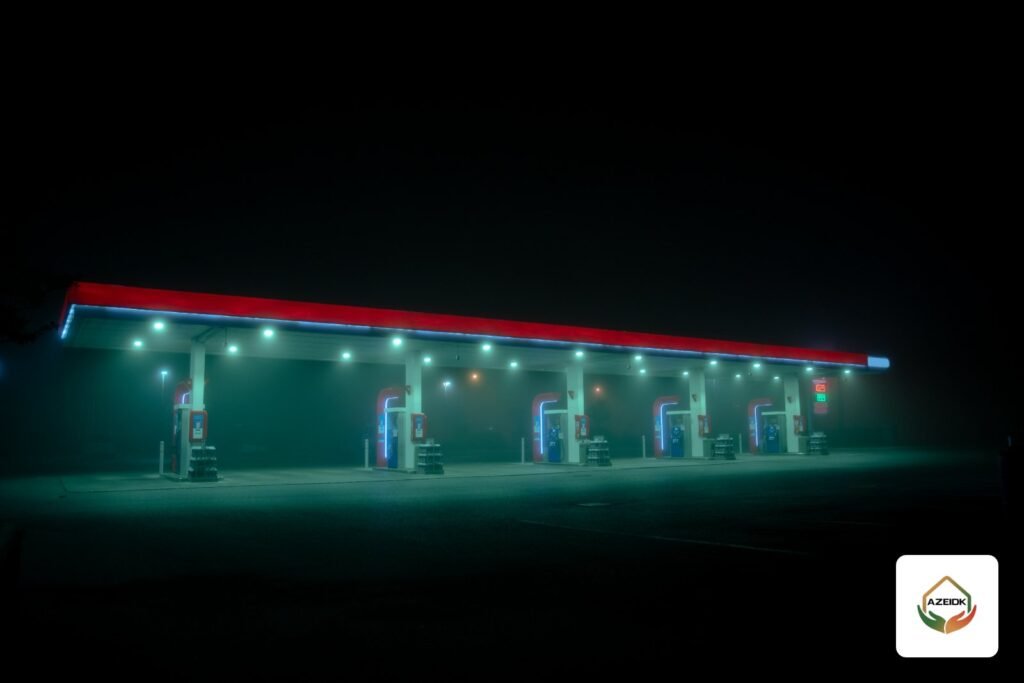
CCTV for petrol stations in Saudi Arabia is a regulatory obligation, not an optional extra. The Executive Regulation of the Security Surveillance Cameras Law requires fuel stations to be covered so that the cameras capture the fuel pumps, tanks and surrounding areas, and the Fuel Stations and Service Centers Requirements call for a CCTV system covering the whole station, with central monitoring and off-site backup storage. This article explains what both documents say, how to place cameras across the pumps, the store and the entrances, and where licence plate recognition cameras earn their place.
For camera types, resolution, night vision and storage, see our CCTV cameras guide for Saudi Arabia.
Key takeaways
- Article 2 of the Executive Regulation of the Security Surveillance Cameras Law lists fuel stations, with coverage of the fuel pumps, tanks and surrounding areas, among the sites cameras must cover.
- Clause 4.8.1 of the Fuel Stations and Service Centers Requirements (1445 AH / 2023) requires central monitoring from head office, backup storage outside the station, cameras covering the entire station and service centers, and color images.
- Licensing authorities may not issue or renew a licence without the certificate confirming the camera installation requirements are met (Article 4 of the Regulation).
- The recording retention period and minimum technical specifications are set by the specifications document linked to the Regulation.
- Any fault that stops the cameras must be reported immediately through the electronic platform and fixed as quickly as possible (Article 3).
In this article
- What are the CCTV requirements for petrol stations in Saudi Arabia?
- Camera layout by zone
- Forecourt cameras: lighting, color and safety
- Licence plate recognition at petrol stations: when is it worth it?
- Recording, storage and central monitoring
- Maintenance and the compliance certificate
- How to start a station CCTV project
- Frequently asked questions
- Conclusion
What are the CCTV requirements for petrol stations in Saudi Arabia?
Two documents govern the subject. The first is the Security Surveillance Cameras Law issued by Royal Decree No. (M/34) dated 7/3/1444 AH, and its Executive Regulation published in Umm Al-Qura on 20/11/1444 AH (9 June 2023). Article 2 of the Regulation lists the sites cameras must cover, including entrances, warehouses, emergency exits, parking entrances and exits, gas cylinder rooms, and fuel stations so that the cameras cover the fuel pumps, tanks and surrounding areas.
The second is the Fuel Stations and Service Centers Requirements issued by the Permanent Executive Committee for Service Centers and Fuel Stations (1445 AH / 2023). Under the security requirements, clause 4.8.1 calls for a central monitoring system at head office with backup storage outside the station site, linked to a CCTV system covering the entire fuel station and service centers, with images displayed in color, and compliance with the authorities’ directives on connecting surveillance systems.
We cover the general obligations on all facilities in our article on the Saudi security cameras law and its obligations. Here we apply them to the station itself.
Camera layout by zone
A station is not one space. Each zone records for a different purpose, so camera type and angle differ. The table summarizes a typical layout; the final design follows the station plan and the specifications document.
| Zone | What the recording must show | Design notes |
|---|---|---|
| Pump islands (forecourt) | Each dispenser, the vehicle, attendant and customer movement | Named in the Regulation; cover each pump row from both sides and watch for canopy light glare at night |
| Tanks and fill points | Tanker offloading area and underground tank fill points | Named in the Regulation; record the full offloading process |
| Convenience store | Entrance, point of sale and cash counter, aisles, stockroom | Entrance camera at face height and one over the point of sale |
| Site entrances and exits | Vehicles entering and leaving | The right place for a plate recognition camera if required |
| Service centers | Car wash, oil change, tyres, attached shops | The station requirements call for full coverage of service centers |
| Gas cylinder rooms, if any | Room door and handling area | Listed among the Article 2 sites |
For camera counts, coverage angles and identification distances, see our CCTV coverage article.
Forecourt cameras: lighting, color and safety
The pump area sits under a brightly lit canopy while the street behind it is dark at night. Standard cameras struggle with that contrast. The answer is wide dynamic range (WDR) cameras, positioned so they do not face the floodlights directly.
The color image condition in clause 4.8.1 means cameras that switch to black and white in low light need a second look at design stage. Full-color night technologies such as Hikvision ColorVu help here; we compare them with Starlight in our night vision CCTV article.
A key safety point: the area around fuel dispensers may be a classified hazardous area because of fuel vapors, and the common technical reference for these facilities is NFPA 30A. Any electrical device installed inside a classified area must suit that classification. We therefore fix camera positions and cable routes with the consultant once the classified area boundaries are known; the usual approach is to mount cameras on canopy columns or the building, outside those boundaries.
Licence plate recognition at petrol stations: when is it worth it?
Plate recognition cameras (ANPR/LPR) capture the plate number as searchable text, not just an image. At a station they help document vehicles that drive off without paying and let staff search recordings by plate instead of scrolling through hours of video.
We found no clause in either document that specifically requires plate recognition, so it is an operational choice for the owner. Its success depends on installation: a dedicated camera, a narrow angle on the vehicle path at the entrance or exit, a suitable shutter speed and infrared illumination for plates at night. A general wide-angle camera over the pumps will not read plates reliably.
AZEIDK supplies Hikvision and Dahua cameras and recorders as part of its security and surveillance solutions, and the right plate recognition model is selected after surveying the vehicle path. For smart analytics such as line crossing or loitering detection, see our AI CCTV cameras article.
Recording, storage and central monitoring
The Regulation ties the retention period to the specifications document, and after a security incident recordings are kept until the investigation ends or for that period, whichever is longer (Article 6). Recordings are released only on a formal request from the competent authorities.
Article 3 requires storage media dedicated to the camera system only, any connection to other networks to be approved by the Ministry and to follow National Cybersecurity Authority controls, and access limited to authorized persons with their entry and exit logged. With the off-site backup condition in the station requirements, network capacity between the station and head office has to be planned from day one.
Storage depends on camera count, resolution, frame rate, compression and retention. Use our CCTV storage calculator and read the NVR storage and bandwidth calculation article.
Maintenance and the compliance certificate
A station runs around the clock, and dust, heat and vibration all affect outdoor cameras. Article 3 requires any fault that stops the devices to be reported immediately through the Directorate’s electronic platform and fixed as quickly as possible. Owners therefore need a routine maintenance program: lens cleaning, angle and focus checks, confirming continuous recording and correct time, and disk health checks.
Remember that Article 4 bars issuing or renewing a licence without the installation compliance certificate. A missing camera on the tanks or a recording fault can hold up a licence renewal.
How to start a station CCTV project
- Survey the site and map the pumps, tanks, store, service centers and entrances, through our technical site inspection and assessment service.
- Review the current specifications document and the station requirements with the owner.
- Set camera numbers, types and positions outside classified areas, plus plate cameras if required.
- Design storage, the head office link and the backup.
- Supply, install and program, then hand over with clear documents and a maintenance program.
Frequently asked questions
Is CCTV mandatory at petrol stations in Saudi Arabia?
Yes. The Executive Regulation of the Security Surveillance Cameras Law lists fuel stations, with coverage of the fuel pumps, tanks and surrounding areas, among the sites that must be covered.
What do the fuel station requirements say about CCTV?
Clause 4.8.1 requires central monitoring from head office, backup storage outside the station, cameras covering the whole station and service centers, and color images.
How long must petrol station CCTV footage be kept?
The specifications document linked to the Regulation sets the period; after a security incident footage is kept until the investigation ends or for that period, whichever is longer.
Is licence plate recognition required at the station?
We found no clause requiring it in either document, but it is useful for documenting drive-offs and needs a dedicated camera at the entrance or exit.
Can cameras be mounted directly over the dispensers?
That depends on the hazardous area classification around the dispensers. The consultant defines its limits; cameras are best placed outside them or must be suitable for the classification.
Can a camera fault affect the station licence?
Article 4 links licensing and renewal to the compliance certificate, and Article 3 requires faults to be reported immediately and fixed quickly.
Conclusion
Petrol station CCTV starts from two clear texts: pump and tank coverage in the Executive Regulation, and full-station color coverage with central monitoring and off-site backup in the station requirements. Good design places cameras by the purpose of each zone, keeps them out of classified areas, plans storage and connectivity from the start, and keeps the system running with regular maintenance.
Fitting out a new station or renewing an existing licence? Send the station plan or photos and the AZEIDK team will prepare the camera layout and recording capacity under our security and surveillance solutions. Talk to the AZEIDK team
Related guides
- Metal Detectors for Facilities: Walk-Through Gates and Handheld Detectors, and Where Each Fits
- Flame Detectors (UV / IR / IR3) in Industrial Facilities
- Non-Magnetic Fire Sprinklers for MRI Rooms: Why You Need One and How to Coordinate Design and Installation with the Hospital
- Landlord and Tenant Responsibility for Fire Safety in Saudi Arabia