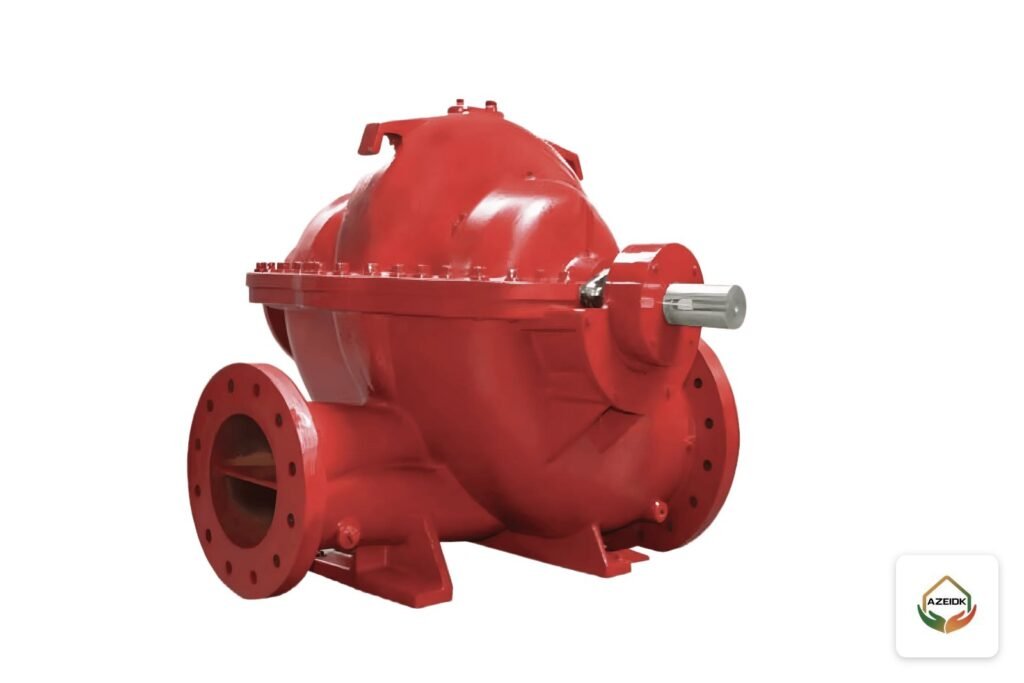
A 500 GPM fire pump is a pump rated to deliver 500 US gallons per minute (about 1,893 L/min) at a rated pressure set by the designer. It is one of the common rated capacities that technical references reproduce from NFPA 20, which run from 25 to 5,000 GPM. The right size comes from the largest water demand the designer calculates, not from the size most often quoted.
This guide covers 500 GPM fire pump specifications, sizes from 150 to 1,500 GPM, the 150%/65% rule and quotation checks. For available products, see the AZEIDK fire pumps category.
Key takeaways
- Technical references list common rated capacities from NFPA 20, including 150, 250, 300, 400, 500, 750, 1,000 and 1,500 GPM. 350 GPM is not among them.
- Rated net pressure is 40 psi or more and is chosen from the project’s hydraulic calculations.
- At 150% of rated flow, the pump must still deliver at least 65% of rated pressure, and churn pressure must sit between 101% and 140% of rated pressure.
- The system demand normally falls between 90% and 140% of the pump’s rated capacity and never above 150%.
- The jockey pump only maintains system pressure. It does not count toward firefighting capacity.
In this article
- What does a fire pump’s GPM rating mean?
- Fire pump capacity as per NFPA 20: commonly listed ratings
- The 150%/65% rule and the churn limit
- 500 GPM fire pump specifications: what to read on the datasheet
- What drives the capacity your project needs?
- Which size covers which demand? Operating range table
- The jockey pump: role and size
- The Saudi framework: SBC 801, Civil Defense and SABER
- What to ask for in a quotation
- Fire pumps from AZEIDK
- Frequently asked questions
- Conclusion
What does a fire pump’s GPM rating mean?
Every fire pump has a rated point: rated flow in US gallons per minute and rated net pressure in psi or bar. Net pressure is discharge minus suction pressure, the pressure the pump itself adds.
So “a 500 gallon pump” is not a full description. Two 500 GPM pumps can differ widely in pressure, power and price. A proper description reads: 500 GPM at 8 bar, plus pump type (end suction, split case or vertical turbine) and driver (electric or diesel).
Per the Hydraulic Institute, NFPA 20 ratings run from 25 to 5,000 GPM at net pressures of 40 psi (about 2.8 bar) or more.
Fire pump capacity as per NFPA 20: commonly listed ratings
The common rated capacities that technical references reproduce from the NFPA 20 capacity table are: 25, 50, 100, 150, 200, 250, 300, 400, 450, 500, 750, 1,000, 1,250, 1,500, 2,000, 2,500, 3,000, 3,500, 4,000, 4,500 and 5,000 GPM. The table below shows the sizes most often used in buildings, with metric conversions:
| Rated capacity (GPM) | L/min (approx.) | m³/h (approx.) | Flow at 150% (GPM) |
|---|---|---|---|
| 150 | 568 | 34.1 | 225 |
| 250 | 946 | 56.8 | 375 |
| 300 | 1,136 | 68.1 | 450 |
| 400 | 1,514 | 90.8 | 600 |
| 500 | 1,893 | 113.6 | 750 |
| 750 | 2,839 | 170.3 | 1,125 |
| 1,000 | 3,785 | 227.1 | 1,500 |
| 1,500 | 5,678 | 340.7 | 2,250 |
Conversions use 1 US gallon = 3.785 litres. Sizes from 50 to 350 GPM are ratings that are selected and sized for each project from its calculations. They are not stocked models.
The 150%/65% rule and the churn limit
A fire pump curve is checked at three points:
- Churn (shutoff): the pump runs with zero flow. Pressure must be between 101% and 140% of rated pressure.
- Rated point (100%): rated flow at rated pressure.
- Overload point (150%): at 150% of rated flow, pressure must not drop below 65% of rated pressure.
Illustrative arithmetic: a pump rated 500 GPM at 100 psi net must deliver at least 65 psi at 750 GPM, and its churn pressure must not exceed 140 psi. When checking valve and pipe ratings, add suction pressure to churn pressure. These figures only show the method, not values for a real project.
For the full step-by-step method, see Fire Pump Calculation: Flow, Pressure and the 150%/65% Curve.
500 GPM fire pump specifications: what to read on the datasheet
On any 500 GPM fire pump datasheet or submittal, check:
- The full rated point (flow and net pressure) and the performance curve with all three points.
- Pump type, suction and discharge sizes, and impeller diameter.
- Electric motor or diesel engine power, voltage and frequency.
- Listing status: UL listed or FM approved for that exact model, or non-listed.
- The controller for each pump, and the jockey pump supplied with the set.
An example from the products documented on the AZEIDK site: the 3PUMP 500 GPM at 8 bar package, model 3P 4×3-10.2. It is an end suction set with a 75 HP electric motor, a diesel pump with an 84 HP engine, and a 40 GPM at 8.5 bar jockey pump. This package is non-listed (Non-UL). UL or FM versions are available on request.
What drives the capacity your project needs?
The required capacity comes from the designer’s hydraulic calculations. Main inputs:
- Sprinkler demand: design density times design area for the hazard class, plus friction and elevation losses. Density rises from light to extra hazard.
- Hose stream allowance: NFPA 13 adds it to the sprinkler demand by hazard class. Technical references give combined inside and outside hose totals of typically 100, 250 and 500 GPM for light, ordinary and extra hazard; the designer checks them against the NFPA 13 edition adopted for the project. The designer decides which part passes through the pump.
- Standpipes and hose cabinets: As summarised by the NFSA, NFPA 14 uses 500 GPM for the most remote standpipe and 250 GPM for each additional one, up to 1,000 GPM in a fully sprinklered building and 1,250 GPM otherwise. The designer checks the edition adopted for the project.
- Largest single demand: the pump is sized on the largest single system it serves, not on the sum of all systems.
Once the demand is known, the designer picks a standard rating so that the demand falls between 90% and 140% of rated flow, as the NFPA 20 annex suggests, and never above 150%. The designer then confirms that the curve pressure at the demand flow exceeds the required pressure.
Which size covers which demand? Operating range table
Straight arithmetic for each size, for a first screen only. The hydraulic calculations and the manufacturer’s curve decide:
| Pump rating (GPM) | Preferred demand (90%–140%) | Maximum demand (150%) |
|---|---|---|
| 150 | 135–210 | 225 |
| 250 | 225–350 | 375 |
| 300 | 270–420 | 450 |
| 400 | 360–560 | 600 |
| 500 | 450–700 | 750 |
| 750 | 675–1,050 | 1,125 |
| 1,000 | 900–1,400 | 1,500 |
| 1,500 | 1,350–2,100 | 2,250 |
150 and 250 GPM fire pumps
These sizes suit a small calculated demand. No rule ties a building type to a fixed size: hazard class, height and standpipes all change the demand.
What about 350 GPM?
350 GPM does not appear in the commonly listed ratings. If the calculated demand is 350 GPM, it sits at 117% of a 300 GPM pump and 140% of a 250 GPM pump, both inside the preferred band if the pressure is adequate. On a 400 GPM pump the same demand is about 88% of rating, below 90%.
750 GPM, 1000 GPM and 1500 GPM fire pumps
These sizes usually come with multiple standpipes, extra hazard or large storage areas, and bring larger pump room pipework, drivers and fuel tanks.
The jockey pump: role and size
A jockey pump makes up minor leakage and holds system pressure so the main pump does not start on every small drop. It is not firefighting capacity. Common practice sizes it below the flow of a single sprinkler and able to make up allowable leakage in about 10 minutes.
In the documented 3PUMP packages the jockey pump is 30 to 40 GPM depending on the model. For start and stop settings, see our jockey pump article.
The Saudi framework: SBC 801, Civil Defense and SABER
In Saudi Arabia, the Saudi Fire Protection Code (SBC 801) sets the requirements for fire protection systems, fire pumps included. Its 2024 edition has been mandatory since 30 June 2025, and the General Directorate of Civil Defense oversees compliance. NFPA 20, 13 and 14 are technical references adopted through the design and project documents, not automatically binding on their own.
The SASO Technical Regulation for Fire Control Materials and Equipment covers fire pumps and requires a certificate of conformity before they are placed on the market. The certificate is issued through the SABER platform.
What to ask for in a quotation
Ask every supplier for the same information:
- Rated flow and rated net pressure, with the manufacturer’s certified performance curve.
- Pump type, casing and impeller materials, and seal type.
- Electric motor and/or diesel engine power, plus fuel tank and batteries for diesel.
- Controllers and starting method, and the jockey pump with its controller.
- UL or FM status for the exact model and size, and the SABER certificate of conformity.
- Scope of supply: baseplate, relief valve, test header or flow meter, and valves.
- Site acceptance testing, warranty period and spare parts availability.
For the factors that change the cost, read Fire Pump Price in Saudi Arabia.
Fire pumps from AZEIDK
The documented 3PUMP models on the AZEIDK site are those listed on its product page: 500 GPM at 8 bar, 750 GPM at 9 bar, 1,000 GPM at 10 bar and 1,500 GPM at 10 bar. All are non-listed end suction packages (electric + diesel + jockey), with UL or FM versions on request. Details are in our 3PUMP packages article.
AZEIDK also supplies UL listed Jack Pump end suction, split case and vertical turbine pumps, and WATEX pumps approved per model (UL and FM for the WE end suction series). Their capacities are sized per project. The AZEIDK engineering team reviews the duty point before selection.
Frequently asked questions
How many litres per minute does a 500 GPM fire pump deliver?
About 1,893 L/min, or roughly 113.6 m³/h, at its rated point.
Is there a 350 GPM fire pump?
350 GPM does not appear in the common ratings reproduced from NFPA 20. The designer selects a standard size such as 300 or 250 GPM if the demand falls inside its range and the pressure is adequate.
What does 150% and 65% mean for a fire pump?
When the pump runs at 150% of its rated flow, its pressure must not fall below 65% of rated pressure.
Is a 250 GPM fire pump enough for a residential building?
There is no single answer. The hydraulic calculations decide, based on hazard class, building height, standpipes and Civil Defense requirements.
Does the jockey pump count toward firefighting capacity?
No. The jockey pump only holds pressure and makes up leakage. Firefighting capacity comes from the main electric or diesel pump.
Is every 500 GPM fire pump UL listed?
No. A listing covers a specific model and size, and some packages are non-listed. Ask for the certificate of that exact model and check it in the issuing body’s directory.
Conclusion
Find the largest single demand, choose the standard rating that puts it between 90% and 140% of rated flow, then check the curve at 150% and churn plus suction. Listing status, the SABER certificate and scope of supply come next.
Need to confirm the fire pump size for your project? Send us the hydraulic calculations or drawings and the BOQ. We will check the duty point and propose a suitable package with datasheets and listing status. Talk to the AZEIDK team