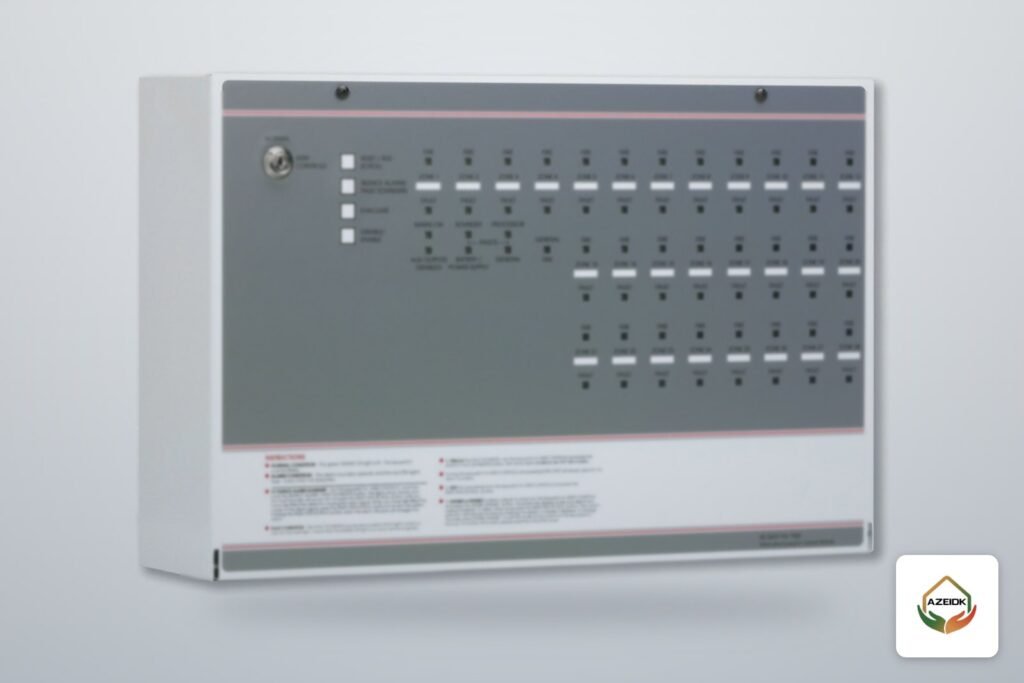
A 16-zone conventional fire alarm panel that grows to 28 zones: that is the Context Plus MFP, model FF516/CON, the largest conventional panel in the Context Plus range AZEIDK supplies in Saudi Arabia. It is used when a building is large enough to need many zones but the project is still designed as a conventional rather than addressable system. This guide covers its datasheet specification, expansion cards, repeater panel and when to choose it.
The panel is part of AZEIDK fire alarm systems. Product page: MFP 16 to 28 zone panel.
Key points
- FF516/CON is supplied with 16 zones and extends to 20, 24 or 28 zones with FF501Z four-zone extender cards.
- The datasheet states full compliance with BS 5839 Part 4, with four sounder circuits.
- Up to 20 smoke detectors per zone and no limit on manual call points.
- Up to eight FF596 repeaters on two wires, with one FF596T transmitter card in the main panel.
- Compatible with Context Plus UL-listed Series 65A conventional detectors, ActiV detectors and the Ei wireless range, per the datasheet.
MFP specification from the datasheet
| Item | Value |
|---|---|
| Zones | 16, extendable to 20, 24 or 28 |
| Supply | 230 VAC ±10%, 50/60 Hz; internal 27 VDC supply |
| Total output current | 3 A across all outputs |
| Sounder circuits | 4, 6800 Ω end-of-line resistor, each output fused at 1.6 A |
| Smoke detectors per zone | Up to 20 (2 mA maximum per detector) |
| Call points per zone | No limit |
| Bells / electronic sounders | Up to 120 bells at 25 mA or 150 sounders at 20 mA |
| Auxiliary relay | Volt-free contacts, 1 A at 30 VDC maximum |
| Enclosure | About 521 × 334 × 140 mm, 9.5 kg without batteries |
The enclosure has a metal lid and back box with heavy-duty base connections, and one end-of-line unit per zone is included. Faults are shown separately: open circuit, short circuit, detector head removed, sounder fault and battery or power supply fault.
Expanding from 16 to 28 zones
Each FF501Z card adds four zones, taking the panel to 20, 24 and then 28 zones; the accessories page notes it comes with a loom between the circuit boards and a loom to the detector terminals. The FF574X expansion loom provides a class change input plus two fire outputs and one fault output, open collector, up to 100 mA each, typically used to drive relays for ventilation, gas valves and door releases. The datasheet warns against powering door releases from the panel itself, as this drastically reduces battery standby time.
Battery standby by zone count
The datasheet includes a standby table. Quiescent current rises with expansion: 90 mA at 16 zones, 105 mA at 20, 120 mA at 24 and 135 mA at 28. A 12 Ah battery therefore gives about 130 hours on a 16-zone panel, dropping to about 85 hours at 28 zones.
These are guideline figures under the datasheet conditions with no extra loads; detector and sounder loads must be added for the real calculation. See fire alarm battery calculation.
FF596 repeater panel
The FF596 repeater mimics the main panel’s key functions elsewhere in the building, such as the fire service entrance, reception or security room. One FF596T transmitter card goes in the main panel, and up to eight repeaters connect over a two-wire power and data cable in star or daisy chain. Each repeater shows zones in fire in multiples of eight up to 32 using FF596R extender cards, with reset, silence and evacuate controls. To compare repeaters across panel families, see fire alarm repeater panels.
Engineering functions
- One-man detector test.
- Sounder walk test.
- Sounder isolate and sounder delay, plus auxiliary isolate.
- Short circuit equals fire, selectable per zone, for retrofits on older systems whose call points have no resistors.
- Non-latching zones for cross-connection to other panels.
- Fault buzzer mute.
MFP, FP or addressable?
If the building needs 14 zones or fewer, Context Plus FP panels are enough. The MFP suits layouts that need up to 28 zones, such as schools, office buildings and warehouses with many sections, provided the specification accepts a conventional system. Where each device must be located individually, or the device count is very high, an addressable system is usually the better choice. See addressable vs conventional fire alarm and Context Plus vs FG panels.
Compatible detectors
The datasheet lists compatibility with Context Plus UL-listed Series 65A conventional detectors, Intertek-certified ActiV conventional detectors and the Ei range of wireless detectors and ancillaries. For the 65A and 65E series see Context Plus conventional smoke detectors, and for wiring see fire alarm wiring diagram.
AZEIDK supplies, installs, tests and commissions the panel and its accessories through its installation service, backed by annual maintenance contracts.
Frequently asked questions
How many zones does the Context Plus MFP have?
It ships with 16 zones and extends to 20, 24 or 28 zones with FF501Z cards.
How many smoke detectors per zone?
Up to 20 per zone according to the datasheet, with no limit on call points.
How many repeaters can connect to an MFP?
Up to eight FF596 repeaters with one FF596T transmitter card in the main panel.
How long does the MFP run on battery?
Per the datasheet table, a 12 Ah battery gives about 130 hours at 16 zones and about 85 hours at 28 zones with no extra loads; project loads must be added.
Which standard is the panel designed to?
The datasheet states full compliance with BS 5839 Part 4.
Can the panel control ventilation and door releases?
Yes, through the FF574X loom’s fire and fault outputs driving relays, with door releases powered from a separate supply.
Conventional project with more than 14 zones? Send the zone plan and drawing, and the AZEIDK team will size the extender cards, repeaters and batteries for an MFP panel. Contact AZEIDK
Related guides
- Mall and Commercial Building Fire Safety: Engineering Guide
- Fire Alarm System for Residential Buildings: When It Is Required, Flat and Corridor Detectors, and Who Runs the Panel
- Safety and Security Systems Companies in Saudi Arabia (Al Alamiya, Al Najjar, Al Rumaih): How to Choose and Verify
- Fire Telephone and Areas of Refuge for People with Disabilities