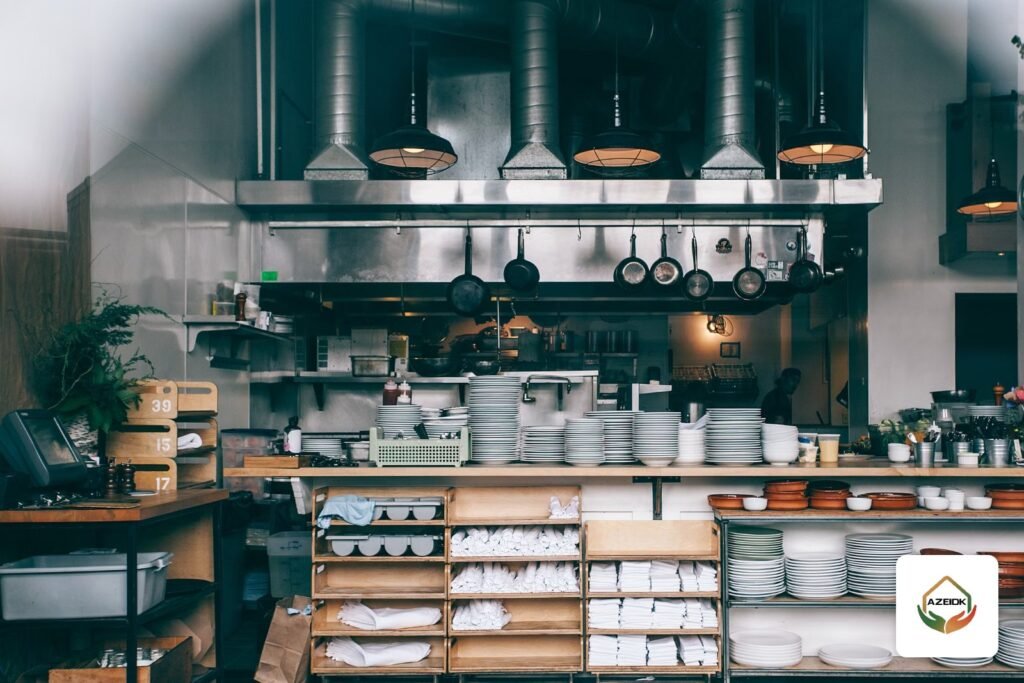
Cloud kitchen requirements in Saudi Arabia sit inside the Restaurant Requirements issued by the Ministry of Municipalities and Housing (1446H / 2025), which define a cloud kitchen as a restaurant dedicated entirely to preparing food for delivery. For fire safety, a cloud kitchen complex differs from an ordinary restaurant in one big way: several hot kitchens side by side in one building, each with its own hood, appliances and licence.
For the steps to obtain the Salamah certificate from Civil Defense on the Salamah platform, see our guide; our page on Saudi Civil Defense requirements covers the general requirements for buildings and facilities.
This article covers what the requirements say about cloud kitchens and how hood suppression, gas shut-off, fire alarm and extinguishers are designed when several operators share one site. AZEIDK supplies kitchen fire suppression systems from Ansul, Hood Safer and American Fire Control as part of its restaurants and commercial kitchens sector work.
Key takeaways
- A cloud kitchen is a restaurant dedicated entirely to preparing food for delivery (clause 1.5.4).
- It must be on a commercial street; complex sites must be at least 50 m from major commercial intersections (3.2).
- Each food activity in a cloud kitchen complex needs its own commercial licence (5.1.2).
- The pickup area is at least 6 m², or 24 m² for a complex (5.1.16).
- In engineering terms: each hood needs a suppression system covering its appliances, and each kitchen its own gas shut-off and Class K extinguisher.
In this article
- What do the cloud kitchen requirements say?
- Why is fire risk different in a cloud kitchen complex?
- Hood suppression: one system per kitchen or a shared system?
- Gas in cloud kitchens: central tank and shut-off valves
- Fire alarm and extinguishers in the complex
- Cloud kitchen versus central kitchen
- Who is responsible: landlord or brand?
- Common cloud kitchen safety mistakes
- FAQ
- Conclusion
What do the cloud kitchen requirements say?
The Restaurant Requirements (Ministerial Decision 4600653138/1) cover restaurants, cafés, cloud kitchens and kiosks (1.3). Cloud kitchens have specific clauses: a commercial street location, complexes at least 50 m from major commercial intersections (3.2), a separate commercial licence for each food activity in a complex (5.1.2), and a pickup waiting area of at least 6 m², or 24 m² for a complex (5.1.16).
For fire protection, the general clauses apply too: Civil Defense approval before licensing (2.1.2), compliance with SBC 801 (4.9.1) and non-combustible ceilings in food preparation and storage areas (4.5.8). We covered restaurant fire safety systems generally in restaurant and café fire safety.
Why is fire risk different in a cloud kitchen complex?
- Cooking density: several cook lines run at once, mostly frying and grilling, which delivery menus rely on.
- Long hours: some kitchens run late, so grease builds up in hoods and ducts faster.
- Many operators: each kitchen is a different brand with different staff, while the building, corridors and exits are shared.
- Tenant turnover: one brand leaves, another arrives with appliances the existing system may not cover.
Hood suppression: one system per kitchen or a shared system?
Each hood should be protected by a system designed around its appliances: nozzle count and positions, plenum and duct coverage, and wet chemical quantity. Because each kitchen is a separately licensed activity with its own operator, the usual approach is one system, cylinder, manual pull station and gas shut-off valve per kitchen, so a fire in one kitchen does not discharge and shut down its neighbour.
| Item | Separate system per kitchen | Complex-level consideration |
|---|---|---|
| Discharge | Only the affected kitchen | Each system reports to the alarm panel by kitchen name |
| Gas shut-off | One valve per kitchen | A master valve at the central tank as well |
| Recharge | Only the affected kitchen | The rest of the complex keeps trading |
| Maintenance | Inspection certificate per system | One schedule covering all systems in one visit |
| Tenant change | Only that kitchen’s system is redesigned | New appliances reviewed before opening |
These systems are designed to NFPA 17A and NFPA 96 with UL 300 listed equipment, as explained in UL 300, NFPA 17A and NFPA 96. For a brand comparison see Ansul R-102 or American Fire Control.
Gas in cloud kitchens: central tank and shut-off valves
Most cloud kitchen complexes run on a central LPG tank feeding every kitchen. Three layers work together: a shut-off valve per kitchen that closes when its hood system discharges, gas leak detectors near appliances and gas lines, and a master valve at the tank. AZEIDK supplies gas leak detectors for restaurants and buildings; see central gas tank requirements. After any discharge, gas is reopened only after a manual system reset.
Fire alarm and extinguishers in the complex
An addressable alarm suits a complex best, because the panel shows which kitchen or device is in alarm and the team goes straight there. Inside each kitchen use heat detectors, not smoke detectors, and connect the hood system signal to a monitor module named for that kitchen. Smoke detectors stay in shared corridors, the pickup area, stores and electrical rooms. See our fire alarm systems solution.
Each kitchen needs a wet chemical Class K extinguisher near the cook line, as covered in kitchen fire extinguisher (Class K), plus extinguishers for corridors and electrical panels by hazard.
Cloud kitchen versus central kitchen
The two are often confused. A central or catering kitchen produces large volumes for branches or clients, usually under one operator; we covered it in central kitchen fire safety. A cloud kitchen prepares meals for delivery straight to consumers, and in a complex several brands operate under separate licences. Safety design in cloud kitchens therefore focuses on separating systems between kitchens and on clear responsibility between the landlord and tenants.
Who is responsible: landlord or brand?
The lease decides, but a common split is: the landlord owns the main alarm system, sprinklers where present, the central gas tank, exits and emergency lighting; each kitchen operator owns its hood system, extinguishers and their six-monthly service. On a tenant change, new appliances must be reviewed before opening, because a system designed for a grill does not necessarily protect a deep fryer. AZEIDK can run this through preventive and periodic maintenance with one schedule for every kitchen in the complex.
Common cloud kitchen safety mistakes
- One system designed for a long hood shared by two kitchens, later split by a wall with new appliances and unchanged nozzles.
- A single master gas valve for the whole complex, so every kitchen stops when one system discharges, or the valve gets disabled to avoid that.
- Smoke detectors inside kitchens causing repeated false alarms, so staff across the complex learn to ignore the alarm.
- Delivery boxes and cartons stacked in the pickup area, narrowing the exit and adding combustible load near the kitchens.
- A new brand starting to cook before the hood system is checked against its appliances, on the basis that “the system is there”.
- No single maintenance schedule, so one kitchen’s system is serviced and its neighbour’s forgotten.
The fix starts at design: separate systems between kitchens, name every point on the alarm panel after its kitchen, and a clear lease clause requiring each tenant to inform the landlord before changing any cooking appliance.
FAQ
What are the cloud kitchen requirements in Saudi Arabia?
They are part of the 2025 Restaurant Requirements: commercial street location, complexes 50 m from major intersections, a licence per activity, and a pickup area of 6 m² or 24 m² for a complex, plus Civil Defense approval and SBC 801.
Does every kitchen in a complex need its own hood system?
Usually yes: each hood gets a system designed for its appliances, with its own pull station and gas shut-off, because each kitchen is a separately licensed activity.
Does a cloud kitchen need Civil Defense approval?
Yes. The Restaurant Requirements require Civil Defense approval before licensing, and cloud kitchens are within their scope.
Which fire detector suits a cloud kitchen?
Heat detectors inside the kitchen; smoke detectors in shared corridors, the pickup area and stores.
What happens to the suppression system when a brand moves out?
The new appliances are reviewed, the system is modified if appliances or positions change, then tested before opening.
Conclusion
Cloud kitchen requirements start with location and a licence per activity, and are completed by a safety design that separates kitchens: a suppression system per hood, a gas shut-off per kitchen and an addressable alarm that pinpoints the fire. That separation is also what keeps a fire in one kitchen from shutting down the whole complex.
Fitting out a cloud kitchen complex or a unit inside one? Send us the layout and each kitchen’s appliance list; we design, supply and install hood suppression, gas shut-off and fire alarm. Talk to the AZEIDK team
See the AZEIDK Salamah certificate and Civil Defense licence service.
Related guides
- Sprinkler Design Software and Fire Protection Design Tools: Hydraulic Calculation, Fire Alarm Design and What the Designer Should Deliver
- How to Verify UL, FM and LPCB Listings for Fire Equipment, Step by Step
- Variation Orders and RFIs on Fire Protection Projects in Saudi Arabia
- Sidewall Sprinklers: When to Use Them in Hotel Rooms and Corridors, K-Factor and Coverage with Victaulic FireLock FL-QR/SW