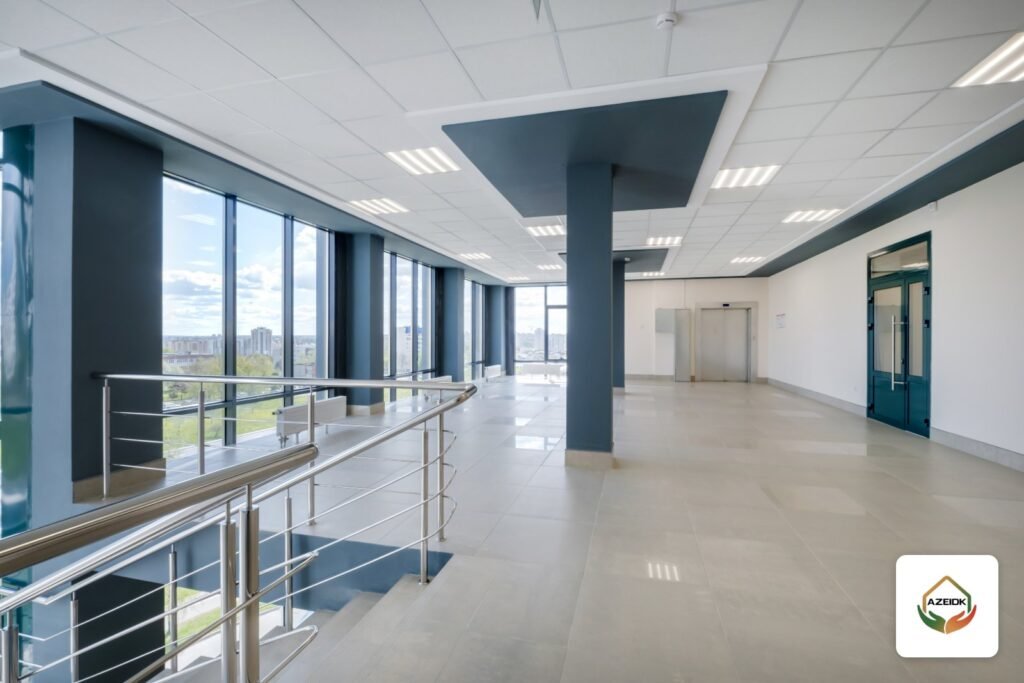
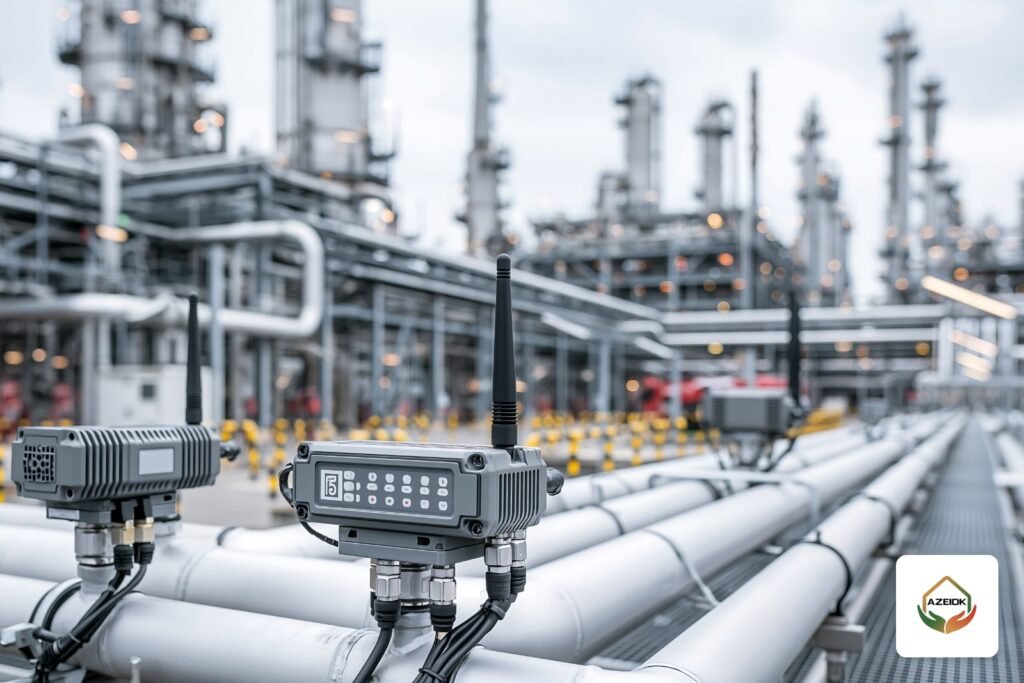
In a high-ceiling hall, a data centre with strong airflow or a warehouse with racking up to the roof, smoke may reach a point detector late, or be diluted before it gets there. Two technologies address this: aspirating smoke detection (ASD), which draws air samples back to a central detector, and projected beam detection, which watches a long optical path across the space.
This article explains how each technology works, how sampling networks and beam paths are designed, when to choose one over the other, and how they are tested at handover and in service. For a general comparison of detector types, see our guide to choosing fire detectors.
Key takeaways
- An aspirating detector uses a fan to draw air through a drilled pipe network into a sensitive detection chamber, and can provide several staged alarm levels.
- NFPA 72 treats each sampling port as a spot-type smoke detector for location and spacing, and transport time from the farthest port must meet the adopted standard and the model’s listing.
- EN 54-20 classifies aspirating detectors as Class A (very high sensitivity), Class B (enhanced) and Class C (normal). The class is achieved through network calculations and hole count.
- A beam detector needs an unobstructed path and rigid mounting on a solid structural element. Spacing follows the manufacturer’s instructions and the adopted standard.
- The choice depends on height, airflow, obstructions and maintenance access, not on sensitivity alone.
In this article
- When point detectors are not enough
- How aspirating smoke detection (ASD) works
- Designing an aspirating smoke detection network
- Beam detectors: types and operation
- Designing and installing beam detectors
- Aspirating and beam detection compared
- Choosing by application
- Testing, commissioning and maintenance
- Common mistakes with aspirating and beam detection
- Aspirating and beam detectors from AZEIDK
- Frequently asked questions
- Conclusion
When point detectors are not enough
Point detectors work well in ordinary rooms, but their performance drops in four situations common on Saudi projects:
- High ceilings: in halls, large mosques, malls and warehouses, smoke can cool and settle in a layer below the ceiling (stratification) without reaching it.
- Strong ventilation: in data centres and telecom rooms, airflow dilutes smoke, so detection needs higher sensitivity.
- Difficult access: detectors 20 m up, above production lines or inside closed voids are hard to test and maintain without shutdowns or lifts.
- Harsh or visually sensitive spaces: dust, humidity and deep cold, or heritage and decorative ceilings where visible devices are unwelcome.
How aspirating smoke detection (ASD) works
The system has a detector unit, usually wall-mounted where it is easy to reach, and a pipe network running into the protected space with small calculated holes. A fan inside the unit continuously draws air from the holes into the detection chamber, which measures the amount of smoke. Each pipe has an airflow sensor. If flow drops because of a blockage or a broken pipe, the unit sends a trouble signal to the fire alarm panel.
VESDA is one manufacturer’s trade name that became so well known that the market uses it for the whole category. Many models offer several alarm thresholds. This allows a staged response: building staff are alerted to investigate first, then the fire alarm activates, then suppression is released where the detector is linked to it. The meaning of each level and its action are set in the approved cause-and-effect matrix.
Designing an aspirating smoke detection network
NFPA 72 rules
NFPA 72 (paragraph 17.7.3.6.1, as cited by the National Training Center) requires each sampling port to be treated as a spot-type smoke detector for location and spacing, except in performance-based designs. Orr Protection cites a maximum transport time of 120 seconds from the farthest port to the detector. Xtralis explains that 120 seconds was the standard transport time for all aspirating detectors under the 6th edition of UL 268, while the 7th edition sets a transport time for each product, so follow the model’s listing and the NFPA 72 edition adopted for the project. The network is therefore designed in the manufacturer’s software, which calculates hole sizes, suction balance and transport time for each hole.
EN 54-20 sensitivity classes
The European standard sorts aspirating detectors into three classes: Class A, very high sensitivity, for clean rooms, data centres and high-value contents; Class B, enhanced sensitivity, for commercial buildings and hotels; and Class C, normal sensitivity, for industrial settings and semi-open areas such as car parks. The class is confirmed for each design by network calculations, with a maximum number of holes that varies by model. The limit usually falls as the required sensitivity class rises; take it from the manufacturer’s data for the selected model.
Sampling methods
- Holes drilled directly in the pipe below the ceiling or above racking.
- Capillary tubes dropping from the pipe to small sampling points in a suspended ceiling, keeping the network hidden in mosques, halls and heritage buildings.
- Points at return air grilles in data rooms, in addition to ceiling points rather than instead of them, unless the approved design allows it.
Beam detectors: types and operation
A projected beam detector sends an infrared beam across the space and alarms when smoke blocks a set share of the signal. Its European product standard is EN 54-12. There are two types:
- End-to-end: a transmitter and a receiver at opposite ends, each needing power and wiring.
- Reflective: a single head that transmits and receives, with an unpowered reflector at the far end, which simplifies cabling.
Newer models offer auto-alignment, which re-aims the beam when the building moves slightly with temperature, and automatic compensation for dust on the optics up to a set limit.
Designing and installing beam detectors
Beam spacing follows the adopted standard and the manufacturer’s instructions. As examples, one manufacturer’s NFPA 72-based application guide gives a maximum of 18.3 m between beams and half that to a side wall, with an operating range of 9 to 106 m. Another manufacturer’s guide gives 7.5 m of coverage on each side of the beam under a flat roof, with the beam mounted 0.3 to 0.6 m below the roof. For BS 5839-1 height limits, see the detector selection guide linked above.
Practical installation rules from manufacturers’ guides include:
- Fix to a solid element such as a concrete wall or a main steel column, not to metal cladding panels that expand and vibrate.
- Keep a clear path about one metre in diameter along the beam, away from overhead cranes or racking that may be raised later.
- Avoid direct sunlight shining into the receiver optics.
- Under high roofs prone to smoke stratification, consider an extra row of beams at a lower level.
Aspirating and beam detection compared
| Item | Aspirating (ASD) | Projected beam |
|---|---|---|
| Detection principle | Air drawn to and measured in a central unit | Smoke obscuration of a light beam |
| Product standard | EN 54-20 or UL listing | EN 54-12 or UL listing |
| Sensitivity | Adjustable, up to very high levels | Thresholds set by the manufacturer; suited to large open spaces |
| Best applications | Data centres, clean rooms, hard-to-reach areas, heritage buildings | Halls, warehouses and tall atriums with an open path |
| Main limits | Calculated network design; hole blockage in dusty areas | Moving obstructions, building movement and alignment |
| Maintenance | Mostly at the unit at floor level, plus network checks | At mounting height, with lens and reflector cleaning |
Choosing by application
- Data centres and server rooms: usually Class A aspirating detection, often linked to gas suppression. See our data centre fire protection guide.
- High-bay warehouses: beams suit open aisles below the roof if racking and cranes do not cross the path, while aspirating systems allow sampling points within the racks. See our warehouse fire protection article.
- Mosques, halls and atriums: beams for open volumes, and aspirating detection with capillary points where devices should be hidden.
- Car parks and dusty areas: Class C aspirating detection with suitable filtration, or other detection methods as the design requires.
Testing, commissioning and maintenance
Testing of these detectors relies largely on the manufacturer’s published instructions. Typical aspirating tests include an alarm response test, introducing smoke and confirming the signal reaches the panel; a transport time test from the farthest hole, compared against the design value; and an airflow check on every pipe. Some designers add a benchmark test point at the end of the network that is opened once a year to compare transport time and suction pressure with earlier readings.
For beam detectors, the signal level after alignment is recorded at commissioning, and the detector is tested with a calibrated filter or the method the manufacturer specifies. Routine maintenance reviews the dust compensation record. One manufacturer’s guide recommends cleaning the lens and reflector and re-aligning once compensation exceeds 50%.
Common mistakes with aspirating and beam detection
- Changing the sampling network on site, adding holes or extending pipes, without re-running the calculations.
- Leaving sampling pipes unmarked, so another trade cuts them or hangs services from them.
- Mounting beam detectors on cladding or light steel that moves with heat, causing repeated alignment faults.
- Ignoring racking, signs or cranes that will enter the beam path after handover.
- Setting aspirating alarm thresholds without a period of environmental monitoring, leading to nuisance alarms or lost sensitivity.
- Claiming a sensitivity class without calculations for the actual number of holes.
Aspirating and beam detectors from AZEIDK
From the Context Plus range, AZEIDK supplies aspirating smoke detectors (models 29650-081 and 29650-082) and intelligent reflective beam detectors (models 55000-268 and 55000-273). For the aspirating unit in detail, see our Context Plus 29650 aspirating detector guide. Through our engineering design and calculations service, we help choose the right technology for each space, prepare network layouts or beam paths, and assemble datasheets and certificates for approval, checking the approval of each specific model.
Frequently asked questions
Is aspirating detection always better than point detection?
No. It is the better fit where you need high sensitivity, access is difficult or airflow is strong. In ordinary rooms, point detectors remain an economical and accepted solution.
How many holes can one aspirating unit serve?
It depends on the model and the sensitivity class required. The design software sets it, within the maximum transport time.
Does summer heat affect beam detectors?
Expansion of steel structures can move the beam, so it should be fixed to a solid element. Auto-alignment helps compensate for small movements.
Can aspirating detection be used in cold rooms?
It is used in these environments with details the manufacturer specifies for condensation and freezing. Follow the instructions for the selected model.
Who sets the alarm thresholds?
The designer, together with the manufacturer and the consultant, after studying the space. Thresholds are documented in the cause-and-effect matrix.
Conclusion
Aspirating and beam detectors solve the same problem, getting smoke to the detector, in different ways. The first goes to the smoke through a calculated network; the second watches a large area along a single line. The right decision comes from studying the space, airflow, obstructions and maintenance access, followed by calculations and installation that follow the manufacturer’s instructions and the adopted standard.
Have a tall hall or data room that needs early detection? Send us the drawings, heights and ventilation details, and we will propose the right technology and explain the limits of each option. Talk to the AZEIDK team
See the fire alarm panels and systems AZEIDK supplies.
Related guides
- Yeastar PBX (P-Series): Models by Extension Count, Cloud Edition and Fit for Saudi Companies
- Safety Equipment Installation Certificate: What It Is and How It Differs from the Salamah Technical Report
- Fire Extinguisher in Arabic: A Reverse Glossary of Fire Protection Terms for Procurement in Saudi Arabia
- Sprinkler Main Drain Test: Annual Procedure, Static and Residual Pressure, and When the Result Signals a Problem