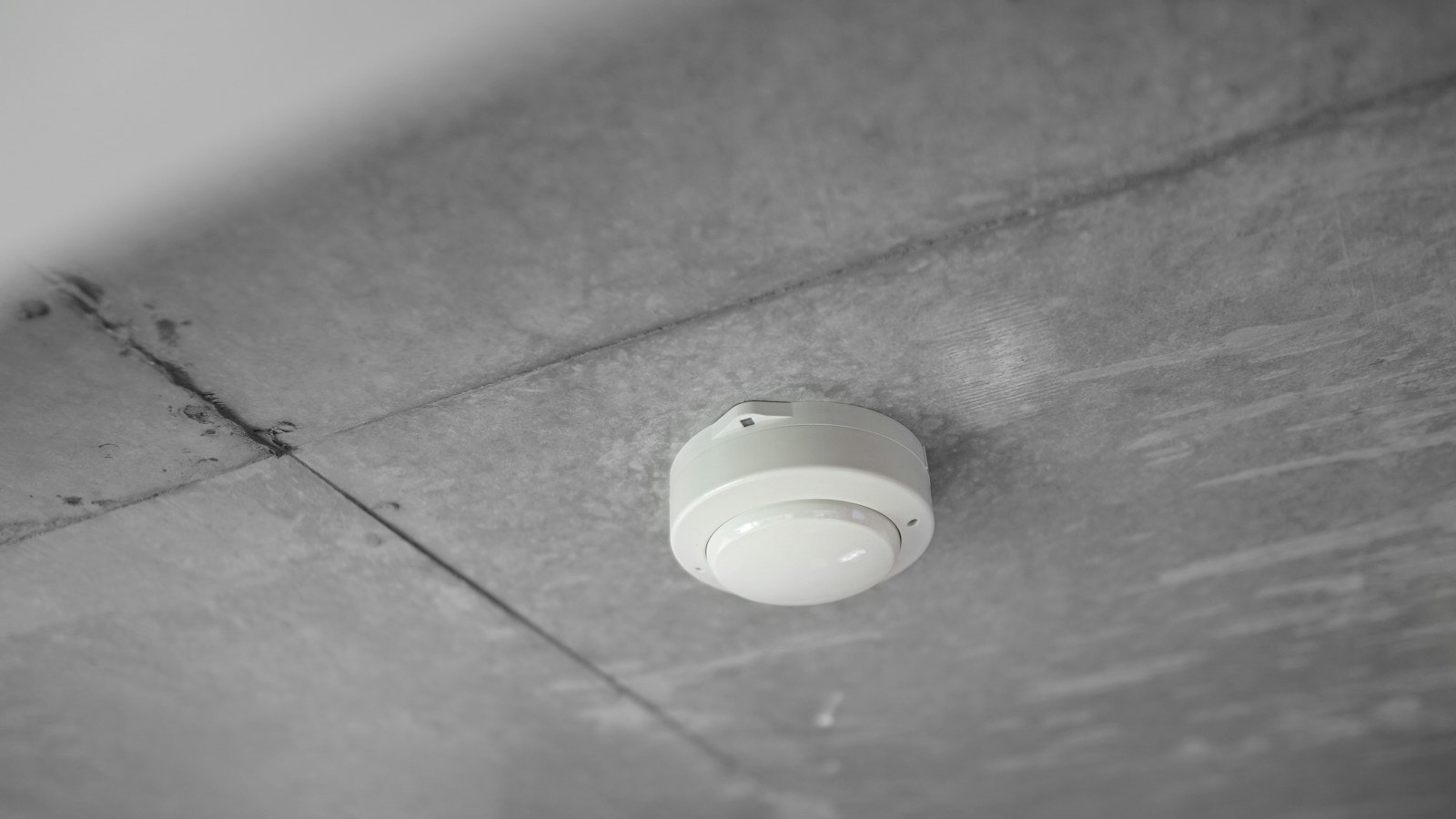
Choosing fire detectors means matching the detection principle to the expected fire and to each space. Optical smoke detectors suit most offices, rooms and escape routes; heat detectors suit kitchens and dusty plant rooms; beam or aspirating detection covers high halls; and flame detectors protect fuel and gas hazards. Ceiling height, temperature, airflow and false alarm risk then set the layout.
Key takeaways
- Match detector to fire and space: optical for smoldering fires, flame for fast fuel fires, heat or multi-sensor where steam or dust cause false alarms.
- Unless designed and listed for the conditions, NFPA 72 does not allow smoke detectors below 0°C or above 38°C, above 93% relative humidity or in air faster than 1.5 m/s.
- NFPA 72 requires heat detectors rated at least 20°F (about 11°C) above the hottest expected ceiling temperature.
- On high ceilings smoke stratifies, so beam or aspirating detection usually replaces spot detectors.
- Approval belongs to the exact model and its panel compatibility, not the brand.
In this article
- How fire detectors work: the main types
- Where each detector fits in Saudi projects
- Selection criteria: environment, height and false alarms
- Spacing and siting: NFPA 72 and BS 5839-1 compared
- Step-by-step: selecting fire detectors for a project
- Common site mistakes
- Inspection, testing, maintenance and cost
- How AZEIDK helps
- FAQ
How fire detectors work: the main types
Each automatic detector watches for a product of fire: smoke, heat, flame radiation or carbon monoxide (CO).
| Type | Typical spaces | Main limit | Product standard |
|---|---|---|---|
| Optical point smoke | Offices, corridors, rooms | False alarms from steam, dust, cooking | EN 54-7; UL 268 |
| Ionization point smoke | Declining use | Radioactive source | EN 54-7; UL 268 |
| Multi-sensor | Rooms with nuisance alarm risk | Mode should be set and recorded | EN 54-29, 30 and 31 |
| Point heat | Kitchens, plant rooms, car parks | Late response | EN 54-5 |
| Linear heat | Cable trays, conveyors, tunnels | No early warning | EN 54-22 |
| Optical beam | Warehouses, halls, atriums | Needs clear line of sight | EN 54-12 |
| Aspirating (ASD) | Data centers, high or harsh spaces | Needs a designed pipe network | EN 54-20 |
| Flame | Fuel and gas hazards, hangars | Blind without flame or line of sight | EN 54-10 |
Smoke detectors: optical, ionization and multi-sensor
Optical detectors sense light scattered by smoke and respond best to smoldering fires; ionization detectors suit fast flaming fires but contain a small americium-241 source. The UK Fire Industry Association (FIA) reports that photoelectric detectors are now preferred, partly because of the regulatory cost of radioactive devices.
Multi-sensor detectors compare smoke, heat and sometimes CO signals before alarming. BS 5839-1:2025 recommends them where point smoke detectors carry a higher false alarm risk, with each mode recorded.
Heat detectors
Fixed-temperature detectors alarm at a set point; rate-of-rise detectors also react to a fast climb. They tolerate steam and dust but respond late, so BS 5839-1:2025 no longer permits them in sleeping rooms in Category L2 systems and advises against them there in L3.
Beam, aspirating and flame detectors
A beam detector alarms when smoke obscures light projected across the space. Aspirating systems draw air through a pipe network to a central detector, rated under EN 54-20 as Class A (very high sensitivity), Class B (enhanced) or Class C (normal).
A 2019 Emerson application article notes that ultraviolet (UV) detectors are susceptible to welding, X-rays, lightning and sunlight, while infrared (IR) detectors can be affected by hot surfaces, exhaust gases and sunlight.
Where each detector fits in Saudi projects
The Saudi Fire Protection Code (SBC 801), whose 2024 edition is listed by the Saudi Building Code Center, sets where detection is required by occupancy, with Civil Defense requirements and the project specification (see our SBC 801 guide). Typical choices:
- Offices, hotel and patient rooms, classrooms, corridors: optical or multi-sensor detectors.
- Commercial kitchens and plant rooms: heat or multi-sensor detectors; hoods also need a kitchen fire suppression system.
- Car parks: heat, multi-sensor or linear heat detection, depending on exhaust fumes.
- Warehouses, halls and high mosque domes: beam or aspirating detection (see our high-rack warehouse guide).
- Data centers: aspirating detection, often Class A, as in our data center fire protection guide.
- Fuel stores, generator rooms and hangars: flame detectors alongside smoke or heat detectors.
Selection criteria: environment, height and false alarms
Temperature, humidity and airflow
NFPA 72, published by the National Fire Protection Association (NFPA), does not allow smoke detectors, unless designed and listed for the conditions, below 0°C or above 38°C, above 93% relative humidity, or in air faster than 1.5 m/s. Metal-roofed warehouses and roof voids can pass 38°C in a Saudi summer, so measure first. BS 5839-1 also recommends keeping detectors at least 1 m from air supply points.
Choosing a heat detector class
EN 54-5 defines each class by a maximum application temperature; choose a class whose maximum is not exceeded at the ceiling:
| EN 54-5 class | Maximum application temperature | Static response temperature |
|---|---|---|
| A1 | 50°C | 54 to 65°C |
| A2 | 50°C | 54 to 70°C |
| B | 65°C | 69 to 85°C |
| C | 80°C | 84 to 100°C |
NFPA 72 requires a rating at least 20°F (about 11°C) above the maximum expected ceiling temperature; BS 5839-1 recommends a static response at least 29°C above average ambient and 4°C above the highest expected temperature. A roof void reaching 55°C in summer therefore rules out Classes A1 and A2.
Ceiling height and stratification
Smoke can cool and stall below a high ceiling before reaching detectors (stratification). The 2025 edition of NFPA 72 limits the prescriptive spacing method for spot smoke detectors to ceilings up to 12.2 m (40 ft), requiring performance-based design above that; fire protection engineer Wayne Moore advises against them on ceilings of 6.1 m (20 ft) or more.
For heat detectors, Table 17.6.3.5.1 in the 2019 edition of NFPA 72 reduces the listed spacing by a factor of 0.64 at about 6.1 m and 0.34 at 8.5 to 9.1 m, so a detector listed at 15.2 m (50 ft) on a 6.1 m ceiling is spaced at about 9.8 m.
False alarms
BS 5839-1:2025 recommends a preliminary investigation above four false alarms per 100 detectors per year, and an in-depth investigation for systems with more than 40 detectors averaging above five per 100 detectors per year.
Spacing and siting: NFPA 72 and BS 5839-1 compared
Apply one standard consistently; the main differences:
| Rule | NFPA 72 | BS 5839-1 |
|---|---|---|
| Smoke detectors, smooth flat ceiling | Nominal spacing 9.1 m (30 ft) with half that to walls, or alternatively every ceiling point within 0.7 × 9.1 m (about 6.4 m) of a detector | Each detector covers a 7.5 m radius |
| Heat detectors | Listed spacing, reduced as the ceiling rises | Each detector covers a 5.3 m radius |
| Sensing element below ceiling | Per the adopted edition and the listing | Smoke 25 to 600 mm; heat 25 to 150 mm |
| Maximum ceiling height | No height table for smoke detectors; 2025 edition: prescriptive method up to 12.2 m | General limits: smoke 10.5 m; Class A1 heat 9 m; other heat classes 7.5 m; beam 25 m, or 40 m with enhanced sensitivity plus supplementary detection unless stratification risk is minimal |
BS 5839-1 values are the 2017 edition’s general limits (higher over up to 10% of the ceiling area), as summarized in Apollo’s 2019 guide; confirm them in Table 3 of the 2025 edition. Under NFPA 72, beams 10% of the ceiling height deep or more and spaced at 40% of it or more need a smoke detector in each beam pocket. Beam spacing follows the manufacturer’s instructions.
Step-by-step: selecting fire detectors for a project
- Confirm where detection is required and the design standard.
- Record each space’s use, ceiling height, temperature, dust and airflow.
- Identify the likely fire: smoldering, fast flaming, liquid or gas.
- Choose the detector type and check the standard’s environmental and height limits.
- Select heat detector classes above the highest ceiling temperature.
- Lay out spacing around beams, ducts and diffusers.
- Verify each model’s EN 54 or UL approval and panel compatibility (see our fire alarm control panel guide).
Common site mistakes
- Spot smoke detectors in hot, unconditioned spaces without a suitable listing.
- Heat detector classes too close to the ceiling temperature, such as A1 under a hot metal roof.
- Heat detectors where early warning is needed, such as bedrooms.
- Detectors next to supply diffusers, or layouts that ignore deep beams.
- Beam detectors on flexing structures, or with racking crossing the beam.
Inspection, testing, maintenance and cost
Detectors are tested with the system at the intervals set by the adopted edition of NFPA 72 or BS 5839-1 and by Civil Defense. Good practice: test each detector with the right method for its type, clean or replace it as the manufacturer directs, check beam alignment and aspirating airflow, and log false alarms by device.
Cost depends mainly on detector count, technology, approval route and model, access at height, cabling and lifetime maintenance.
How AZEIDK helps
Through our fire alarm system solutions, AZEIDK provides site surveys, engineering design and calculations, equipment selection and supply, installation and programming, testing and commissioning, Civil Defense approval support and annual maintenance contracts, backed by 16+ years in the Saudi market and 17+ branches and service regions.
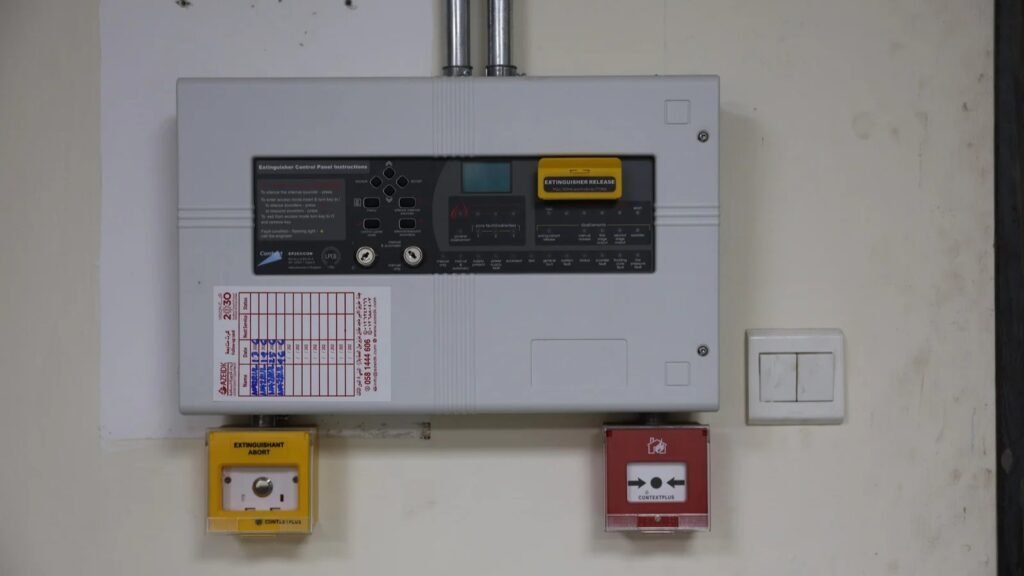
We supply the Context Plus fire alarm range with a compliance review for each project; its detectors include addressable optical smoke, A2S heat, self-aligning beam and IR2 flame models. For recurring false alarms, our existing systems assessment helps find detectors to move or replace; our EN 54 guide and NFPA 72 guide cover approval and design.
FAQ
What is the difference between optical and ionization smoke detectors?
An optical detector senses light scattered by smoke and responds best to smoldering fires; an ionization detector uses a small radioactive source and suits fast flaming fires. Optical and multi-sensor detectors are now the usual choice, partly because radioactive devices carry extra transport and disposal rules.
Can I install a smoke detector in a commercial kitchen?
Heat detectors are the usual choice in commercial kitchens, because steam and cooking fumes set off smoke detectors. Where earlier warning is needed nearby, BS 5839-1:2025 recommends multi-sensor detectors in areas with high false alarm risk. The hood itself needs a separate kitchen suppression system.
How far apart should smoke detectors be?
Under NFPA 72, the nominal spacing on a smooth flat ceiling is 9.1 m (30 ft), with walls within half that; alternatively, every ceiling point within about 6.4 m (0.7 × 9.1 m) of a detector. Under BS 5839-1, each smoke detector covers a 7.5 m radius. Beams, height and airflow can reduce these distances.
Which detector suits a high warehouse ceiling?
Beam detectors suit open, stable spaces with a clear line of sight; BS 5839-1 (2017 values) gives a general limit of 25 m, or 40 m with enhanced sensitivity and supplementary detection unless stratification risk is minimal. Aspirating detection suits very high or hard-to-reach spaces: Apollo’s guide lists 40 m for Class B with at least 15 sampling holes, with multi-level detection recommended.
When do I need a flame detector?
Where a fire can grow fast with open flame and little early smoke, such as fuel, solvent or gas areas, generator rooms and hangars. Flame detectors need a clear line of sight, and the type should resist local false sources such as welding and sunlight. They usually supplement smoke or heat detection.
Need the right detectors for your project? Send our engineers your drawings and space conditions for a detector selection and layout review. Contact the AZEIDK team