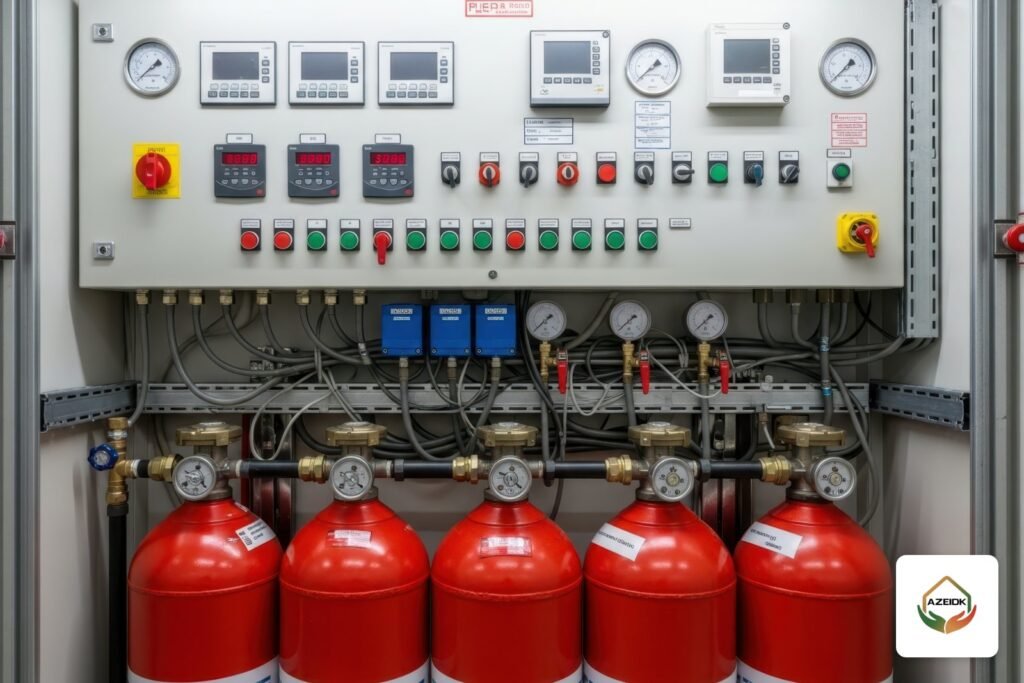
A fire and gas system (F&G) is a dedicated detection and control system for industrial facilities that handle flammable gases, flammable liquids or toxic gases. It detects flame and gas leaks early, then runs automatic actions agreed in advance, such as opening a deluge valve, stopping ventilation fans or sending a trip signal to the emergency shutdown system. A standard building fire alarm has a different main job: detect fire, warn occupants and drive the interfaces linked to it. AZEIDK designs, supplies and installs detection and alarm systems as part of its fire alarm systems. This article explains when a facility needs F&G and how it differs from a conventional fire alarm.
Key takeaways
- An F&G system is built around process hazards (leaks, flame, explosion). A building fire alarm is built around life safety and evacuation.
- The cause and effect matrix is the core of the system: every detector and every action it triggers is written and approved before commissioning.
- Detectors in classified hazardous areas need a protection marking that suits the area, such as a flameproof enclosure (Ex d).
- The flame detection technology (UV, UV/IR or IR3) is chosen by fuel type and by the false alarm sources on site.
- Facilities under the High Commission for Industrial Security (HCIS) follow its directives, alongside Civil Defense requirements and owner standards.
In this article
- What is a fire and gas system?
- How does an F&G system differ from a standard fire alarm?
- Flame detectors in a fire and gas system: UV, IR3 and the differences
- Gas detectors in an F&G system
- Cause and effect matrix and detector voting
- What does the Ex marking on hazardous area detectors mean?
- How does F&G connect to suppression systems?
- Who approves a fire and gas system in Saudi Arabia?
- Steps to prepare a fire and gas system project
- Frequently asked questions
- Conclusion
What is a fire and gas system?
An F&G system has three layers that work together:
- Detection: flame detectors, combustible and toxic gas detectors, heat and smoke detectors in plant buildings such as control rooms and warehouses, and manual call points.
- Logic: a dedicated controller that receives the signals, applies confirmation rules (voting between detectors) and decides the action according to the approved matrix.
- Outputs: sounders and beacons in the field, deluge valve release, special suppression release, ventilation fan shutdown, and signals to the emergency shutdown or process control system.
The point is that the system does more than inform the operator. It is one of the protection layers of the facility and is expected to limit the consequences of an event before it grows into a larger fire or an explosion.
How does an F&G system differ from a standard fire alarm?
The two are often mixed up in tender documents. The table below sums up the practical differences:
| Item | Building fire alarm | Fire and gas system (F&G) |
|---|---|---|
| Main purpose | Detect fire and alert occupants to evacuate | Detect flame and leaks and limit the event with automatic actions |
| Hazard | Ordinary combustibles inside a building | Flammable gases and liquids, and toxic gases, in process areas |
| Main detectors | Smoke, heat and manual call points | Flame, combustible gas and toxic gas, plus smoke and heat in buildings |
| Decision logic | One detector usually raises the alarm | Often confirmation from more than one detector before executive actions |
| Outputs | Sounders, voice messages, interfaces with lifts, HVAC and doors | Deluge and suppression release, ventilation shutdown, ESD signals |
| Installation environment | Ordinary locations | Classified hazardous areas needing Ex-marked equipment |
| Technical basis | SBC 801, usually with NFPA 72 for details | Hazard studies and owner standards, with ISA TR84.00.07 for effectiveness |
Many plants have both: an addressable fire alarm for offices and warehouses (see the addressable fire alarm comparison) and an F&G system for process areas, with an interface between them set by the design.
Flame detectors in a fire and gas system: UV, IR3 and the differences
A flame detector sees the radiation emitted by a flame. It does not wait for smoke or heat to reach it, so it suits open areas and equipment zones where smoke does not collect. Common technologies:
- Ultraviolet (UV): fast response, but it reacts to sources such as arc welding, so the mounting location needs careful review.
- Combined UV/IR: both signals must be present, which cuts false alarms compared with UV alone.
- Triple infrared (IR3): compares three infrared bands and is a common choice for hydrocarbon fires in outdoor areas.
One example from the products AZEIDK lists is the SFP-IR3-EXD explosion-proof triple IR flame detector from Select Fire Plus. According to its product page, it uses three sensors at 3.8, 4.4 and 5.3 μm, detects an N-Heptane fire of 0.3 × 0.3 m at up to 60 m, has a 110° horizontal field of view, carries the markings Ex db IIC T6 Gb and Ex tb IIIC T80°C Db, is rated IP66 and holds ATEX and IECEx approvals. It provides 3 relay outputs, a 4–20 mA output and an RS-485 output, which makes it straightforward to wire to an F&G controller. For integration with addressable fire alarm systems, AZEIDK also lists Context Plus intelligent IR3 flame detectors (55000-020, and the flameproof 55000-021); confirm the Ex marking and certificate of the model before installing it in a classified area.
Gas detectors in an F&G system
The gas detector in a fire and gas system raises the alarm before a leak reaches an ignition source. Detectors fall into two broad groups:
- Combustible gas: the reading is a percentage of the lower explosive limit (LEL), using point detectors or open path detectors that cover a line between a transmitter and a receiver.
- Toxic gas: the reading is a concentration, and the target gas comes from the process materials themselves.
Performance requirements for flammable gas detectors are covered by IEC 60079-29-1. The gas type, detector locations and quantities do not come from a generic table. They come from a site study: likely leak sources, gas density relative to air, ventilation and wind direction in open areas. That is why the gas detection scope of each F&G project is defined after a site survey and a hazard review, not copied from another project.
Cause and effect matrix and detector voting
The cause and effect matrix is a table that links each input signal to the actions that follow. It is the document the consultant reviews and the one the system is tested against at commissioning. An illustrative example of common logic in an equipment area:
| Event (cause) | Action (effect) |
|---|---|
| One flame detector in the zone | Alarm in the control room and local alarm |
| Two flame detectors in the same zone (confirmed) | Open the zone deluge valve, stop ventilation, signal ESD |
| Gas detector at first alarm level | Alarm to the operator to investigate |
| Two gas detectors at high level | Isolation actions defined for the zone |
| Detector or cable fault | Fault signal, no executive action |
The table is for illustration only. Alarm levels and the number of detectors needed for confirmation come from the risk assessment and owner standards. Voting is there to reduce spurious releases without weakening the response, a balance set during engineering design and calculations and delivered through programming and systems integration.
What does the Ex marking on hazardous area detectors mean?
A classified hazardous area is a location where an explosive atmosphere may form. Any electrical device installed there needs a recognised protection method, shown on its nameplate. Take Ex db IIC T6 Gb as an example:
- d: flameproof enclosure, covered by IEC 60079-1. The enclosure withstands an internal explosion and stops it spreading to the surrounding atmosphere.
- IIC: the gas group, the most demanding one, which includes hydrogen and acetylene.
- T6: the temperature class, meaning the maximum surface temperature does not exceed 85 °C.
- Gb: the equipment protection level, suitable for Zone 1 and Zone 2.
The detector marking must match the area classification shown on the project hazardous area drawings. Protection also extends to cables, cable glands and junction boxes, so an Ex-marked detector on its own is not enough.
How does F&G connect to suppression systems?
In process areas, the best-known F&G output is the release of a deluge valve. A deluge system uses open sprinklers or nozzles, so the whole area is flooded with water or foam once the valve opens. The difference from wet, dry and pre-action systems is covered in the sprinkler system types article. Among the valves AZEIDK lists is the Cla-Val 134-05 solenoid-operated deluge valve, the type released by an electrical signal from the control panel.
Control rooms and electrical rooms inside the plant are often protected by special suppression systems such as clean agents, with release tied to detection signals in the same room. Details are on the special fire suppression systems page.
Who approves a fire and gas system in Saudi Arabia?
The reference authority depends on the type of facility:
- Civil Defense: the reference for fire safety requirements in facilities generally. See AZEIDK’s Civil Defense approval support service.
- High Commission for Industrial Security (HCIS): issues safety and fire protection directives for facilities under its supervision, including SAF-01 for general requirements. These facilities should check the HCIS directives in force for their facility type before the design is approved.
- Owner standards: many industrial and petroleum companies have internal fire and gas specifications that set technologies, alarm levels and test methods.
To assess F&G effectiveness, designers often use the ISA technical report TR84.00.07, which gives guidance on evaluating the effectiveness of fire, combustible gas and toxic gas detection systems, including coverage studies (F&G mapping).
Steps to prepare a fire and gas system project
- Survey the site and review hazard studies and area classification drawings.
- Define detector types, locations and coverage, and select the technology for each zone.
- Prepare the cause and effect matrix and get it approved by the owner and consultant.
- Select the controller and define how it interfaces with suppression, ventilation and ESD.
- Prepare shop drawings and coordination and issue the submittal with datasheets and certificates.
- Install, then carry out testing, commissioning and handover, testing every line of the matrix.
- Maintain the system per the manufacturer’s instructions, including gas detector calibration and bump testing with a known gas concentration.
For general requirements in plants, see the industrial facilities page.
Frequently asked questions
What is a fire and gas system?
It is a detection and control system for industrial facilities that detects flame and gas leaks and runs automatic actions such as deluge release and ventilation shutdown.
Can a standard fire alarm replace an F&G system in a plant?
Not in process areas with flammable gases or liquids. A building fire alarm does not detect gas leaks and is not designed for isolation or deluge actions. It may be enough for offices and ordinary warehouses inside the facility.
How is a fire alarm gas detector different from a smoke detector?
A smoke detector senses combustion products after a fire starts. A gas detector senses leaked gas before ignition and reads combustible gas as a percentage of the lower explosive limit (LEL).
Is every flame detector suitable for a hazardous area?
No. The detector must carry an Ex marking that matches the zone, gas group and temperature class, such as Ex db IIC T6 Gb, with suitable cables and glands.
Why does an F&G system need confirmation from more than one detector?
Its executive actions are costly, such as flooding a zone or stopping the process. Voting reduces spurious releases, and the design sets how many detectors each action needs.
Which standards apply to industrial fire alarm systems in Saudi Arabia?
Civil Defense requirements and SBC 801 for facilities in general, HCIS directives for facilities under its supervision, and owner standards, with technical references such as NFPA 72, ISA TR84.00.07 and the IEC 60079 series.
Conclusion
A fire and gas system is not a larger version of a fire alarm. It detects, decides and acts based on process hazards, under an approved cause and effect matrix, with Ex-marked detectors that match the zone and planned links to deluge, ventilation and ESD. Start with the hazard study and area classification, then choose detection and control on that basis.
Planning a fire and gas system for an industrial facility? Send the site drawings and area classification, and the AZEIDK team will review the right scope for detection, control and suppression interfaces. Talk to the AZEIDK team
Related guides
- Elevator CCTV and Elevator Access Control: Choosing the Camera, Getting the Signal Down the Shaft and Restricting Floors by Card
- Sprinkler Head Types: K-Factor, Temperature Rating and Response
- Access Control for Data Centers: Mantraps, MFA, Anti-Passback and Audit Logs
- Time Attendance Devices: Choosing Fingerprint, Face or Card with ZKTeco and Hikvision Models