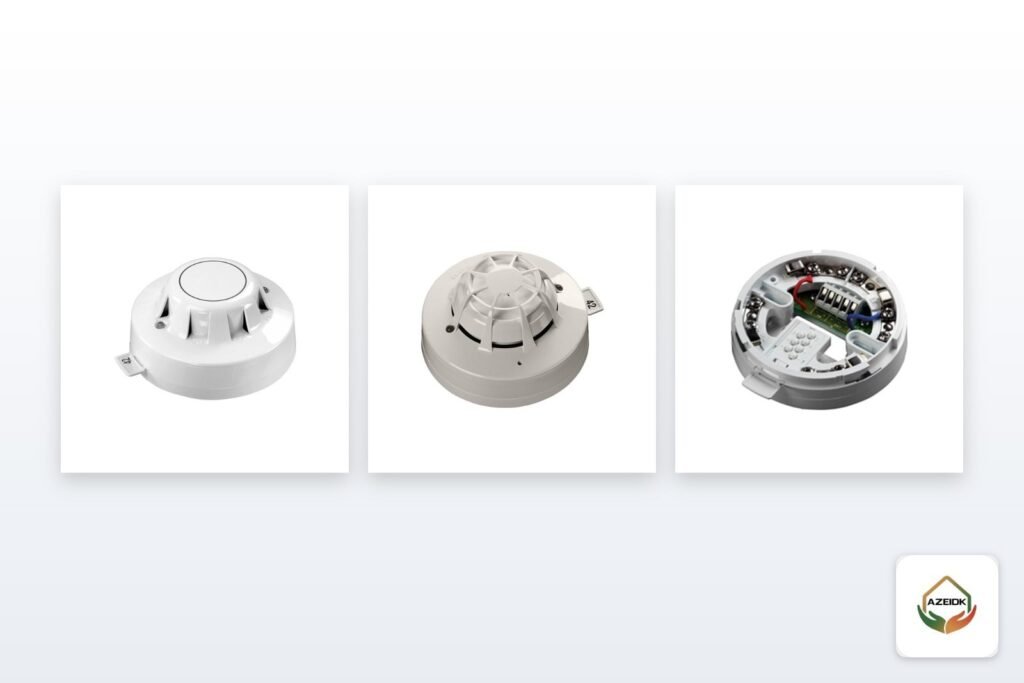
An addressable smoke detector has its own address on the loop of the fire alarm control panel, so the panel knows exactly where it is and reads its status continuously. On the Context Plus detectors supplied by AZEIDK, the address is set by an XPERT card in the base, the detector head fits onto that base, and the bases are wired on a loop that leaves the panel and returns to it, with short-circuit isolators along the way. This article covers the models listed on our site, the bases, loop wiring, and when to choose addressable over conventional within our fire alarm systems.
Key takeaways
- An addressable detector sends the panel its address and sensor reading, so the alarm shows the room name, not just a zone number.
- Context Plus detectors are supplied as heads only; the XPERT card in the base sets the address, which stays the same when the head is replaced.
- The Context UL-Plus range is UL listed, while the 55000-885IMC Xpert-card detector is LPCB approved; the project specification decides.
- Isolators are placed so that no more than 20 devices sit between two isolators, and at fire and zone boundaries.
- Price depends on point count, detector and base type, cabling and programming, not on the detector alone.
In this article
- How does an addressable smoke detector work?
- Context Plus addressable smoke detector models on the AZEIDK site
- UL or LPCB: reading the project specification
- The base and the XPERT card: the address stays in the ceiling
- Isolating bases and loop isolators
- Addressable smoke detector wiring diagram on the loop
- Programming and diagnostics after installation
- When to choose an addressable smoke detector over a conventional one
- What drives the addressable smoke detector price?
- Frequently asked questions
- Conclusion
How does an addressable smoke detector work?
In a conventional system several detectors share one circuit (zone), and on alarm the panel knows only the zone. In an addressable system each detector is an individual device on the loop, talking to the panel over a digital protocol as the panel polls each address in turn. This is why it is also called an analogue addressable or analog smoke detector: the detector reports a value for the smoke level or sensor state, and the panel, or the detector itself, decides whether that is an alarm.
On site this means a panel message such as “Level 3, Office 305”, knowing which detector is dirty before it causes a false alarm, and being able to set sensitivity per detector to suit the room. For a fuller comparison of the two system types, see addressable fire alarm system.
Context Plus addressable smoke detector models on the AZEIDK site
The table summarises the Context Plus addressable smoke detectors as described on AZEIDK’s product pages:
| Model | Sensor | Approval and protocol | Base |
|---|---|---|---|
| 58000-650IMC | Optical smoke | UL listed, Discovery protocol | 45681-210IMU with XPERT card |
| 58000-750IMC | Multisensor: optical smoke and heat | UL listed, Discovery protocol | 45681-210IMU with XPERT card |
| 55000-885IMC | Multisensor: optical smoke and heat | LPCB approved, XP95 protocol | XPert base with XPERT card |
The 58000-650IMC optical detector page lists five response modes, drift compensation to hold sensitivity in dusty areas, a 360-degree alarm indicator, conventional alarm capability if the panel processor fails, and applications in offices, corridors, hotel rooms and hospitals. The 58000-750IMC multisensor combines optical smoke and heat; its page states that the heat element gives a response to fast-flaming fires similar to an ionisation detector, so it can replace one, with high immunity to false alarms. The 55000-885IMC follows the same smoke-plus-heat idea in one head, with LPCB approval.
When to use optical and when multisensor? Optical suits offices, corridors and ordinary rooms. Multisensor helps where fast-flaming fires with little visible smoke are expected, or where false alarms need to be reduced. Sensor types are covered in smoke detector types. For rooms where smoke detection does not suit, such as kitchens, see the sibling article on Context Plus addressable heat detectors.
UL or LPCB: reading the project specification
The two ranges work the same way; the difference is the approval body. The Context UL-Plus range is UL listed, and the 45681-210IMU base page says it is intended for projects that require UL-listed addressable detectors. The 55000-885IMC Xpert-card detector is LPCB approved, and the Context Plus XFP panels are certified to EN54 parts 2 and 4 by the LPCB according to their datasheet.
In practice, read the fire alarm section of the specification before ordering. If the consultant requires UL, choose from UL-Plus; if EN54 with LPCB is accepted, both ranges can be compared. In every case the detectors, bases and panel must belong to one compatible family, and the submittal must carry the datasheet for each device.
The base and the XPERT card: the address stays in the ceiling
Context Plus addressable detectors are supplied as heads only and fit onto a separate base. The XPERT card sits in the base and sets the address, which is why the 55000-885IMC page states that the address belongs to the base and does not change when the head is replaced. This simplifies maintenance: a dirty head is removed, a new head of the same model is fitted, and the device returns with the same address and description on the panel without re-addressing.
The 45681-210IMU base page for the UL-Plus range states that it ships with the addressing card, has stainless steel contacts, a locking feature against unauthorised removal, and one-way clockwise fitting of the detector. The lock is useful in schools, staff housing and public areas.
Isolating bases and loop isolators
A short circuit on the loop cable can take many devices out of service. Isolators prevent that. Context Plus offers two options on the AZEIDK site:
- XPERT Style isolating base 45681-284IMC: a detector base with a built-in isolator, loop powered, polarity sensitive and accepting the XPERT card. On a short circuit a yellow LED lights and the base isolates the negative line towards the fault while its own detector keeps working; supply is restored automatically once the fault is cleared. Its page allows up to 20 devices between two isolating bases, provided the total switch-on current does not exceed 20 mA.
- Loop isolator 55000-720 with base 45681-211: a separate LPCB-approved isolator installed at intervals along the loop, allowing up to 20 detectors or equivalent loads between isolators.
The XFP panel datasheet states that isolators should be installed at intervals not exceeding 20 devices and at the building’s structural fire barriers and zonal boundaries.
Addressable smoke detector wiring diagram on the loop
The addressable smoke detector wiring diagram is simple in principle:
- A two-core cable leaves the loop-out terminals of the panel, runs through the bases in sequence and returns to the loop-in terminals, so every device stays fed from both ends if the cable breaks at one point.
- Isolating bases are polarity sensitive, so positive and negative must follow the installation instructions at every point.
- The addressable loop itself returns to the panel and is not terminated with an end-of-line resistor like a conventional zone; conventional circuits fed from interface modules have their own EOL as per the datasheet, for example a 5.1 kΩ resistor on the detector circuit of the zone monitor.
- Other devices such as loop-powered sounders and input/output units count towards the loop load. The datasheet states that the XFP loop driver supports up to 40 loop-powered 10 mA sounders per loop.
Cable type, cross-section, maximum length and loop resistance are set by the panel manual, the project specification and Civil Defense requirements. For base and riser drawings, see the fire alarm wiring diagram, and for capacity and isolator layout, see addressable fire alarm loop design.
Programming and diagnostics after installation
After installation the panel learns the devices on the loop, then each address gets a location text and is assigned to a zone and to the cause and effect. The Context Plus XFP datasheet lists auto-learn loops, individual sensitivity settings per device, a day/night function, adjustable contamination levels, a loop continuity test and a one man walk test. Programming is covered in addressable fire alarm panel programming.
These readings are what make an addressable detector useful in maintenance: a contamination warning gives time to clean or replace the head before a false alarm, and the device is found by address and location without searching the whole zone.
When to choose an addressable smoke detector over a conventional one
| Item | Conventional detector | Addressable smoke detector |
|---|---|---|
| Alarm location | Zone number | Address and room description |
| Cabling | One circuit per zone with EOL resistor | Loop through all devices back to the panel |
| Cable short circuit | Affects the zone | Contained between two isolators |
| Contamination and sensitivity | Not normally shown at the panel | Reading per detector with contamination warning |
| Typical fit | Small buildings and shops | Medium and large buildings, hospitals, hotels, towers |
The final decision follows building size, the approved design and the consultant’s requirements. For an existing system, see upgrading an old fire alarm system.
What drives the addressable smoke detector price?
We do not quote fixed prices, because they vary with quantity, model and scope. The factors are clear: sensor type (optical or multisensor), required approval (UL or LPCB), base type (standard, isolating or sounder base), number of isolators, cable lengths, panel type and loop count, and programming and testing. Send your bill of quantities or drawings for a detailed offer. All devices are listed under addressable fire alarm systems.
Frequently asked questions
What is an addressable smoke detector?
A detector with its own address on the panel loop that reports its location and sensor reading, so the alarm shows the place name instead of a zone number.
How is a Context Plus detector addressed?
With an XPERT card fitted in the base. The address stays with the base, so it does not change when the detector head is replaced.
Can an addressable detector work on a conventional panel?
No. An addressable detector needs an addressable panel compatible with its protocol. Conventional panels use conventional detectors.
How many detectors can sit between two isolators?
The Context Plus pages on the AZEIDK site allow up to 20 devices between isolators, subject to the isolating base’s switch-on current limit.
What is the difference between the 58000-750IMC and the 55000-885IMC?
Both are smoke and heat multisensors. The first belongs to the UL-listed UL-Plus range with the Discovery protocol; the second is LPCB approved with the XP95 protocol.
Does a small building need addressable smoke detectors?
Not always. Shops and small buildings may be served by a conventional system; the approved design and the consultant decide.
Conclusion
A Context Plus addressable smoke detector means an optical or multisensor head on a base that holds the address on an XPERT card, wired on a loop that returns to the panel with isolators every 20 devices and at fire boundaries. Choose the range by the approval in the specification, plan isolators and cabling from the start, and you get a system that pinpoints the alarm and flags contamination before it turns into a false alarm.
Preparing a project with an addressable fire alarm system? Send the drawings or bill of quantities and the fire alarm specification, and our team will propose detectors, bases and isolators with their datasheets. Talk to the AZEIDK team
Related guides
- CCTV Shop in Madinah: Directory of Companies and Shops and How to Check Licensing
- CCTV Field of View: 2.8 vs 4 vs 6 mm Lens and DORI Distance Calculation
- Hotel PBX in Saudi Arabia: Room Phones, Reception, Paging and How to Choose the Right System
- Fire System Maintenance Contract Cost in Saudi Arabia: What Drives the Price (Systems, Area, Visits and Spare Parts)