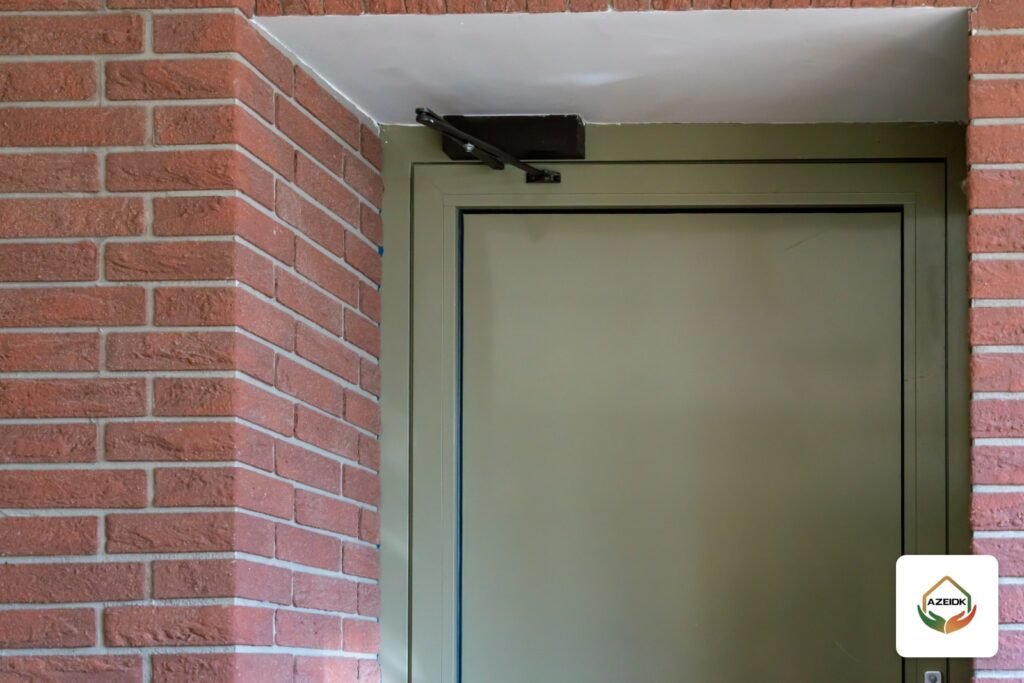
A magnetic door holder (magnetic door holder fire alarm release) is an electromagnet fixed to the wall or floor that keeps a fire door open only while it is powered. When the fire alarm panel goes into alarm, or the power fails, the holder lets go and the door closer shuts and latches the door. This is the accepted way to keep a fire door open in daily use. A wedge, chair or hook does the opposite: it stops the door from closing during a fire and is a clear violation.
Key takeaways
- A fire door only works if it is closed during a fire, so it must be self-closing or automatic-closing.
- A magnetic holder releases when its power is cut, so an alarm, a power failure or the release button all close the door.
- The holder does not close the door. A listed door closer on the leaf is always needed.
- The link to the fire alarm panel is a relay output, an addressable output module or a dedicated holder power supply, and it belongs in the cause and effect matrix.
- Wedges, chairs and mechanical kick-down holders are not allowed on fire doors because they do not release on alarm.
In this article
- What is a magnetic fire door holder and how does it work?
- Can a fire door be kept open? Why wedges are not allowed
- Ways to keep a fire door open, compared
- Magnetic door holder fire alarm connection: how is it wired to the panel?
- What should the engineer check before installing a magnetic holder?
- Testing and maintaining magnetic door holders
- Frequently asked questions
- Conclusion
What is a magnetic fire door holder and how does it work?
The device has two parts: an electromagnet mounted on the wall behind the door or on the floor, and a steel armature plate fixed to the door leaf opposite it. When the door is pushed open against the magnet, it stays there as long as the coil is energized.
The key principle is fail-safe operation: holding force exists only while power is present. If the fire alarm panel cuts the supply, the building loses power, or someone presses the release button found on many models, the door is released and the closer swings it shut until it latches. Operating voltage, holding force and current draw vary by model, so the datasheet is the reference. Holders tied to fire alarm panels commonly run on 24 VDC.
AZEIDK supplies magnetic door holders as part of its fire-rated doors and emergency exit solutions, together with fire-rated steel doors and the interface to fire alarm systems.
Can a fire door be kept open? Why wedges are not allowed
A fire door is part of a fire-resistance-rated wall. Its job is to keep fire and smoke in one part of the building and protect the exit stair or corridor. Held open with a wooden wedge, an extinguisher or a chair, the whole wall loses its value at the moment of the fire, and smoke reaches the route people depend on to get out.
That is why the standards require that fire doors are not blocked or prevented from closing, and that a door which must stay open in normal use is an automatic-closing door, held by a device that releases on smoke detection or alarm. NFPA 80, the US standard for fire doors, distinguishes a self-closing door, which stays closed and returns to closed after each use, from an automatic-closing door, which normally stays open and closes on alarm. NFPA 101, the Life Safety Code, in Section 7.2.1.8 requires the automatic release to be activated by smoke detectors in accordance with NFPA 72, and the hold-open mechanism to release on loss of power to the device. A Fire Engineering article on door holders put it plainly: propping a fire door with a wedge, a block or a bucket of sand is not an acceptable way to hold it open.
On site inspections, a wedged fire door is one of the most frequent findings, because staff open doors for easier movement or ventilation. The practical fix is not to forbid opening the door but to install a holder that meets the daily need without defeating the door. Related items are in the Salamah inspection checklist.
Ways to keep a fire door open, compared
| Method | Does the door close in a fire? | Verdict on a fire door |
|---|---|---|
| Wedge, chair or extinguisher behind the door | No | Not allowed |
| Mechanical kick-down holder or hook | No | Not allowed |
| Closer arm with mechanical hold-open, no release | No | Not acceptable on a fire door |
| Magnetic holder tied to the fire alarm panel or a smoke detector | Yes, on alarm or power loss | Acceptable when listed and installed to the design |
| Closer-holder with built-in smoke detector | Yes, on smoke detection | Acceptable when listed for this use |
Magnetic door holder fire alarm connection: how is it wired to the panel?
A common question is whether the holder needs a connection to the fire alarm panel. In most buildings it does. The holder does not detect fire; it carries out a command, and the command comes from the alarm system. Three arrangements are common.
1. Relay output from the panel
Conventional and addressable panels have relay or supervised power outputs that can be programmed to cut power to the holder circuit on any alarm, or on alarm in a given zone. This suits a small number of holders close to the panel.
2. Addressable output module on the loop
In addressable systems an output module is installed near a group of doors and drops their supply according to the programming. This lets you release only the doors on the fire floor or in one area, and it shortens the power cabling from the panel.
3. Separate holder power supply
Where there are many holders, they are fed from a dedicated power supply, and the panel cuts that supply with a control signal. The point is to keep the holder load off the panel standby batteries; the load is checked as part of the fire alarm battery calculation.
In every case the behaviour must be written into the cause and effect matrix: which alarm releases which door, and whether a door releases on any detector in the building or only on detectors in its area. In buildings with smoke extraction systems, door commands are coordinated with the fan sequence, because open doors change the airflow path.
What should the engineer check before installing a magnetic holder?
- A suitable closer: the door needs a closer that shuts it fully until it latches, strong enough to overcome door friction and air pressure.
- Mounting position: wall-mounted behind the door or floor-mounted depending on the opening angle, without the open door narrowing the corridor or exit route.
- Pairs of doors: where the leaves must close in sequence because of an astragal, a coordinator is needed so they close in the right order.
- Listing: the holder, the closer and any built-in detector must be listed for the use, and fitting them must not breach the door’s own listing. Check the datasheet and product certificates before ordering.
- Manual release button: lets staff close the door at the end of the day without pulling hard enough to damage the holder or closer.
- Records: door number, location, power source and controlling output, so testing and maintenance are straightforward later.
Testing and maintaining magnetic door holders
The basic test is done at handover and at every maintenance visit: trigger an alarm in the associated area and confirm every door released, closed fully and latched on its own. Then remove power from the circuit to confirm the doors also release on power loss, and try the release button on each holder.
The most frequent faults: a door that releases but does not latch because the closer is weak or badly adjusted; an armature plate that has shifted and no longer meets the magnet; or a holder that stays energized after the alarm because it was fed from a source the panel does not control. Record results in the fire safety log book, and holders and doors can be included in the periodic maintenance contract for fire systems.
Frequently asked questions
Can a fire door be left open?
Not with a wedge or anything else that will not release in a fire. It may be held open only by a device that releases automatically on alarm or smoke detection, with a closer that shuts it fully.
How does a fire door close by itself when the alarm sounds?
The fire alarm panel cuts power to the magnetic holder, the door is released, and the overhead closer shuts it until it latches.
Does a magnetic door holder need to be connected to the fire alarm panel?
In most buildings yes, through a relay output, an output module or a holder power supply controlled by the panel. The alternative is a closer-holder with a built-in smoke detector listed for this use.
What happens to the door during a power cut?
It releases and closes, because the holder is fail-safe and only holds while powered.
Is a magnetic holder enough without a closer?
No. The holder only releases the door; it does not close it. Without a closer the door stays open after release.
Can holders be fitted to exit stair doors?
Yes, where the approved design allows it, the doors are automatic-closing and they are tied to the fire alarm system. The decision rests with the designer and the building’s Civil Defense requirements.
Conclusion
A magnetic holder solves a real building problem: doors that need to stay open for daily traffic and closed during a fire. It works only with three things in place: a closer that shuts the door until it latches, a correct fire alarm interface written into the cause and effect matrix, and periodic testing that proves each door actually releases and closes.
Fire doors propped open with wedges, or doors you need to keep open the right way? Send the number of doors, their locations and the fire alarm panel you have, and our team will propose holders, the interface and the test method. Talk to the AZEIDK team
Related guides
- Fire Protection for Flour Mills and Feed Mills: Grain Dust, Silos and Detection in Hazardous Areas
- Hikvision Intercom DS-KIS604-S(B): Video Intercom Kit Components, Installation and Hik-Connect Phone Setup
- Kitchen Suppression Installation in Saudi Arabia: Survey, Nozzles, Detection and Gas Shut-Off
- Kitchen Fire Suppression System Price in Saudi Arabia: What Drives the Cost (Hood Length, Appliances, Automatic Gas Shut-off) and How to Compare Quotations