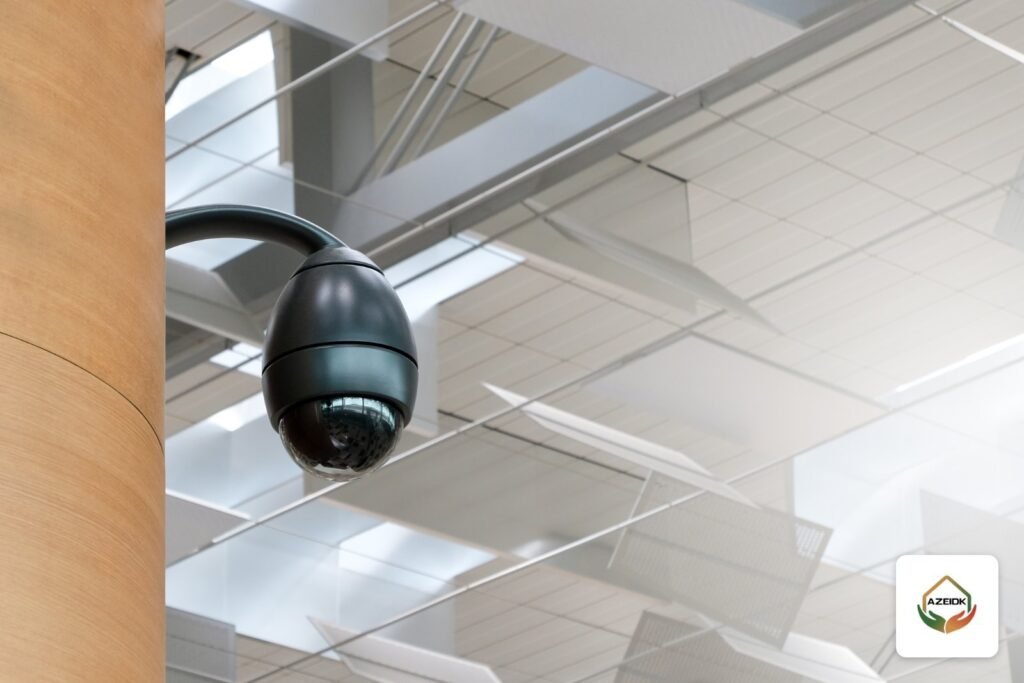
CCTV field of view is set by the lens: the shorter the focal length, the wider the angle and the shorter the distance at which detail is visible. A 2.8 mm lens covers a wide area close to the camera, 4 mm is the middle ground, and 6 mm gives a narrower view that identifies faces from further away. To know the distance at which a camera can recognize a person, designers use DORI, which is based on pixels per meter.
Key takeaways
- For the Hikvision DS-2CD2T46G2-2I4I network camera, the datasheet gives a horizontal FOV of 103° at 2.8 mm, 83° at 4 mm and 53° at 6 mm.
- DORI splits viewing into four levels: detection, observation, recognition and identification, each with a reference pixel density under IEC EN 62676-4:2015.
- Identification needs about 250 pixels per meter of scene width.
- You can calculate the distance yourself from resolution and horizontal FOV, then compare it with the datasheet DORI values.
- Lighting, mounting height and tilt reduce the real distance below the theoretical figures.
In this article
- What is CCTV field of view (FOV)?
- 2.8 vs 4 vs 6 mm: field of view and DORI distances compared
- What is DORI and how do you read it?
- How to calculate recognition distance yourself (CCTV field of view calculator)
- Which lens for which location?
- What reduces real distance below datasheet figures
- Frequently asked questions
- Conclusion
What is CCTV field of view (FOV)?
Field of view is the part of the scene the camera captures. Datasheets give three values: horizontal, vertical and diagonal FOV. The horizontal value matters most in design, because it is the cone drawn on the CCTV layout plan and it sets the scene width.
The angle depends on two things: the lens focal length in millimeters and the size of the image sensor. The standard optical relationship is:
Horizontal FOV = 2 × arctan (sensor width ÷ (2 × focal length))
This is why a 4 mm lens can give different angles on two cameras. The Hikvision DS-2CD2T46G2-2I4I (1/3″ sensor) datasheet lists 83° horizontal at 4 mm, while the DS-2CD2087G2-L (1/1.2″ sensor) lists 88° for the same focal length. The rule: always take the angle from the datasheet of the actual model, not from the focal length alone.
2.8 vs 4 vs 6 mm: field of view and DORI distances compared
The table below is taken from the official datasheet of the Hikvision DS-2CD2T46G2-2I4I (2688 × 1520), one of the cameras AZEIDK supplies. The figures are the manufacturer’s values.
| Lens | Horizontal FOV | Detection (D) | Observation (O) | Recognition (R) | Identification (I) |
|---|---|---|---|---|---|
| 2.8 mm | 103° | 60 m | 23.8 m | 12 m | 6 m |
| 4 mm | 83° | 80 m | 31.7 m | 16 m | 8 m |
| 6 mm | 53° | 120 m | 47.6 m | 24 m | 12 m |
Moving from 2.8 to 6 mm roughly doubles the identification distance but narrows the angle from 103° to 53°. You gain distance and lose scene width. For the analog Hikvision DS-2CE76K0T-LMFS, the datasheet gives 104.9° horizontal at 2.8 mm and 81.3° at 3.6 mm.
What is DORI and how do you read it?
DORI stands for four viewing levels used by designers. Manufacturer sources link them to IEC EN 62676-4:2015, the application guidelines standard for video surveillance systems. Each level is tied to pixels per meter of scene width:
| Level | Pixel density | What it means in practice |
|---|---|---|
| Detection | 25 px/m | You can tell a person or object is in the scene |
| Observation | About 62 px/m | General features such as clothing color and movement |
| Recognition | 125 px/m | You can recognize a person you already know |
| Identification | 250 px/m | You can establish identity with a high degree of confidence |
If a camera at an entrance must identify faces, the identification distance is the number that matters. In a large car park, detection or observation may be enough to see movement, with a second camera for identification at the gate.
How to calculate recognition distance yourself (CCTV field of view calculator)
Online calculators follow the same logic. You can do it by hand in three steps:
- Maximum scene width: horizontal pixels ÷ required density. For 2688 px at identification level: 2688 ÷ 250 ≈ 10.75 m.
- Angle factor: 2 × tan (horizontal FOV ÷ 2). For 6 mm at 53°, the factor is about 0.997.
- Distance: scene width ÷ angle factor = 10.75 ÷ 0.997 ≈ 10.8 m.
The result is 10.8 m, while the datasheet gives 12 m for identification. The same method gives about 4.3 m for the 2.8 mm lens against 6 m in the datasheet. The gap is normal: each manufacturer calculates DORI with its own assumptions. The horizontal FOV method is more conservative and is the safer basis when a clear face image is truly required. The design report should state which method was used.
Once resolution is chosen, size recording with the AZEIDK CCTV storage calculator.
Which lens for which location?
| Location | Typical goal | Lens direction |
|---|---|---|
| Room or small shop | See the whole space | 2.8 mm wide angle |
| Entrance, door or counter | Identify faces | 4 or 6 mm, set to the point where people pass |
| Long corridor | Recognize people along the corridor | 4 or 6 mm depending on length |
| Car park or perimeter | Detect movement at distance | 6 mm, a varifocal lens, or a PTZ camera |
A practical rule: do not ask one camera to cover a whole yard and identify faces at the same time. Use a wide camera for the overview and a narrower one at the forced pass point. If the distance is not known precisely at design stage, a varifocal lens lets the angle be set on site after installation, provided the final angle is recorded on the as-built drawing. Placement is covered in our guide to CCTV camera placement and coverage.
What reduces real distance below datasheet figures
- Mounting height and tilt: a camera mounted high and looking down sees the top of the head more than the face.
- Lighting: DORI distances assume a clear image. At night, IR or white-light range limits what the camera sees. The DS-2CD2T46G2-2I datasheet lists IR up to 60 m. See night vision with ColorVu and Starlight.
- Depth of focus: the DS-2CD2087G2-L datasheet gives depth of focus from 4.5 m at 2.8 mm and from 13 m at 6 mm. Objects closer than that may not be sharp.
- Backlight: a glass entrance behind a person darkens the face unless the camera supports wide dynamic range (WDR) and is set up correctly.
- Compression and bitrate: heavy compression removes detail even when pixel density is enough on paper.
Lens and model selection is part of AZEIDK’s technical selection of systems and equipment service, within our security and surveillance systems solutions. You can also compare models such as the Hikvision DS-2CD2087G2-LU and the Hikvision DS-2CE76K0T-LMFS.
Frequently asked questions
What is the field of view of a 2.8 mm CCTV lens?
It depends on the sensor. On the Hikvision DS-2CD2T46G2-2I4I it is 103° horizontal, and on the DS-2CE76K0T-LMFS it is 104.9°, per the datasheets.
2.8 mm or 4 mm for an entrance?
If you need to identify faces, a narrower lens such as 4 or 6 mm gives a longer identification distance. 2.8 mm suits seeing a whole space from close range.
What does DORI mean in CCTV?
Detection, Observation, Recognition and Identification. Each level has a reference pixel density per meter of scene width.
How many pixels do I need to identify a face?
The reference for identification is 250 pixels per meter of scene width, as manufacturer sources cite from IEC EN 62676-4:2015.
How do I use a CCTV FOV calculator?
Enter the resolution and the horizontal FOV, or the focal length and sensor size. The calculator returns scene width and the distance for each level. Always check the angle in the datasheet.
Why does my calculation differ from the datasheet DORI values?
Manufacturers calculate DORI with their own assumptions. The horizontal FOV method is more conservative. For critical points, test the camera on site.
Conclusion
Lens selection starts with one question: what do you need to see at this point, a general scene or a clear face? Then come the numbers: horizontal FOV from the datasheet, camera resolution, the DORI level required, and a check of lighting and mounting height. That way the choice between 2.8, 4 and 6 mm is made on facts, not by trial after installation.
Need help choosing lenses and placing cameras? The AZEIDK team reviews the goal of each point and proposes the right model and lens from the cameras we supply. Talk to the AZEIDK team
Related guides
- Are Sprinklers Mandatory? Civil Defense Sprinkler Requirements Under Saudi Fire Code SBC 801
- Fire Extinguishers in Makkah and Taif: Choosing Extinguishers for Hotels, Shops, Homes and Rest Houses and Preparing Them Before Peak Season
- BFT Parking Barriers: MOOVI vs GIOTTO vs MAXIMA vs MICHELANGELO by Boom Length, Duty and Access Control Integration
- UL or EN 54 for Fire Alarm Devices: How the Two Approvals Differ, What Saudi Consultants Ask For, and Why Not to Mix Them