A fire alarm system upgrade in an existing building is a different decision from choosing a system for a new one. Ceilings are closed, cables have been in place for years, and the building is occupied and cannot be left unprotected while work goes on. A sound decision therefore starts with an assessment of what is actually installed, not with the catalogue of the new panel.
This article explains when replacing a conventional system with an addressable one is justified, and how to build the scope of work: what to survey, what may be reused only after verification, how to phase the works, and which tests are needed before the system goes back into service. AZEIDK delivers this work through its existing systems assessment and scope definition service.
Key takeaways
- An upgrade starts with a documented assessment: drawings, fault history, cable condition and device compatibility.
- Existing cables can be reused only after measurements and tests show they meet the new addressable panel’s requirements.
- Class A circuits need a return path, and NFPA 72 restricts how outgoing and return conductors are routed, so old radial zones rarely qualify as they stand.
- Phased work keeps the building protected. Conventional zones can be connected temporarily to the addressable loop through a compatible zone monitor.
- Every modification is followed by reacceptance testing under NFPA 72 Chapter 14, then updated documentation.
In this article
- When does a fire alarm system upgrade become necessary?
- The regulatory frame in Saudi Arabia
- Why routine maintenance inspections are not enough to decide
- What the assessment of an existing system covers
- Reusing cables: only after verification
- Phasing the work without leaving the building unprotected
- Choosing the replacement addressable panel
- Reacceptance testing after the upgrade
- Common mistakes in upgrading existing alarm systems
- Frequently asked questions
- Conclusion
When does a fire alarm system upgrade become necessary?
Age alone does not mean a system must be replaced. Some practical signs, however, make continued repair more expensive and less reliable than an upgrade:
- No spare parts: a discontinued panel or detectors with no compatible replacement turns every fault into a temporary fix.
- Repeated false alarms and faults: a conventional system reports at zone level, so time is lost finding the device responsible. For how deferred repairs erode reliability, see our article on the risks of deferred fire system maintenance.
- Change of use or extension: added floors, new partitions or a change of occupancy can exceed the zones available on the current panel.
- New interface requirements: precise control of lifts, air handling units, fire doors and suppression systems is hard to achieve with a conventional panel and its limited outputs.
- Inspection findings: repeated Civil Defense notes on detector coverage, indication or event logging.
The basic differences between the two technologies are covered in our conventional vs addressable selection guide. This article deals with what happens when the old system is already installed.
The regulatory frame in Saudi Arabia
The binding reference is the Saudi Building Code, including the Saudi Fire Protection Code SBC 801, whose 2024 edition has been mandatory since 30 June 2025, as set out in our SBC 801 guide. The Saudi Building Code also includes the Saudi Existing Building Code (SBC 901), and Saudipedia notes that the code applies to existing buildings undergoing renovation, change of use, expansion or modification. The General Directorate of Civil Defense follows fire protection requirements throughout a building’s life, and facility licences are issued and renewed through the Salamah platform.
NFPA 72 is a technical reference that the designer adopts or the project documents specify. Its latest edition is 2025. The responsible engineer sets the edition that applies to the project; no clause should be assumed to be binding automatically.
Why routine maintenance inspections are not enough to decide
According to a Consulting-Specifying Engineer article on the 2025 edition of NFPA 72, that edition adds a new section (14.1.6) stating that testing and maintenance personnel are not required to evaluate the adequacy of the design of an existing, previously approved system. The article adds that where building changes affect the system’s ability to perform, it is appropriate to report the condition to the owner or their representative as an observation. In practice, a maintenance report tells you whether devices work. It does not necessarily tell you whether the design still suits the building after its changes.
That question is the subject of a pre-upgrade technical assessment. AZEIDK’s service runs in four stages: an inventory of the current systems, an inspection of condition and technical gaps, classification of findings and priorities, and a clear, reviewable preliminary scope of work with recommendations.
What the assessment of an existing system covers
The scope should rest on measurable findings. The table summarises the main items and their effect:
| Item | What is checked | Effect on scope |
|---|---|---|
| Documents | As-built drawings, fault log, maintenance reports and datasheets for existing devices | No drawings means a full field survey before pricing |
| Existing panel | Model, spare-part availability, zones and outputs in use | Whether the panel is replaced first or kept for a while |
| Detectors and call points | Type, age, condition and compatibility with the proposed zone monitor | Temporary retention or direct replacement |
| Cables | Type, cross-section, insulation resistance, continuity and route | Reuse after verification, or new cabling |
| Interfaces | Lifts, HVAC, fire doors, suppression and pumps | Number of input/output units and the cause and effect matrix |
| Current coverage | Device layout compared with how spaces are now used | Additional or relocated devices |
Reusing cables: only after verification
Cabling is the item most often assumed to be fine, because it is hidden in ceilings and conduits. A conventional zone circuit carries simple power and signalling, while an addressable loop carries continuous data communication between the panel and every device. Reuse should be decided only after:
- Checking the cable requirements in the installation manual of the selected addressable panel: cross-section, maximum length, and loop resistance and capacitance.
- Measuring and recording insulation resistance and continuity for each circuit.
- Confirming cable type and fire resistance where the project documents require it.
- Surveying the route: can the old radial circuits be turned into a closed loop that returns to the panel?
The last point is decisive where the design calls for Class A circuits. Under NFPA 72 Chapter 12, as summarised in City of San Diego Technical Bulletin FIRE 9-4 (June 2020), outgoing and return conductors must be routed separately, with limited exceptions such as a short distance at the panel entry and vertical runs protected by two-hour rated construction or circuit integrity cable. A radial circuit that ends at the last detector provides no such path, so some new cabling is usually needed. For device distribution and isolators, see our addressable loop design guide.
Phasing the work without leaving the building unprotected
Occupied hotels, hospitals and malls cannot switch the system off until installation ends. The work is divided into phases, each with interim protection arrangements agreed with the authority and the project documents. Common approaches:
| Approach | How it works | When it fits |
|---|---|---|
| Panel first | Install the addressable panel, connect conventional zones through zone monitors, then replace devices floor by floor | When existing detectors are compatible with the zone monitor |
| Parallel operation | The old panel serves zones not yet converted; the new one serves completed zones | When devices are not compatible, with a clear plan for transferring each zone |
| Single-stage replacement | Complete cabling and installation, then a cut-over in a short window | Unoccupied buildings, or those that accept a planned shutdown with interim measures |
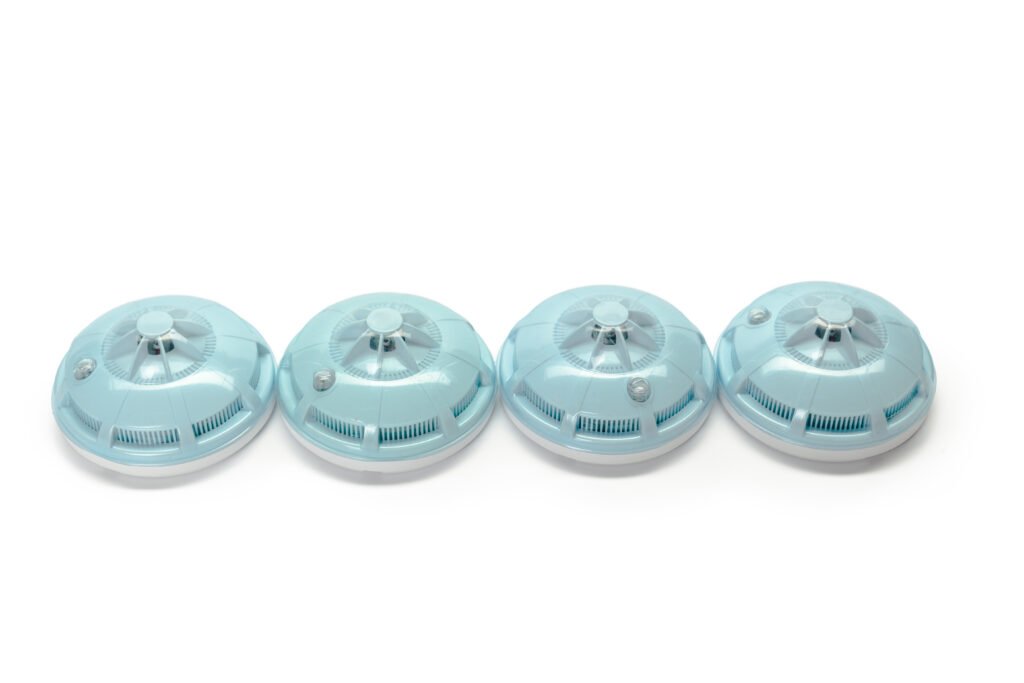
For the Context Plus systems AZEIDK supplies, the product page states that the zone monitor with isolator (55000-845IMC) connects up to 20 Series 65 conventional detectors to a Context Plus addressable system, with the zone powered from the loop. That makes it a useful phasing tool, but it does not make every old detector suitable: compatibility is checked model by model. Switch monitors and input/output units with isolators connect flow switches, tamper switches and controlled loads.
Choosing the replacement addressable panel
Panel size follows from the assessment: device count after the upgrade, number of loops and zones, and the need for networking and repeaters. Context Plus panels listed on AZEIDK’s Saudi site include:
- FirePlus addressable panels: 1 to 6 loops, up to 126 devices per loop and 64 zones, compatible with the XP95 and Discovery protocols, and networkable. The site notes that the UL certificate in the submittal covers the 1- to 4-loop models.
- ZFP panels: 1-, 2-, 4-, 6- and 8-loop models, a full-colour touchscreen and 40 zonal LEDs, with an optional onboard printer.
Check each model’s approval status on its own datasheet before approval. For panel selection criteria, see our fire alarm control panel buyer’s guide.
Reacceptance testing after the upgrade
NFPA 72 Chapter 14 distinguishes acceptance testing of a new system from reacceptance testing after a modification. As an NFPA Journal article (Spring 2021) explains, when site-specific software in an addressable system is changed, all functions known to be affected must be fully tested, plus 10% of unaffected initiating devices up to a maximum of 50, selected at random and including at least one device per initiating device circuit. The article adds that program comparison software helps find changes but is not a substitute for testing. Check these rules against the edition adopted for the project.
In a phased upgrade the test repeats at each stage, because every zone transfer is a database change. When replacement is complete, the system receives a full acceptance test, and the as-built drawings, cause and effect matrix and record of completion are updated. AZEIDK provides this through its testing, commissioning and handover service.
Common mistakes in upgrading existing alarm systems
- Pricing the upgrade as “panel replacement only” before cables and devices are surveyed.
- Assuming old cables suit an addressable loop without documented measurements.
- Connecting conventional detectors to a zone monitor without checking model compatibility.
- Converting radial circuits to a Class A loop with outgoing and return conductors in the same raceway outside the permitted exceptions.
- Switching off the old system before the new one is live, without an agreed interim protection plan.
- Testing only the new devices and neglecting interfaces with lifts, HVAC and fire doors.
- Not updating as-built drawings and the cause and effect matrix after each phase.
Frequently asked questions
Can the system be upgraded without replacing the cables?
Sometimes. It depends on cable type and size, insulation and continuity results, the new panel’s requirements, and whether a closed loop can be formed. The decision comes after these tests, not before.
Must all detectors be replaced at once?
Not necessarily. In some cases conventional zones can be connected temporarily to the addressable loop through a compatible zone monitor, with devices replaced in phases.
Are maintenance reports enough to define the upgrade scope?
No. Maintenance reports confirm that devices operate. An upgrade scope needs a review of the design against the building’s current use, the cabling and the interfaces.
What testing is needed after each phase?
Reacceptance testing that covers all affected functions plus a sample of unaffected devices under NFPA 72, then a full acceptance test at the end, together with any authority requirements.
Does an upgrade affect the Civil Defense licence?
Modifying the alarm system changes what the approved documents show, so coordinate with the authority and the project documents before the works and update the documents afterwards.
Conclusion
Upgrading a fire alarm system in an existing building is an engineering project with a defined scope, not a panel swap. A good decision starts with a documented assessment, reuses cables and devices only where tests prove them fit, phases the work so the building stays protected, and ends with reacceptance testing and updated documents.
Does your conventional system need a clear decision? Send us the drawings you have and the fault history, and we will work out with you what to repair, what to upgrade and the scope of each phase. Contact the AZEIDK team
Related guides
- Wheeled Fire Extinguisher (50 kg Unit): When You Need One Instead of a Portable, 25 to 150 kg Sizes, Hose Length and Placement
- Intrusion Alarm Systems: Components, Design and Integration
- WATEX Fire Pumps: The Complete Guide to WATEX Pumps in Saudi Arabia (Models, Approvals, Capacities)
- Fire Alarm System Price in Saudi Arabia: What Drives the Cost (Conventional vs Addressable, Device Count, Cabling, Programming) and How to Compare Quotes