A hotel PBX differs from an office phone system in one way: the user is a guest who changes every night. The room phone must know the guest’s name at check-in, wake them on time, post outside calls to the folio, then lock down at check-out. Within AZEIDK’s network and communication systems, we treat the hotel PBX as one system tied to the front desk, the property management system and the network.
For the full picture of the fire and security systems hotels and serviced apartments need and the Civil Defense requirements that apply, see our safety systems guide for hotels and serviced apartments.
Short answer: The right hotel PBX is usually an IP PBX with a hospitality module: check-in and check-out, wake-up calls, do not disturb, room status and guest call billing, plus a FIAS link to the property management system where one is used. Extensions roughly match rooms and offices, while outside lines are sized from concurrent calls at peak time.
Key takeaways
- Hospitality features are often a paid add-on or module, not enabled by default on every IP PBX.
- PMS integration with systems such as Oracle OPERA normally runs over the FIAS protocol; confirm the model and firmware support it.
- Extensions, outside lines and concurrent calls are three different numbers.
- PBX paging is an operational tool and does not replace the voice evacuation function of the fire alarm system.
- The network comes first: a separate voice VLAN, PoE switches and backup power.
In this article
- How is a hotel PBX different from an office PBX?
- Which features does a hotel PBX need?
- Can the PBX be integrated with the hotel PMS?
- Room phones, reception and paging
- How many lines does a hotel need?
- IP, cloud or analogue PBX for a hotel?
- Network and power behind a hotel PBX
- What drives hotel PBX cost, and what should the quote include?
- Common mistakes with hotel phone systems
- Frequently asked questions
- Conclusion
How is a hotel PBX different from an office PBX?
In an office, an extension belongs to an employee and permissions are set once. In a hotel, it belongs to a room and permissions change with every guest. At check-in, outside calling opens if management allows it and the guest name shows at reception. At check-out, permissions close, wake-up calls are cleared and call charges move to the bill.
Manufacturers therefore offer hospitality modules. Yeastar, for example, describes a Hotel Management Module for the P-Series as a paid add-on, with room-to-room and outbound calls disabled by default and granted per room. For IP PBX basics, see IP PBX for business.
Which features does a hotel PBX need?
Functions listed in Yeastar and Grandstream hotel documentation. Availability depends on model, firmware and subscription, so ask for each in writing.
| Feature | What it does | Used by |
|---|---|---|
| Check-in / check-out | Links the guest name to the room extension and opens or closes calling permissions | Front desk |
| Room move | Moves guest data and settings to another extension | Front desk |
| Wake-up call | Schedules an automatic call to the room, with a log | Front desk or guest |
| Do not disturb (DND) | Stops the room phone ringing | Guest or front desk |
| Room status | Housekeeping enters cleaning or maintenance status by code from the room phone | Housekeeping |
| Minibar | Posts minibar consumption by code from the phone | Housekeeping |
| Call billing | Applies rates to outside calls and adds them to the guest bill | Management, accounts |
| Per-room class of service | Sets what a room may dial: internal, local or international | Management |
| Service and emergency numbers | Short codes for reception, room service and maintenance, and an emergency number from every room | Guests |
Some functions run on the PBX alone; others need the PMS link. Grandstream’s UCM6300 series includes a Local PMS with check-in and check-out, wake-up, room status and billing, which suits small hotels and serviced apartments without an external PMS.
Can the PBX be integrated with the hotel PMS?
Yes, and it saves front-desk time. A check-in on the PMS is sent to the PBX, which opens the room and tags the extension with the guest name. Wake-up requests entered in the PMS are placed by the PBX. In return, the PBX sends outside call records, minibar codes and housekeeping status back to the PMS.
The FIAS protocol
The common protocol for this link is FIAS (Fidelio Interface Application Specification), used by systems such as Oracle Hospitality OPERA and Micros Fidelio. Yeastar states its integration works with any FIAS-compatible PMS, as an add-on on specific P-Series models. Grandstream states OPERA integration is supported on the UCM6300 series and CloudUCM from a minimum firmware version.
What to check before buying
- The PMS name and version, and whether it holds a PBX interface licence.
- Whether the proposed model and firmware support FIAS or a direct link to your PMS.
- Who configures the PMS side, usually the PMS vendor.
- The functions to be tested at handover: check-in, check-out, room move, wake-up, minibar, room status and call posting.
Setting up and testing this link is part of our programming and systems integration service.
Room phones, reception and paging
Guest room phones
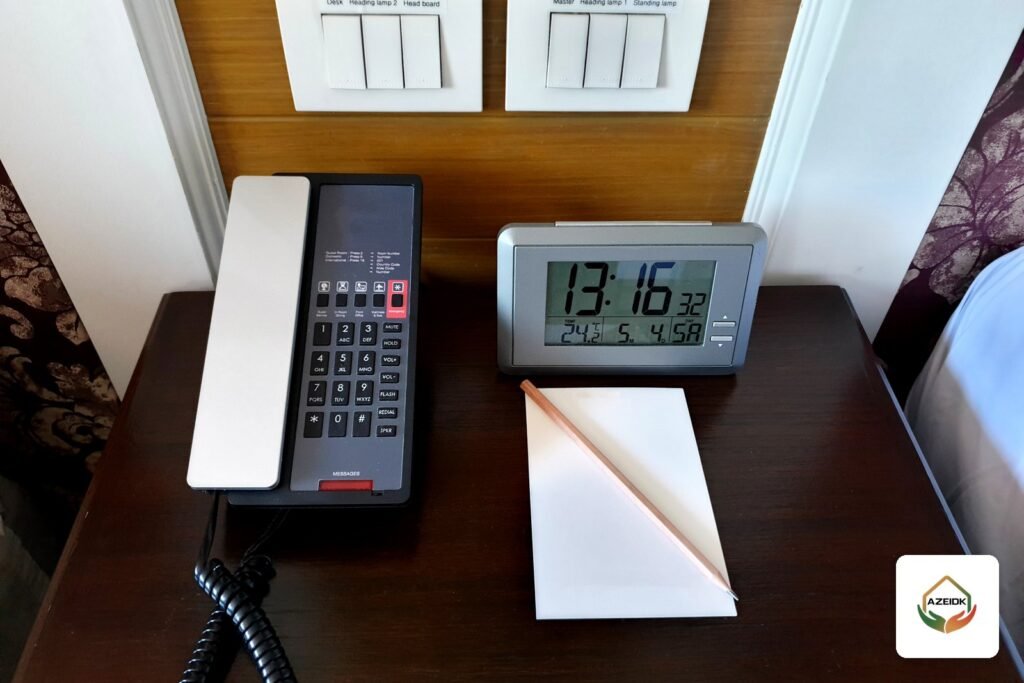
A room phone needs simplicity: one SIP line, programmed service keys for reception, room service and emergency, and PoE power from the switch so there is no adapter by the bed. Some manufacturers make hotel ranges, such as Fanvil’s H series, some with a USB port for charging the guest’s mobile. Bathrooms take a small extra or wall-mounted set, depending on the room design.
Reception and operator desk
Reception needs a display phone with keys showing extension status, or a PC operator panel such as Yeastar’s Linkus panels, which show room status and handle check-in, check-out and transfers. An IVR and queues cover busy periods.
Mobile staff
Maintenance, housekeeping and security staff need DECT cordless or Wi-Fi phones registered on the PBX. Wi-Fi handsets depend on coverage in corridors and back-of-house areas, see business Wi-Fi network design.
Paging
The PBX supports one-way paging to a group of phones, multicast paging, two-way intercom, and scheduled announcements. This is an operational service only, not a substitute for the voice evacuation function of the fire alarm system, which has its own design and approval requirements.
How many lines does a hotel need?
This question mixes three numbers:
- Extensions: one per room, plus bathroom phones if any, then reception, offices, kitchen, restaurant, security, service rooms and lifts where needed.
- Concurrent calls: the highest number of calls through the PBX at the same moment at peak, far lower than the extension count.
- Outside lines: SIP trunk channels or conventional lines from the provider, sized from concurrent outside calls only.
Peak load depends on occupancy, a reservations desk, the guest mix and how often guests use the room phone rather than their mobile. No fixed ratio fits every hotel. Call records from an operating hotel are the best basis; for new projects, agree a written assumption and leave room to grow. Most IP PBXs accept more channels and extensions later through licences, up to the model limit, so ask for that limit.
IP, cloud or analogue PBX for a hotel?
| Item | On-site IP PBX | Cloud PBX | Analogue PBX |
|---|---|---|---|
| Where it runs | Appliance or server in the hotel | Provider’s server | Unit in the hotel |
| Hospitality features and PMS link | Available on many models as an add-on | Offered by some providers; depends on internet | Limited, model dependent |
| Internal calls during internet outage | Continue | Affected | Continue |
| Cabling | Same data network with PoE | Same data network | Separate telephone cabling |
| Suits | Most hotels and new projects | Small branches and serviced apartments with stable internet | Existing buildings with phone cabling that cannot be replaced |
In older buildings, analogue sets can stay on through FXS gateways to an IP PBX, with a phased migration. For the brands AZEIDK supplies, see IP PBX and IP phone brands in Saudi Arabia and the Yeastar, Grandstream and Fanvil pages.
Network and power behind a hotel PBX
Voice quality depends on the network first. Review:
- A separate voice VLAN with QoS priority, isolated from guest Wi-Fi.
- PoE switches with a power budget that covers all phones at once, with margin.
- A data outlet at every phone location within the structured cabling, including bathrooms with phones.
- UPS for the PBX and core switches, so reception and emergency calling stay up during a power cut.
- Security against toll fraud: strong passwords, restricted remote access and limits on international calls from rooms.
Telecom devices and IP phones in Saudi Arabia are subject to conformity requirements through the SABER platform, see certificates of conformity for network and telecom devices.
What drives hotel PBX cost, and what should the quote include?
Cost depends on the number of extensions and concurrent channels, the hospitality module and its subscription, the PMS interface licence, the type and number of phones, the state of the network, and whether cabling exists or is new. The quotation should state:
- PBX model and its maximum extensions and concurrent calls.
- Licences and subscriptions with their terms: hospitality module, PMS integration, apps.
- Phone models and quantities per category: rooms, bathrooms, reception, offices, cordless.
- Trunk type and channel count, and who contracts with the service provider.
- Switches, data points and backup power, or a statement that they are excluded.
- Programming scope: service numbers, IVR, call rates, permissions and paging.
- Handover test list, front-desk training, warranty and post-commissioning support.
Common mistakes with hotel phone systems
- Buying a generic IP PBX, then finding the hotel module or PMS link is not supported on that model.
- Leaving international dialling open from rooms with no rate or limit, so calls are never posted to the bill.
- Running phones on the guest network, so calls break up at busy times.
- No backup power for the PBX, so reception loses contact with rooms during an outage.
Frequently asked questions
What PBX features does a hotel need?
Check-in and check-out, wake-up calls, DND, room status, minibar, guest call billing and per-room permissions, each confirmed on the proposed model and subscription.
Does a hotel need an IP PBX?
For most new hotels, yes: IP PBXs offer hospitality features and PMS integration on the data network. Older buildings can keep analogue phones through FXS gateways.
How many lines does a hotel need?
Extensions roughly match rooms and offices, while outside lines are sized from concurrent calls at peak. There is no fixed ratio; use call records or a written assumption.
Can the PBX connect to the hotel management system?
Yes, usually through FIAS with systems such as Oracle OPERA, passing check-in, check-out, wake-up and call data. It needs model support and a PMS-side licence.
Can lines be added to the PBX later?
On most IP PBXs, yes, through licences or channels up to the model’s limit.
Does an IP PBX need a strong network?
It needs an organised network more than fast internet: a voice VLAN with priority, enough PoE and backup power.
What is the difference between an on-site and a cloud PBX?
An on-site PBX runs in the hotel and keeps internal calls going if the internet drops. A cloud PBX runs at the provider with less hardware, but depends on the internet.
Conclusion
Start from what the front desk and guests need, then the PMS link, then network and power. Put each item in the quotation and test it at handover. For AZEIDK’s other hotel solutions, see the hospitality page.
Fitting out a hotel or serviced apartments? Send us your room and office count and your PMS, and we will propose the PBX, phones and network with a clear programming scope. Talk to the AZEIDK team
Related guides
- IP PBX Price in Saudi Arabia: What Drives the Cost (Lines, Phones and Licensing) and How to Compare Quotes
- CCTV Field of View: 2.8 vs 4 vs 6 mm Lens and DORI Distance Calculation
- WATEX UL-Listed Foam Bladder Tanks: Capacities, Specifications, Ratio Controllers and Sizing
- FM-200 Generator vs Aerosol: Differences, When to Choose Each, and Equivalent Sizes