The American Fire Control FM-200 system comes in two configurations: AFC-227, where the agent cylinder is superpressurized with nitrogen, and AFC-P227, which adds a separate nitrogen driver cylinder for longer pipe runs and multi-cylinder systems. The choice depends on pipe length, cylinder count and the flow calculation, not on price alone.
This guide sets out what the manufacturer’s catalogue states for the American Fire Control (AFC) FM-200 system supplied by AZEIDK: cylinder sizes and fill ranges, working and test pressures, actuation and supervision devices, and what consultants check in the submittal before approval.
Key points
- Both configurations use HFC-227ea, sold under the trade name FM-200.
- AFC-227 cylinders are superpressurized with nitrogen to 24.8 bar at 21°C, with water capacities from 26.8 to 175 L.
- AFC-P227 connects the agent cylinder to a 68 L nitrogen cylinder filled to 60, 70 or 80 bar, depending on agent cylinder size.
- Agent cylinder rated working pressure is 34.5 bar and hydrostatic test pressure 137.9 bar, per the catalogue.
- AZEIDK’s product page lists UL File EX29550 and FM Approval PID PR472172; approval applies to the system as a whole, not to a single component.
In this article
- What is the American Fire Control FM-200 system?
- AFC-227 vs AFC-P227
- FM-200 cylinder sizes and fill ranges in the AFC system
- Working pressures, test pressures and supervision
- How is the AFC FM-200 system actuated?
- Nozzles and room height limits
- What consultants check in an AFC FM-200 submittal
- Common supply mistakes
- Supplying the AFC FM-200 system in Saudi Arabia
- Frequently asked questions
- Summary
What is the American Fire Control FM-200 system?
It is a total flooding system that stores liquid HFC-227ea under nitrogen pressure and releases it through piping and nozzles so the protected room reaches its design concentration. It suits enclosed rooms with water-sensitive or hard-to-replace equipment, such as control rooms, electrical rooms, archives and high-value stores, as part of AZEIDK’s special fire suppression systems.
The usual design reference for clean agent systems is NFPA 2001, under which halocarbon agents are discharged within about 10 seconds; in Saudi Arabia the Saudi Building Code (SBC) and Civil Defense requirements remain binding. See our NFPA 2001 guide and the overview article on the FM200 fire suppression system.
AFC-227 vs AFC-P227
The difference lies in what pushes the agent through the pipework.
AFC-227: single cylinder superpressurized with nitrogen
Liquid HFC-227ea is superpressurized with nitrogen to 24.8 bar (360 psi) at 21°C inside the agent cylinder. This is the common arrangement for small and medium rooms where the cylinder sits close to the hazard and the pipe network is short.
AFC-P227: agent cylinder with a nitrogen driver
A separate nitrogen cylinder feeds the agent cylinder through a flexible hose and a 20 mm nitrogen inlet valve fitted with its own rupture disc. AZEIDK’s product page describes this configuration for longer or more complex piping and multi-cylinder systems. The catalogue lists extra parts it needs, including the NNC-06 nitrogen needle cylinder and the interlock tube.
| Item | AFC-227 | AFC-P227 |
|---|---|---|
| Propellant | Nitrogen inside the agent cylinder | Separate nitrogen cylinder |
| Agent cylinders | AFC-26 to AFC-175 | AFC-P63 to AFC-P175 |
| Nitrogen cylinders | None | ANC68-60, ANC68-70, ANC68-80 |
| Typical use | Small and medium rooms, short networks | Longer networks, multi-cylinder systems |
FM-200 cylinder sizes and fill ranges in the AFC system
The catalogue gives each cylinder a water capacity and a fill range in kilograms. The actual agent weight comes from the design concentration calculation for the room volume; the designer then selects the smallest cylinder whose range covers that weight. For how FM-200 compares with other clean agents, see our clean agent comparison.
| Model | Water capacity (L) | Fill range (kg) | Valve (mm) |
|---|---|---|---|
| AFC-26 | 26.8 | 13.3 to 25.6 | 40 |
| AFC-40 | 40.2 | 19.9 to 38.4 | 40 |
| AFC-63 / AFC-P63 | 63.0 | 31.2 to 60.6 | 40 |
| AFC-68 / AFC-P68 | 68.0 | 33.7 to 65.4 | 40 |
| AFC-89 / AFC-P89 | 89.0 | 44.1 to 85.6 | 40 |
| AFC-115 / AFC-P115 | 115.4 | 57.2 to 111.0 | 50 |
| AFC-175 / AFC-P175 | 175.0 | 86.7 to 168.3 | 50 |
For AFC-P227 the catalogue pairs each agent cylinder with a specific driver: ANC68-60 with P63 and P68, ANC68-70 with P89, and ANC68-80 with P115 and P175. All three nitrogen cylinders hold 68 L of water capacity and differ only in fill pressure: 60, 70 and 80 bar at 21°C.
Working pressures, test pressures and supervision
- Agent cylinder: 24.8 bar fill at 21°C, 34.5 bar (500 psi) rated working pressure, 137.9 bar (2,000 psi) hydrostatic test. Carbon steel with red powder coating, mounted vertically.
- Nitrogen cylinder: 147 bar rated working pressure and 406.7 bar test pressure; manganese steel made without a weld seam with grey coating.
- Gauges: a standard gauge, or a 2n1 gauge that combines the pressure reading with an electrical low-pressure switch. On the agent cylinder the switch is set to operate at 19.9 ± 1.5 bar on falling pressure.
- Safety devices: rupture disc, safety plug and valve protection caps for transport.
Wiring the low-pressure switch to the fire alarm or releasing panel turns a slow leak into a clear trouble signal instead of something found only at the next inspection.
How is the AFC FM-200 system actuated?
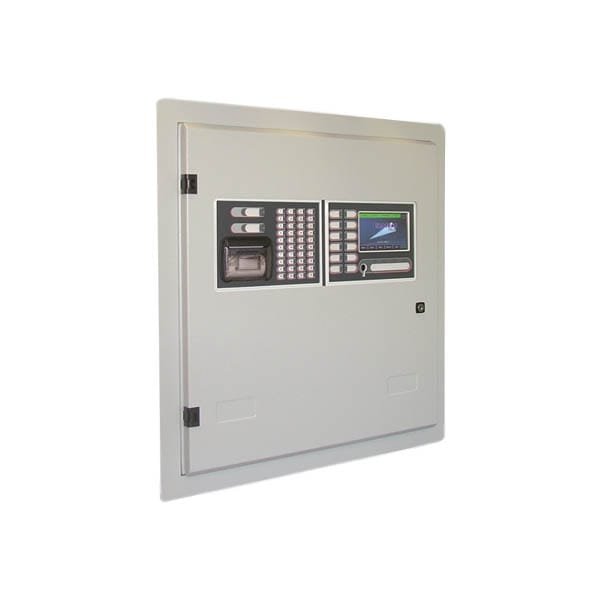
- Solenoid cutter AFC-SC01: 24 VDC, 1.7 A, opens the cylinder valve on a panel signal. A supervisory switch (AFC-SS01) reports its status.
- Pilot cylinder AFC-PC01: a 1.1 L CO2 cylinder used to open cylinders pneumatically.
- Pneumatic actuator: uses line pressure to open additional cylinders in multi-cylinder systems.
- Manual emergency release: must be protected against accidental operation.
These devices work with a releasing panel, smoke and heat detectors, manual release stations, hold and abort switches and a discharge pressure switch. The sequence and its pre-handover testing are covered in FM200 testing procedure.
Nozzles and room height limits
The AFC catalogue lists nozzles from 15A to 50A (½ in to 2 in) in 360° and 180° patterns, with the orifice drilled to the flow calculation. It gives a protected height of 0.3 to 4.5 m and a maximum nozzle distance of 0.3 m below the ceiling. Anything beyond these limits needs an additional nozzle tier or another arrangement set by the designer under the manufacturer’s manual.
What consultants check in an AFC FM-200 submittal
- System-level approval: the product page states that every supplied component must fall under the same system approval. UL and FM numbers are matched against the official directories.
- Flow calculation: output from the system’s listed software: agent quantity, pipe sizes, nozzle orifices and discharge time.
- Cylinder fill range: the calculated agent weight falls inside the selected cylinder’s range.
- Configuration: why AFC-227 or AFC-P227 was chosen, based on network length and cylinder count.
- Enclosure integrity: the test plan before handover; see room integrity test.
- Civil Defense requirements: drawings and documents for the project through Civil Defense approval support.
Common supply mistakes
- Choosing an oversized cylinder so the agent weight falls below its minimum fill.
- Mixing components from different manufacturers, which voids the system approval.
- Ignoring the 4.5 m height limit in tall halls or deep ceiling voids.
- Leaving the low-pressure switch unwired, so leaks go unnoticed.
- Postponing the integrity test until after installation, then finding openings that need sealing.
For the work after supply, see FM200 installation and FM-200 system maintenance.
Supplying the AFC FM-200 system in Saudi Arabia
AZEIDK uses AFC-227 as its standard American Fire Control FM-200 configuration and supplies AFC-P227 on request, through its technical supply service, with catalogue and datasheet. Related work includes engineering design and calculations, installation, testing and maintenance. For the rest of the brand’s range, see American Fire Control in Saudi Arabia.
Frequently asked questions
What is the difference between AFC-227 and AFC-P227?
AFC-227 superpressurizes the agent cylinder with nitrogen directly. AFC-P227 uses a separate nitrogen cylinder to drive the agent, which suits longer networks and multi-cylinder systems.
What FM-200 cylinder sizes does the AFC system use?
From AFC-26 (26.8 L water capacity) to AFC-175 (175 L), with fill ranges from 13.3 kg in the smallest to 168.3 kg in the largest, per the catalogue.
What pressure is an AFC FM-200 cylinder?
Fill pressure is 24.8 bar (360 psi) at 21°C and rated working pressure is 34.5 bar (500 psi).
Is the AFC FM-200 system UL listed and FM approved?
AZEIDK’s product page lists UL File EX29550 and FM Approval PID PR472172. Check the numbers in the official directories and confirm all components sit under the same system approval.
What is the maximum room height with AFC nozzles?
The catalogue gives a protected height of 0.3 to 4.5 m, with the nozzle no more than 0.3 m below the ceiling.
Can parts from another manufacturer be fitted to an AFC cylinder?
This is not advisable, because the approval covers the system with its listed components; a substitute part can void it.
Summary
The AFC FM-200 system is selected in two steps: the configuration (AFC-227 or AFC-P227) based on the network and cylinder count, then the cylinder whose fill range covers the calculated agent weight. System approval, flow calculations and enclosure integrity are then checked before handover.
Need a quote for an FM-200 system for a specific room? Send the room dimensions, layout and proposed cylinder location, and AZEIDK will prepare the calculation, catalogue and submittal. Contact AZEIDK
Related guides
- Dahua in Saudi Arabia: Cameras, Intercom and Turnstiles from AZEIDK
- Fitting Out a New Fuel Station with Safety Systems: From Drawing Review to Installation, Handover and Salamah
- Fire Extinguishers in Schools: Right Type for Each Space, Quantity, Mounting and Inspection
- NFPA Meaning: What NFPA Stands For and How to Read Its Codes in Saudi Projects