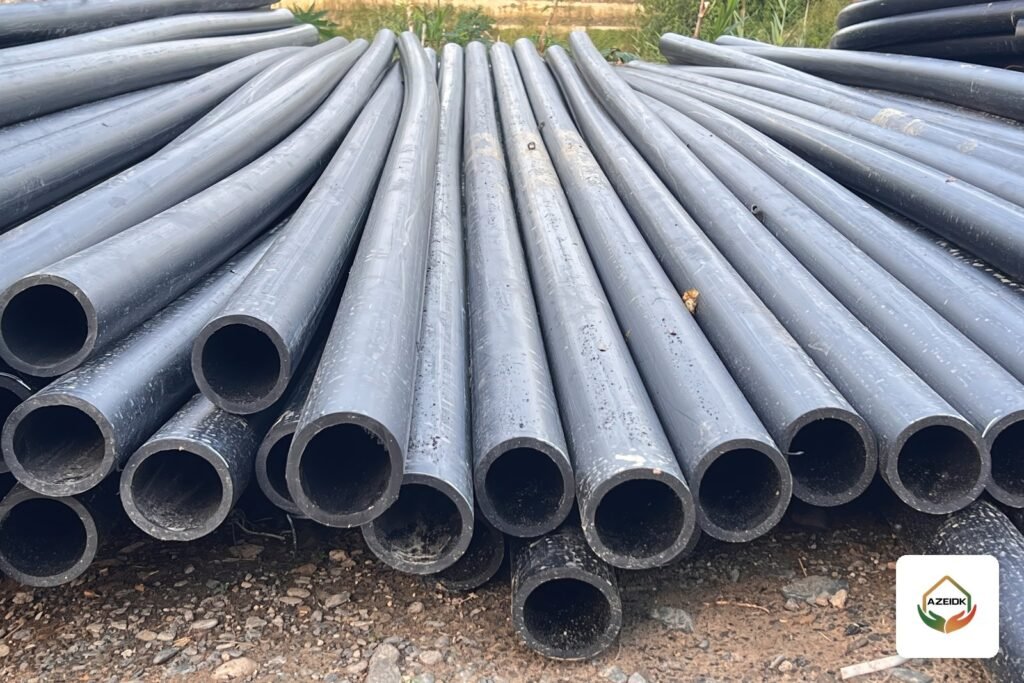
HDPE (high density polyethylene) pipe is a common choice for buried fire water networks, such as the main that feeds fire hydrants around compounds, factories and warehouses. This guide covers when HDPE suits a fire network, how to choose the pressure class, what the consultant usually asks for, and how the joints are made, using aj pipe, made by Abuljadayel Factory in Jeddah, as a worked example.
AZEIDK supplies these pipes as part of its firefighting systems work in Saudi Arabia, together with fire hydrants, valves and fire pumps.
Quick answer
- HDPE pipe is used for the buried parts of a fire water network. Exposed sections above ground are usually metallic, as the project specification sets.
- Choose the pressure class from the network’s maximum working pressure and the test pressure, not from the diameter alone.
- Pipe-to-pipe joints are heat fused. Transitions to valves and hydrants use flange adaptors or mechanical joints.
- Before ordering, confirm whether the consultant accepts ISO 4427 pipe or requires pipe listed by FM or UL.
When is HDPE pipe used in a fire network?
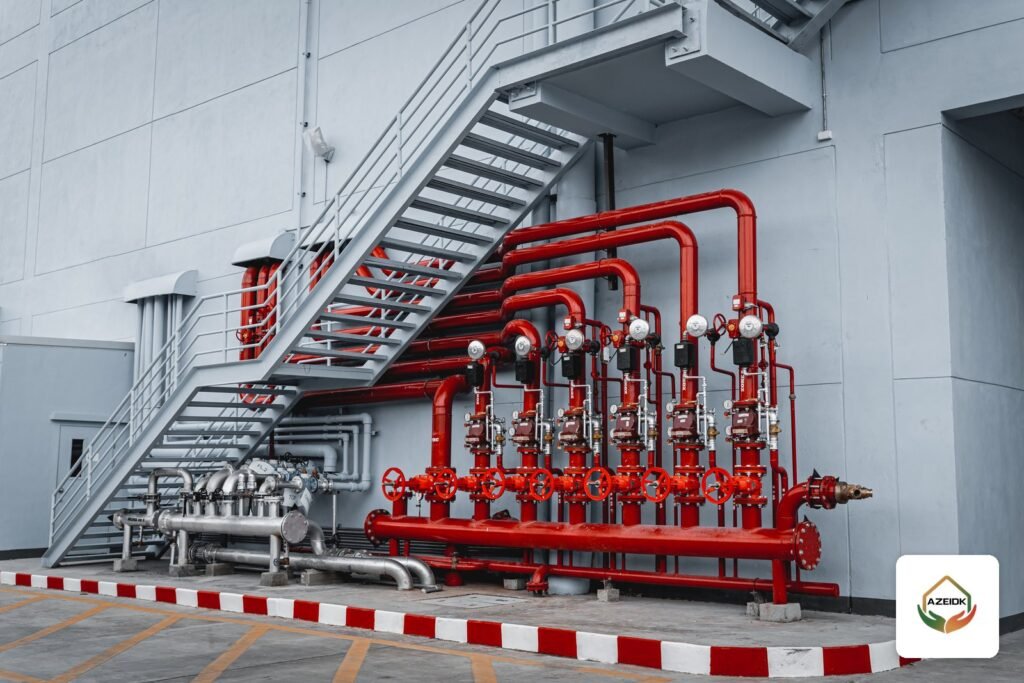
HDPE belongs in the buried lines: the main from the pump room or fire water tank, the ring main around a building or site, and the branches to outdoor fire hydrants and fire department connections. Polyethylene does not rust and needs no coating or cathodic protection in the soil, which matters on coastal sites and in saline ground.
Polyethylene is a plastic, so it is not normally left exposed inside buildings or on the visible parts of the network. The line changes to metallic pipe where it leaves the ground towards a riser, the pump room or a hydrant, and the project specification sets the transition point and material. For steel sprinkler pipe inside buildings, see the KDI fire sprinkler pipe page.
Choosing the pressure class: SDR and PN
HDPE pipe is graded by SDR, the outside diameter divided by the wall thickness. A lower SDR means a thicker wall and a higher nominal pressure (PN). This is the PE100 range from the aj pipe catalogue, to DIN 8074 and ISO 4427:
| Class | Nominal pressure (bar) | Outside diameters in the catalogue (mm) |
|---|---|---|
| SDR 9 | 20 | 20 to 560 |
| SDR 11 | 16 | 20 to 630 |
| SDR 13.6 | 12.5 | 20 to 630 |
| SDR 17 | 10 | 25 to 630 |
| SDR 21 | 8 | 40 to 630 |
| SDR 26 | 6.3 | 40 to 630 |
The manufacturer’s nominal pressures are for water pipes with a safety factor of 1.25. In a fire network the designer compares this figure with the highest pressure the network sees, including the fire pump churn pressure, and with the hydrostatic test pressure the project requires. So do not pick a lighter class just because the diameter is large. For friction loss along the main, see Hazen-Williams for fire pipe.
Standards and certificates the consultant asks for
An HDPE material submittal usually holds the manufacturer catalogue, dimension tables, quality certificates and test reports. The aj pipe submittal that AZEIDK provides shows the pipes are made and tested to:
- PE100 material, dimensions to DIN 8074 and requirements to DIN 8075.
- International standard ISO 4427, adopted in Saudi Arabia as SASO ISO 4427.
- Material suitability for contact with water tested to BS 6920, with test reports from laboratories in Germany, Sweden and the UK.
- Factory quality control tests, including internal pressure resistance to ISO 1167, carbon black content and density.
Note that some projects require pipe listed by FM or UL for fire service. The aj pipe submittal does not include those certificates, so settle the consultant’s requirement before ordering. For what to check in pipe certificates in general, see fire pipe mill test certificates.
Jointing methods
HDPE pipes are joined to each other by heat fusion. The two usual methods are butt fusion, where a machine heats both pipe ends and presses them together, and electrofusion fittings with a built-in heating wire, which suit tight spaces and repairs. A sound fused joint becomes one piece with the pipe, with no gaskets.
At a fire hydrant, gate valve or metallic pipe, the usual transition is a polyethylene stub end with a metal backing flange, or a suitable mechanical joint. The aj pipe submittal states that the factory supplies the required fittings but does not set a jointing method, so the jointing and welding procedure is fixed in the project method statement.
Installation and site testing
The pipe is laid in a trench on a bed of sand or fine soil with no sharp stones and covered before full backfill. Because the pipe is not metallic, metal detectors cannot trace it, so a warning tape or tracer wire is often laid above the line as the project specifies. After installation the line is flushed and hydrostatically tested at the pressure and duration the project sets, before it is connected to the hydrants. For hydrant selection, see AFC dry and wet barrel fire hydrants and fire hydrants for residential compounds.
aj pipe range available from AZEIDK
aj pipe is the brand of Abuljadayel Factory for GRP & PE Pipes in Jeddah Industrial City. The factory states that it produces pipe from 20 to 630 mm OD, in 12 m lengths from 110 mm upwards and in coils up to 110 mm. The classes available from AZEIDK, each with its dimension table and datasheet:
- HDPE PE100 pipe SDR 9, PN 20
- HDPE PE100 pipe SDR 11, PN 16
- HDPE PE100 pipe SDR 13.6, PN 12.5
- HDPE PE100 pipe SDR 17, PN 10
All products of the brand are on the aj pipe brand page.
FAQ
Can HDPE pipe be used inside a building for sprinklers?
The usual fire use of HDPE is buried lines outside the building. Sprinkler networks inside buildings are normally built with metallic pipe or with materials listed for that use, as the project specification sets.
Which class should I use for a fire main?
The designer sets it from the highest network pressure and the required test pressure. Heavier classes such as SDR 11 at 16 bar and SDR 9 at 20 bar give more margin than the lighter ones.
Is aj pipe made in Saudi Arabia?
Yes. It is made by Abuljadayel Factory in Jeddah Industrial City, as shown in the factory documents.
How do I get the full submittal?
The datasheet is attached to each product page. For a full project submittal or a quotation, contact AZEIDK.
Related guides
- Context UL-Plus UL Listed Detectors: Optical, Ionisation, Heat and Multisensor on the 45681-210IMU Base
- FM-200 Questions and Answers: 15 Questions on FM-200 and Clean Agent Systems in Saudi Arabia
- Helipad Fire Protection: Foam Systems, Monitors and NFPA 418 Requirements
- FirePro Aerosol Fire Suppression for Electrical Rooms and Panels