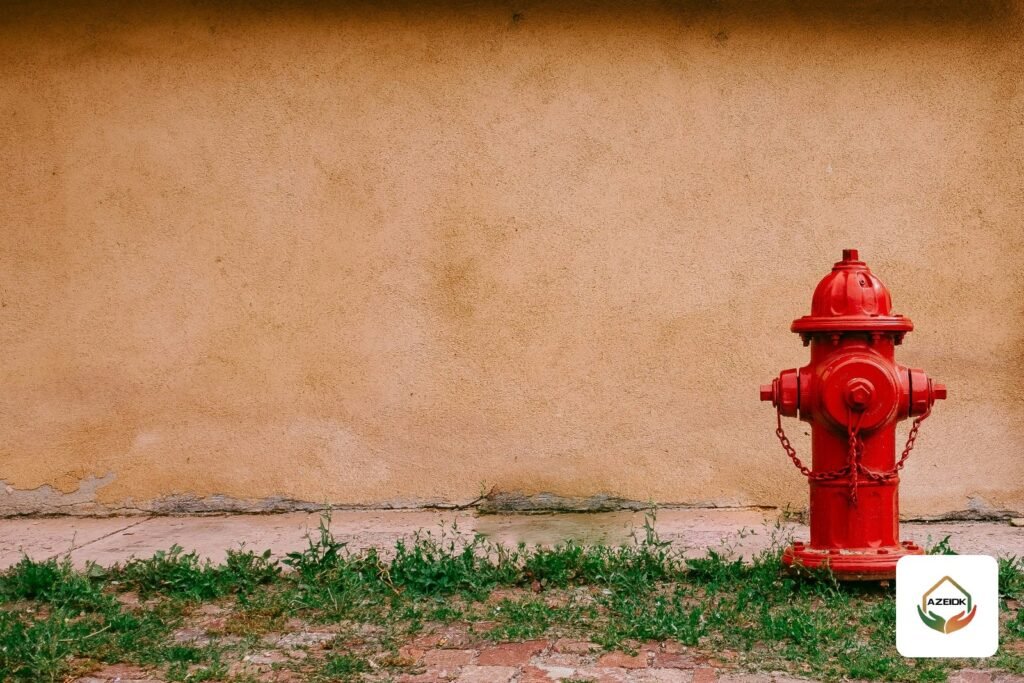
Fire hydrants for residential compounds are the points where Civil Defense connects hoses or a fire engine when a villa or apartment block inside the compound catches fire. They sit on the external fire main running between buildings, and the choice is usually between two types: the wet barrel hydrant, whose body stays full of water, and the dry barrel hydrant, whose main valve stays below ground. The practical questions for owners and consultants are which type to choose, where to place them and how to keep them ready after handover.
AZEIDK supplies American Fire Control (AFC) outdoor fire hydrants as part of its fire fighting systems for residential developments: the AFC FW-9000 wet barrel hydrant and the AFC F-7700 and F-8700 dry barrel hydrants.
Key points
- A wet barrel hydrant stays full of water; the FW-9000 page says it is mainly intended for warm and moderate climates where water does not freeze.
- A dry barrel hydrant keeps its main valve below ground and drains the barrel after closing; it is designed for freezing locations.
- Both AZEIDK models have a 6-inch inlet, a 4.5-inch pumper outlet, two 2.5-inch hose outlets and 250 psi maximum working pressure.
- Hydrant layout on compound roads and distance from buildings are set by the consultant to SBC 801 and Civil Defense requirements.
- Hydrants need periodic maintenance and protection from vehicles and unauthorized use.
Wet vs dry barrel hydrants in a compound
| Item | Wet barrel AFC FW-9000 | Dry barrel AFC F-7700 / F-8700 |
|---|---|---|
| Water in the barrel | Always full | Empty; main valve below ground |
| Reference standard per product page | AWWA C503 | AWWA C502 |
| Climate per product page | Warm and moderate, no freezing | Freezing locations |
| Inlet | 6-inch flanged | 6-inch flanged (F-7700) or mechanical joint (F-8700) |
| Outlets | 4.5-inch pumper and two 2.5-inch hose outlets, each with its own valve | 4.5-inch pumper and two 2.5-inch hose outlets |
| Maximum working pressure | 250 psi | 250 psi |
| Approvals | UL and FM as shown in the catalogue | UL and FM as shown in the catalogue |
| Extra feature | Each outlet opens independently | Breakaway connection near ground level protects the buried valve if a vehicle hits it |
In most parts of Saudi Arabia freezing is not the deciding factor, so wet barrel hydrants are a practical option, but the final choice is the consultant’s, based on site and specification. Each product page lists materials and dimensions, and the AFC hydrant submittal is in our technical documents.
Where should compound fire hydrants go?
Hydrants are placed on compound roads that fire engines can reach, so that every villa, apartment block and shared facility such as the clubhouse, mosque or school is covered. Binding distances come from the Saudi Fire Protection Code SBC 801 and Civil Defense requirements. For background only: the International Fire Code (IFC), on which SBC 801 is based, requires hydrants where any part of a building is more than 400 ft (about 122 m) from a hydrant on a fire apparatus access road, increasing to 600 ft (about 183 m) for Group R-3 and U occupancies and for buildings fully protected by an approved sprinkler system.
In design, consultants usually make sure that:
- The hydrant is at the roadside where an engine can stop, not behind a wall or inside a garden.
- The area around it is kept clear of planting, outdoor furniture and bins.
- It is near the fire department connection of buildings with sprinklers or standpipes; see our fire department connection guide.
- It is protected from cars at parking areas and bends, with bollards where needed.
The external main that feeds the hydrants
A hydrant is part of a network. In a compound the external main is usually a loop around the buildings, fed by fire pumps from the dedicated fire water tank, and split by isolation valves so the whole compound is not shut down to repair one section. Underground main design, testing and flushing follow NFPA 24 as adopted by the designer, covered in our NFPA 24 underground fire mains article.
Flow and pressure at the hydrants are tested before handover and after any major change; see our fire hydrant flow test article. A hydrant added during a compound expansion needs the pump and network capacity reviewed, not just a tie-in to the nearest pipe.
Common hydrant problems after handover
- Using hydrants to water gardens or wash roads, which leads to leaks and damaged outlets.
- Painting hydrants another colour or hiding them in planting, so they are hard to find at night.
- Missing outlet caps, letting dust and insects into the outlets.
- An isolation valve closed for a repair and forgotten.
- A vehicle hitting a hydrant without anyone telling compound management.
Periodic maintenance visits catch these issues; see our fire maintenance contract for residential buildings and compounds. For hydrant and landing valve types inside buildings see the fire hydrants and landing valves guide, and for the brand range see American Fire Control (AFC) in Saudi Arabia.
FAQ
What is the difference between wet and dry barrel hydrants?
A wet barrel stays full of water and suits climates without freezing. A dry barrel keeps its valve below ground and drains after closing, for freezing locations.
How many hydrants does a compound need?
The consultant sets the number and locations from the compound’s area, roads and the distances in SBC 801 and Civil Defense requirements. There is no fixed number.
What outlet sizes do AZEIDK’s AFC hydrants have?
A 4.5-inch pumper outlet, two 2.5-inch hose outlets and a 6-inch inlet. Thread type follows the project specification and the relevant authority.
Are the hydrants UL listed and FM approved?
AZEIDK’s FW-9000 and F-7700/F-8700 pages state UL listing and FM approval as shown in the catalogue, which goes into the submittal.
Can a fire hydrant be used for garden irrigation?
It is not advisable. Repeated use causes leaks and outlet damage, and the hydrant must stay ready for Civil Defense.
How do I know the network gives enough flow?
Run a flow test at the hydrants before handover and after any expansion, and compare results with the approved design.
Summary
Compound fire hydrants work when the type suits the climate, they sit on roads Civil Defense can reach with clear space around them, they are fed by a looped main split by valves, and they are maintained and kept for fire use only.
Developing a residential compound? Send us the master plan and external fire main specification, and we will prepare an AFC hydrant supply offer with the submittal. Talk to the AZEIDK team
Related guides
- Special Fire Suppression Brands in the Saudi Market: Clean Agent, Aerosol and Kitchen
- Sprinkler Test and Drain Valve: How It Works, Choosing the Test Orifice, and the Giacomini A61
- Integrated Fire and Life Safety Systems Testing Before Handover: Elevators, HVAC, Smoke Control and Doors Under NFPA 4
- NFPA 13: Standard for Sprinkler System Design and Installation