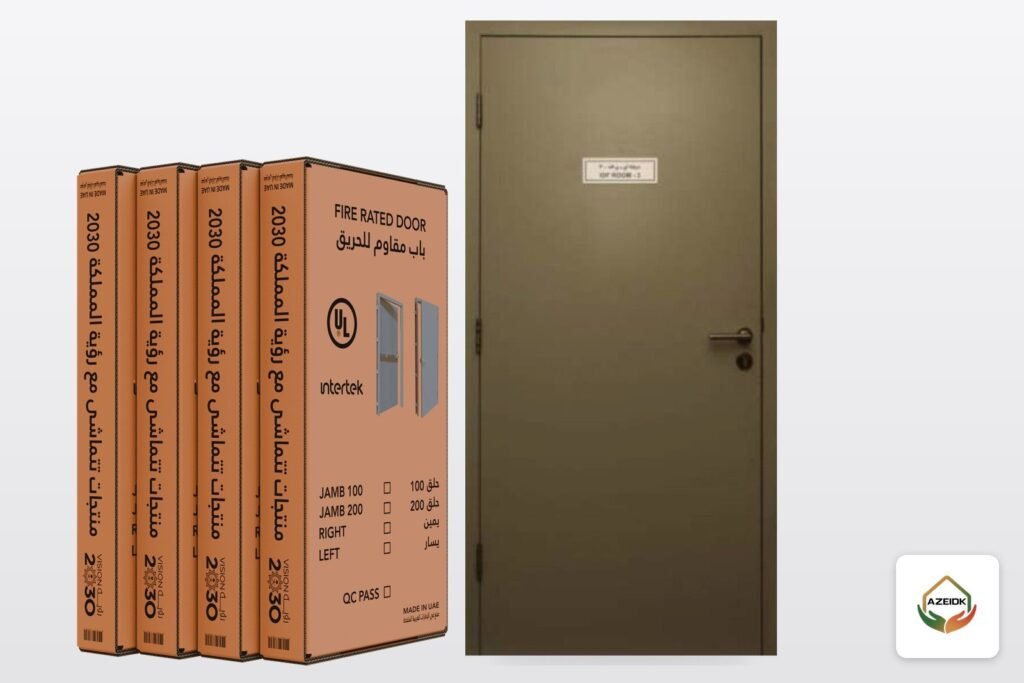
Before you ask how many minutes a fire door is rated for, there is an earlier question for any door placed on the Saudi market: does it carry the conformity certificate required by the SASO Technical Regulation for Doors, Windows and their Accessories? The regulation names fire resistant doors and windows explicitly and gives them a stricter conformity route than ordinary doors.
This article sets out what the regulation itself says: its scope, the fire safety requirement, the conformity assessment model for fire doors, the reference standards for door hardware, and what owners and contractors should check before supply. The source is the regulation text published by SASO; read it alongside this summary.
Key points
- The regulation defines the product as doors, windows and their accessories, including fire resistant ones.
- Fire resistant doors and windows need a conformity certificate from a SASO-accepted body under conformity model Type 3 of ISO/IEC 17067.
- Other doors and windows in scope need a certificate under model Type 1a.
- Reference standards for fire doors include SASO NFPA80 and SASO/UL 10A.
- Complying with the regulation does not replace the Saudi Building Code requirements.
What the regulation is
It is a mandatory technical regulation approved by the SASO Board at its meeting No. 177 on 15 October 2020 and published in the Official Gazette on 12/04/1442 AH (27 November 2020). It applies to door and window products used in buildings, according to its definitions and the standards listed in its Annex 1.
For anyone in fire protection, the key line is the product definition: doors, windows and their accessories, even if fire resistant. A fire door on a stair, an electrical room or a protected corridor is inside the scope of this regulation, not outside it as some suppliers assume.
The regulation also states that compliance with it does not replace compliance with the Saudi Building Code. The certificate shows that the product conforms when it is placed on the market; the rating needed at each opening comes from the code and the approved design. See fire door rating by location.
The fire safety requirement
Among the essential requirements is a clause on safety in case of fire. Products in scope must be designed and made so that, in a fire:
- flame and smoke spread inside the building does not exceed the rates in the interior finishes chapter (Chapter 8) of the Saudi General Building Code SBC 201;
- the same limits are respected for neighbouring buildings;
- occupants can be evacuated or rescued by other means;
- products described as fire resistant meet the requirements of the related standards.
The last point links a fire door to its reference standards in Annex 1, which is what the consultant checks when reviewing the submittal.
Conformity certificate for fire doors: model Type 3
| Product | Conformity model | What it means for the supplier |
|---|---|---|
| Fire resistant doors and windows | Type 3, ISO/IEC 17067 (Annex 2) | Certificate from a SASO-accepted body, based on type approval plus assessment of the production process with periodic surveillance |
| Other doors, windows and accessories in scope | Type 1a, ISO/IEC 17067 (Annex 3) | Certificate from a SASO-accepted body based on type approval |
Annex 2 describes Type 3 as conformity to type based on assessment of the production process. The supplier declares, under full responsibility, that the products match the type in the type approval certificate. The supplier must run an approved product safety management system covering the production line, final inspection and testing, and that system is under periodic surveillance.
The application goes to an accepted body chosen by the supplier and includes the supplier’s name and address, proof that the manufacturer is officially licensed in the country of manufacture, a written statement that the same application has not been lodged with another body, the product safety management system documents, the technical documents of the approved type and a copy of the type approval certificate.
In project terms, one test report is not enough. The type must be approved and the factory itself must be assessed and kept under surveillance so that every door produced matches the approved type. This fits the principle that a fire door is rated as a complete assembly of leaf, frame and hardware, as the fire rated steel doors page on the AZEIDK site explains.
Reference standards for fire doors and hardware
| Standard | Title in the regulation |
|---|---|
| SASO NFPA80 | Fire doors and other opening protectives |
| SASO/UL 10A | Tin clad fire doors |
| SASO-EN-1125 | Panic exit devices operated by a horizontal bar |
| SASO-EN-1154 | Controlled door closing devices |
| SASO-EN-1155 | Electrically powered hold-open devices for swing doors |
| SASO-EN-1303 | Cylinders for locks |
| SASO-EN-12365-1 | Gaskets and weather stripping for doors and windows |
Hardware is not a side issue. The panic bar on an exit door, the closer and the magnetic holder released by the fire alarm each have their own reference standard. For practical guidance see fire door closers and magnetic door holders with fire alarm release.
The regulation notes that the product list and customs codes on the SABER platform are the current approved version, so importers check SABER for the line their product falls under. The steps are in SABER conformity certificates for fire equipment.
Labelling and technical file
Article 5 requires the information on the package to match the regulation and related standards, to include warnings and instructions for use in clear, hard to remove print, and to be correct and verifiable. A technical file accompanies the product, starting with the supplier’s declaration of conformity in the Annex 4 format and a risk assessment document.
Violations and transition periods
Article 9 prohibits manufacturing, importing, placing on the market, displaying or even advertising products that do not conform. Inspection authorities may take samples at production points and ports and send them to laboratories.
The transitional provisions applied the regulation within 180 days of publication and gave suppliers up to 730 days from publication to correct their position. With publication in November 2020, both periods have ended.
What to check before ordering fire doors
- Take the required rating for each opening from the approved drawings, then select a type tested as a complete assembly for that rating.
- Ask for the conformity certificate for the fire door type, issued by a SASO-accepted body and covering the exact type supplied.
- Match the hardware (panic bar, closer, holder, cylinder) to the tested assembly.
- Check the labelling on each door at delivery against the submittal.
- Keep the technical file and certificates with the handover documents. See ordering and receiving fire rated doors.
AZEIDK supplies fire rated steel doors from Falcon Gold, for which AZEIDK is the exclusive agent in Saudi Arabia, as part of its fire rated doors and emergency exits solution. We confirm the required rating and tested type with the consultant before supply and prepare the documents through technical supply.
Frequently asked questions
Are fire doors covered by the SASO doors and windows regulation?
Yes. The regulation defines its products as doors, windows and accessories, including fire resistant ones, and gives fire resistant doors and windows their own conformity model.
Which conformity model applies to fire doors?
Type 3 under ISO/IEC 17067: type approval plus assessment of the production process with periodic surveillance, certified by a SASO-accepted body.
Which reference standard applies to fire doors?
Annex 1 lists SASO NFPA80 for fire doors and other opening protectives, and SASO/UL 10A for tin clad fire doors.
Does the certificate replace code and Civil Defense requirements?
No. The regulation states that it does not replace the Saudi Building Code. Ratings and locations come from the code and the approved design.
Is door hardware covered too?
Yes. Annex 1 lists standards for panic exit devices, door closers, electrically powered hold-open devices, lock cylinders and other hardware.
Need fire doors with full documents? Send us your door schedule and ratings, and the AZEIDK team will prepare the offer and submittal. Request a quote from AZEIDK
Related guides
- Approved Electrical Contractor for Commercial Projects in Saudi Arabia: Scope, SBC 401 and Electrical Works Within an Integrated MEP Package
- Smoke Detector Sensitivity Testing and Cleaning on Addressable Systems (NFPA 72)
- Fire Hose Cabinet Manufacturers in Saudi Arabia: Available Brands and How to Compare Manufacturers
- UPS Online vs Offline vs Line-Interactive: Which One for Network and CCTV Rooms