Electrical panels, motor control centres (MCC) and UPS rooms need suppression that leaves no water on live conductors and needs no cylinders or pipework in tight spaces, so designers often consider an aerosol fire suppression system. Success depends on assessing and sealing the enclosure, calculating the quantity, and tying the system into detection and power isolation.
This guide for designers, contractors and facility managers shows how the FirePro condensed aerosol system is applied in electrical spaces, as part of AZEIDK’s special fire suppression systems. For the brand, its certifications and how the compound works, see FirePro in Saudi Arabia.
Key takeaways
- Design references: NFPA 2010 (2025) or ISO 15779 (2026), plus manufacturer instructions and Civil Defense requirements.
- Choose in-cabinet protection or room flooding first; everything else follows.
- Quantity comes from net volume, hazard class, the model’s listed design density and leakage compensation, never from a rough generator count.
- Ventilation and power shut down before or at discharge, per an approved cause-and-effect matrix.
- Occupied spaces need a dedicated safety review, pre-discharge alarms and a time delay, and clearances around generator outlets.
- Lithium-ion batteries need their own hazard assessment.
In this article
- Regulatory and technical references in Saudi Arabia
- Hazard assessment: where an aerosol fire suppression system fits
- Enclosure integrity: the step most often skipped
- Sizing principles
- Detection, activation and sequence of operations
- Safety and occupancy
- Maintenance and service life
- Common mistakes with aerosol in electrical spaces
- Frequently asked questions
- Conclusion
Regulatory and technical references in Saudi Arabia
The binding framework is the Saudi Building Code, including SBC 801 (Saudi Fire Protection Code); the 2024 edition has been mandatory since 30 June 2025. Civil Defense approves safety systems before occupancy.
The designer chooses the technical standards, and the consultant and authority accept them. For condensed aerosol:
- NFPA 2010, Standard for Fixed Aerosol Fire-Extinguishing Systems, 2025 edition. Its scope names electrical and telecom equipment, server rooms and machinery spaces. This edition aligns alarm terminology with NFPA 72 and adds annex guidance on control panels where no primary AC supply exists and on sealing penetrations.
- ISO 15779:2026, the second edition, published in August 2026 to replace the 2011 edition. It covers total flooding with electrically non-conducting condensed aerosol and excludes local application. Among its changes is a new requirement on the time to reach minimum design density in Class B fires.
NFPA is not legally mandatory on its own; it is the reference the designer commits to in the calculations and submittal.
Hazard assessment: where an aerosol fire suppression system fits
FirePro offers two modes: in-cabinet protection, with a small generator inside the panel suppressing fire at its source, and room flooding, with one or more generators discharging into the whole space. The choice sets detection, control and sealing.
| Space | Hazard | Usual protection mode | Points to settle in design |
|---|---|---|---|
| Distribution boards (DB) and control cabinets | Overheated terminations, arcing, cable insulation | In-cabinet, thermal or electrical activation | Net cabinet volume, ventilation slots and cable entries, generator distance from busbars and components |
| LV switchgear and MCC rooms | High loads, dense cabling in trays and raised floors | Room flooding, sometimes with in-cabinet units in selected panels | Volume including floor voids, HVAC shutdown, power isolation per the matrix |
| UPS and lead-acid battery rooms | Cable and equipment fires, hydrogen during charging | Room flooding | Hydrogen ventilation, area classification if an explosive atmosphere is possible, a model listed for it where needed |
| Small telecom and server rooms | Sensitive equipment, continuous heat load | Room flooding | Post-discharge cleanup, comparison with clean agents |
| Lithium-ion batteries and energy storage | Thermal runaway, flammable gases, re-ignition | Only after a specific hazard assessment | NFPA 855, manufacturer test data for the same chemistry, authority approval |
AZEIDK’s product page states that energy storage applications are subject to a hazard assessment. FirePro reports around 100 lithium-ion tests since 2016 across different chemistries and thermal runaway methods. That is manufacturer data, to be read within a project-specific hazard study, not instead of one. For a room-level comparison, see Electrical Room Fire Protection.
Enclosure integrity: the step most often skipped
Aerosol must hold its concentration long enough, and every unclosed opening lowers actual density below the calculated value. Typical openings: cable entries, panel door louvres, HVAC ducts and doors left open.
FirePro states that the standards it follows require neither an airtight room nor a door fan test, and that a visual check of the openings-to-volume ratio is enough, with leakage compensation for larger openings. In practice:
- Measure every permanent opening at the site survey and include it in the calculation.
- Shut down HVAC and close its openings automatically before discharge.
- Seal cable penetrations after installation, a point on which NFPA 2010 (2025) added annex guidance.
- Make room doors self-closing, or include any opening in the calculation.
- Re-check after any change: a new panel, cable route or HVAC modification.
Sizing principles
AZEIDK’s product page states that a system must not be selected by generator count or model without an approved calculation, which we prepare under our engineering design and calculations service. The usual sequence:
- Net volume. Internal dimensions less permitted deductions, including connected floor and ceiling voids.
- Hazard class. The manufacturer covers Classes A, B and C under the applicable classification. Decide whether the hazard is purely electrical or also involves solids (insulation, cardboard) or liquids (equipment oils).
- Design density. From the model’s listing (UL 2775 or EN 15276, as the project requires) and the manufacturer’s design manual. It is higher than the tested extinguishing density because it includes a safety factor set by the standard.
- Leakage compensation. Extra agent for each opening that cannot be closed, using the manufacturer’s method.
- Model selection and layout. The FirePro models on AZEIDK’s page range from FP-20 to FP-5700. Lay out generators to cover the whole space, respecting each model’s discharge distance.
- Clearances. Each model has minimum distances to people, combustibles and structures because of discharge temperature, given in the datasheet and installation manual.
AZEIDK’s page gives a discharge time of about 5 to 10 seconds for several small and medium generators and about 10 to 15 seconds for some larger models, and an operating range of -54 °C to +54 °C for selected models. The upper limit matters in Saudi summers, when outdoor kiosks and unconditioned rooms get very hot, so check site temperatures against the datasheet.
Detection, activation and sequence of operations
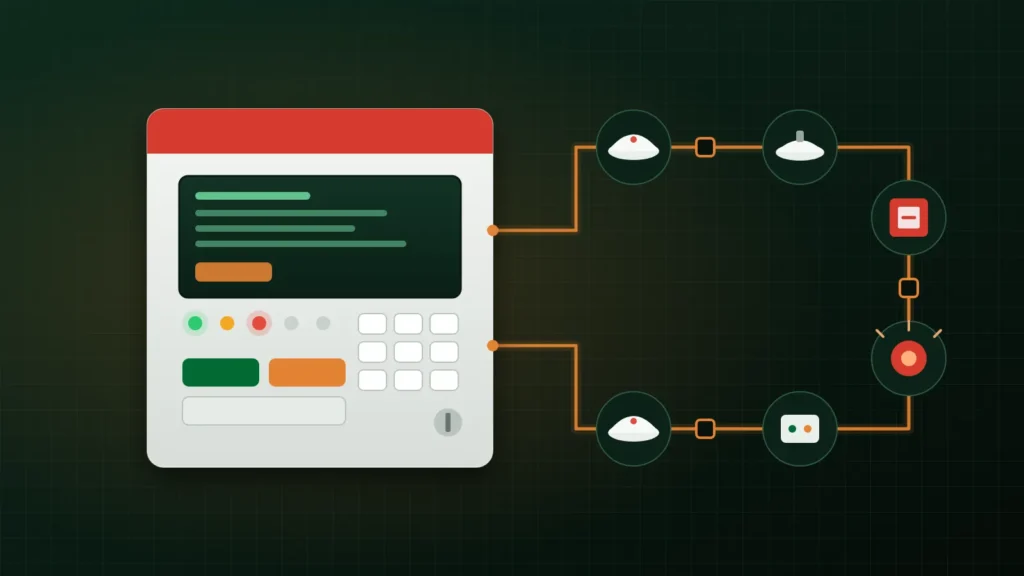
For room flooding, FirePro describes a control and monitoring panel linked to two detection zones (cross-zoning) and notification devices. It commands door closing and air-handling shutdown, and signals the BMS and the building’s general fire alarm. AZEIDK’s page lists the control functions: first- and second-stage alarms, pre-discharge delay, automatic or manual operation, hold and abort, and supervision of the release circuit.
Before installation, the cause-and-effect matrix should define at least:
- Which two detectors or zones must operate to start the countdown.
- The pre-discharge delay and the hold switch location.
- When power is isolated, and who decides, so ignition sources do not stay live.
- HVAC shutdown and closure of its openings.
- Signals to the fire alarm system and the BMS.
In-cabinet protection commonly uses a thermally activated generator that self-operates at a set temperature, or an electrically activated one wired to a detector in the panel. Its activation signal should reach the fire alarm panel.
Safety and occupancy
Technicians do enter electrical rooms. FirePro lists pre-discharge alarms, time delay, and abort and isolation switches among the measures that protect people. AZEIDK’s page says use in occupied spaces needs a dedicated safety review; that generator outlets must not face people, must stay clear of combustibles and must not be covered or modified; and that generators must not be touched during or right after operation.
Add warning signs on doors, train operators on the alarm stages and hold switch, and isolate the release circuit during maintenance.
FirePro says particles can be vented or vacuumed soon after discharge; they absorb moisture over time, making cleaning harder, but water-based cleaners remove them. It recommends thorough cleaning after any fire. The emergency plan should cover venting before entry, inspection before restoring power, and cleaning panels before re-energising.
Maintenance and service life
FirePro generators are not pressurised, so the company says they need no hydrostatic testing. Certified service life is up to 15 years under FirePro’s conditions, and a generator is replaced after any discharge. The maintenance programme should include:
- A register for each generator: model, manufacture date, location and planned replacement date.
- Periodic checks that generators are secure and outlets undamaged and unobstructed.
- Testing the control panel, detectors, alarms and shutdown outputs without discharging any generator; AZEIDK’s page states that tests must not use a real release signal.
- A review of room sealing after any electrical or building change.
Inspection and test intervals come from NFPA 2010, the manufacturer and the authority, and can be organised under an annual maintenance contract.
Common mistakes with aerosol in electrical spaces
- Estimating generator numbers by experience, such as two per medium room, without a net volume and openings calculation.
- Ignoring connected voids, such as raised floors or cable trenches open to the room.
- Leaving HVAC running during discharge, which pulls aerosol out of the space.
- Mounting a generator next to cables or busbars without checking the datasheet clearance.
- Not isolating power, so the ignition source remains after discharge.
- Treating a lithium-ion battery room as an ordinary UPS room, with no separate thermal runaway assessment.
- Accepting a general brand certificate instead of verifying the listing of the exact model supplied.
Frequently asked questions
Can an aerosol fire suppression system be fitted inside an electrical panel?
Yes. FirePro offers in-cabinet protection with a small thermally or electrically activated generator, sized to the cabinet’s net volume and openings, with component clearances respected.
Does an electrical room need a door fan test?
FirePro says the standards it follows do not require one, and that a visual check of openings with leakage compensation is enough. The consultant or authority may ask for more; settle it at approval.
Should power be isolated before discharge?
The control functions on AZEIDK’s page include shutting down ventilation and equipment. The timing and extent of isolation are set in the cause-and-effect matrix with the facility’s electrical operator.
Is aerosol suitable for lithium-ion battery rooms?
FirePro has lithium-ion test data, but this application needs a project-specific hazard assessment covering NFPA 855, the battery chemistry and authority approval. It should not be generalised.
Conclusion
An aerosol fire suppression system in electrical rooms and panels succeeds through more than model selection: the right protection mode, sealed openings, an approved calculation, a clear shutdown matrix and a register tracking each generator’s life. These are easier to settle before supply than after handover.
Have an electrical room or panels that need aerosol protection? Send us the layout, room and panel dimensions and ventilation details, and we will review the protection mode and models with you, with datasheets. Contact the AZEIDK team