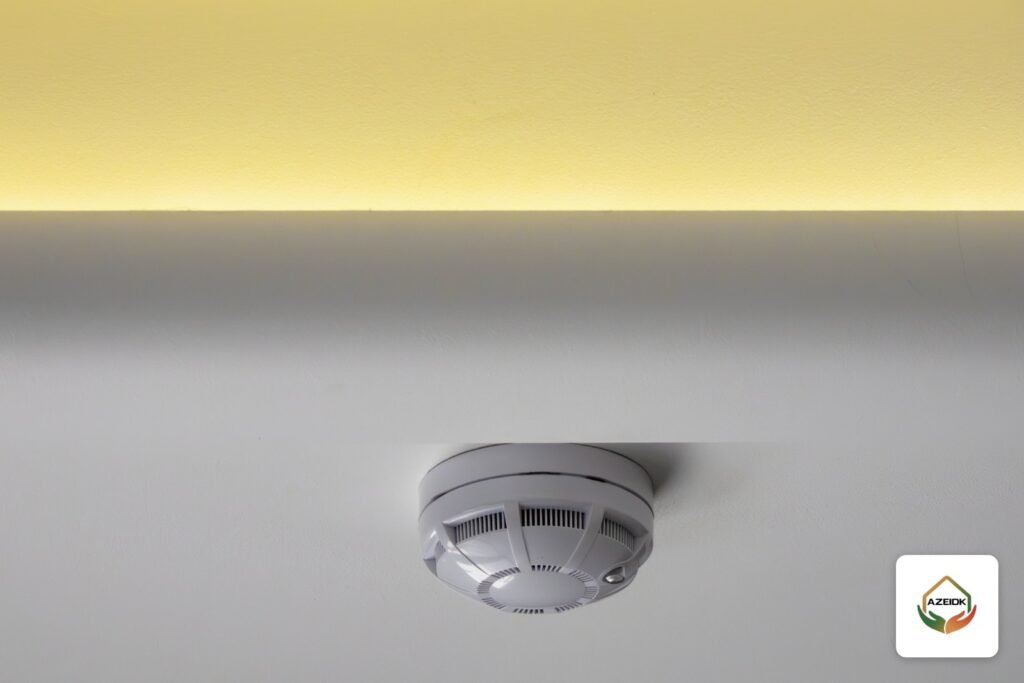
If your project specification calls for a UL listed smoke detector and you want to stay on a Context Plus addressable panel, the answer inside the same family is the Context UL-Plus range: the 58000-650IMC optical smoke detector, the 58000-550IMC ionisation detector, the 58000-450IMC heat detector and the 58000-750IMC multisensor. All four are detector heads that fit one common base, the 45681-210IMU.
This guide covers the differences between the four heads, the correct base, what the UL listing documents actually say, and when to choose this range over the EN 54 detectors from the same manufacturer.
Key takeaways
- Context UL-Plus is an analogue addressable detector range that the manufacturer’s documents describe as UL Listed, using the Discovery protocol with Context Plus addressable panels; the datasheet states it is manufactured in the United Kingdom.
- The common base for the range is the 45681-210IMU, not the 45681-210IMC used with the other XPert Style detectors.
- The UL directory record published by the manufacturer shows the three smoke heads (optical, ionisation and multisensor) investigated to ANSI/UL 268 under the smoke detectors for fire alarm systems category.
- Each head has five response modes set from the panel, and the datasheet gives a grid matching mode to application.
- A listing covers a specific model and file number, so check it in the UL database before the submittal goes in.
In this article
- What does a UL listed smoke detector mean on a Saudi project?
- The four Context UL-Plus detector types
- The 45681-210IMU base: why not the 45681-210IMC?
- What do the UL listing documents say?
- Technical data for the four heads
- How to choose the detector and response mode by location
- When to choose Context UL-Plus over EN 54 detectors
- Common mistakes when supplying UL detectors
- Frequently asked questions
- Conclusion
What does a UL listed smoke detector mean on a Saudi project?
On site people say “UL approved”; the correct term is “UL Listed”. It means the model was tested to a specific UL standard and appears in the UL certification directory under a file number and product category. For point smoke detectors in fire alarm systems the relevant standard is UL 268. Heat detectors have their own standard, UL 521.
The mandatory design reference in the Kingdom is the Saudi Fire Protection Code, SBC 801, and NFPA 72 is used as a technical reference the designer adopts for detection and alarm details. Whether the project goes the UL route or the EN 54 route is set by the specification the consultant writes, often at the request of the owner or operator. We covered the two routes in UL vs EN 54 in fire alarm systems. Here we focus on the product that answers a UL requirement on Context Plus panels.
The four Context UL-Plus detector types
Every item in the range is supplied as a head only, addressed with an XPERT card, and runs the Discovery protocol, which shares decision-making between the head and the panel. The heads share drift compensation as dust builds up, five response modes, a 360-degree alarm indicator with a flashing LED option, and a conventional alarm fallback if the panel processor fails.
Optical smoke detector 58000-650IMC
Best for slow, smouldering fires. Typical locations are offices, corridors, hotel rooms and hospitals, and it is the default choice for most air-conditioned spaces. Product page: Context UL-Plus optical smoke detector 58000-650IMC.
Ionisation smoke detector 58000-550IMC
Uses a low-activity radioactive foil to ionise the air in the chamber; smoke reduces the current flow and triggers the alarm. It responds well to fast, flaming fires, and the manufacturer describes it as a good general-purpose detector. Product page: Context UL-Plus ionisation smoke detector 58000-550IMC.
Heat detector 58000-450IMC
A single thermistor senses air temperature, inside a low airflow-resistance case. It suits areas that are dirty or smoky in normal use, such as kitchens and plant rooms. Product page: Context UL-Plus heat detector 58000-450IMC.
Multisensor detector 58000-750IMC
Combines an optical smoke sensor and a thermistor. The panel can read each sensor separately and distinguish a rise in temperature from the smoke level, which helps with false alarm management. Product page: Context UL-Plus multisensor detector 58000-750IMC.
The 45681-210IMU base: why not the 45681-210IMC?
This is where BOQs most often go wrong. The official range datasheet and the Context Plus technical data both name the common base 45681-210IMU (Context UL-Plus Common Mounting Base), supplied with an XPERT addressing card. The 45681-210IMC, also shown on our site, is the XPert Style base for the other detector family and should not appear in a submittal that calls for a UL listed system.
The manufacturer’s documents describe the base itself as UL Listed, with stainless steel contacts, a locking feature that stops the head being removed without a tool, and one-way, clockwise twist-on fitting. The UL directory record lists the range base as compatible with all four heads, 58000-450/550/650/750. The technical data also names an isolating base for the range, 45681-284IMC, which is shown on our site, and the manufacturer’s UL-Plus range page labels it “UL Listed”. The 2019 copy of the UL record does not mention it, so ask the manufacturer for listing evidence before it goes into a submittal.
What do the UL listing documents say?
The manufacturer publishes a copy of the UL Online Certifications Directory record on its product pages (last updated date shown: January 2019). It shows:
- Category: UROX, Smoke Detectors for Fire Alarm Systems.
- Company and file number: Context Plus Ltd, file 524127.
- Standard: “Investigated to ANSI/UL 268”, noted as editions prior to the 7th edition.
- Models: 58000-550IMC, 58000-650IMC and 58000-750IMC for open area protection, at air velocities of 0–300 ft/min.
Two points matter to the consultant. First, the 58000-450IMC heat detector appears in the same record as a unit compatible with the base, and the manufacturer labels it “UL Listed”, but the manufacturer documents we reviewed do not state the standard the heat head is listed to. If the specification calls for UL 521 explicitly, ask the manufacturer for proof or check the UL database. Second, UL 268 7th Edition added, for the United States, a cooking nuisance smoke test plus flaming and smouldering polyurethane foam tests, with an effective date of 30 June 2024 according to Intertek’s standard update notice. If your specification names the 7th Edition, get written confirmation of the current listing status before supply.
The reliable check is a search by file number or model in UL Product iQ.
Technical data for the four heads
Figures below are from the Context Plus technical data. All heads operate at 17–28 V DC and 0–95% RH, non-condensing.
| Head | Model | Quiescent current | Alarm current (LED on) | Operating temperature | Best suited to |
|---|---|---|---|---|---|
| Optical smoke | 58000-650IMC | 440 µA | 3.4 mA | -40 to 70°C | Smouldering fires; offices, corridors, rooms |
| Ionisation smoke | 58000-550IMC | 380 µA | 3.4 mA | -30 to 70°C | Fast flaming fires; general purpose |
| Heat | 58000-450IMC | 350 µA | 3.4 mA | From -40°C (upper limit depends on mode) | Kitchens, boiler rooms, dirty areas |
| Multisensor (optical + heat) | 58000-750IMC | 470 µA | 3.5 mA | -40 to 70°C | Warehouses, car parks, false-alarm-prone areas |
These currents feed straight into the panel battery calculation and loop load. The heat detector has five modes under the UL heat classification in the same data: Mode 1, 135°F (about 57°C) fixed temperature plus rate of rise; Mode 2, 150°F (about 66°C) plus rate of rise; Mode 3, 150°F fixed only; Mode 4, 200°F (about 93°C) plus rate of rise; Mode 5, 200°F fixed only.
How to choose the detector and response mode by location
Mode 1 is the most sensitive and Mode 5 the least; the mode is selected at the panel. This summarises the datasheet’s response mode selection grid:
| Location | Datasheet recommendation | Suitable alternatives |
|---|---|---|
| Cleanroom, EDP suite | Multisensor or optical, Mode 1 | None |
| Hotel room, studio, small flat under 50 m³ | Multisensor, Mode 3 | Multisensor 4; optical or ionisation 3–5 |
| Long office corridor, hospital ward, light industrial | No single recommendation | Multisensor 3–4; optical or ionisation 3–5 |
| Warehouse, bar | Multisensor, Mode 3 | Multisensor 2, 4, 5; optical 4; ionisation 3–4; heat 1–2 |
| Loading bay, car park | Multisensor, Mode 4 | Multisensor 2, 3, 5; optical 4; heat 1–2 |
| Kitchen, laundry (enclosed and ventilated) | Heat, Mode 3 | Heat 4–5; multisensor 3–4 |
| Boiler room | Heat, Mode 5 | Heat 3; optical 4–5; multisensor 2 |
The grid is a starting point, not a design. Detector spacing, ceiling height and HVAC airflow are calculated to the reference adopted for the project. For heat detection layouts in general, see heat detector types and installation.
When to choose Context UL-Plus over EN 54 detectors
- When the specification explicitly calls for UL listed initiating devices, as on some government, industrial and international-consultant projects.
- When you want to stay on Context Plus addressable panels; the datasheet describes the range as fully compatible with Context Plus analogue addressable fire panels.
- When the whole system follows the UL route: the 56000-005IMC addressable manual pull station is UL listed and meets UL 38 according to its datasheet, and belongs to the same family.
If the specification calls for EN 54, the European Context Plus addressable detectors are the better fit. Either way, do not mix devices from the two routes in one system presented as UL.
Common mistakes when supplying UL detectors
- Writing 45681-210IMC in the BOQ instead of 45681-210IMU, or ordering heads without bases when each head is supplied on its own.
- Submitting a general UL certificate for the company instead of the listing record that names the model and file number.
- Assuming the heat detector is listed to UL 268, when the heat detector standard is UL 521.
- Leaving every detector on the default mode, then dealing with false alarms in car parks and kitchens.
- Choosing ionisation on a project that restricts radioactive sources without checking storage and end-of-life disposal with the supplier.
- Ignoring quiescent currents in the battery calculation when replacing older detectors with UL-Plus heads.
Frequently asked questions
Does a UL listed smoke detector work with any fire alarm panel?
No. Context UL-Plus detectors use the Discovery protocol and are described as compatible with Context Plus addressable panels. Compatibility with any other panel needs a manufacturer document.
Which base do UL-Plus detectors use?
The 45681-210IMU common base with an XPERT card, according to the range datasheet and technical data.
Are the detectors listed to UL 268?
Per the manufacturer’s documents, the UL record it publishes (last updated 2019) shows ANSI/UL 268, editions prior to the 7th, for the three smoke heads. For the heat head, ask the manufacturer for listing evidence or check the UL database.
What is the difference between optical and ionisation smoke detectors?
Optical suits slow smouldering fires; ionisation responds well to fast flaming fires. The multisensor combines optical smoke and heat.
How do I check that a detector is really UL listed?
Search by model or file number in UL Product iQ, and match the model and base with what is in the submittal.
Conclusion
If the specification asks for a UL listed smoke detector on Context Plus panels, the Context UL-Plus range covers optical, ionisation, heat and multisensor detection on one base, the 45681-210IMU. Pick the head by the expected fire type, set the mode by location, check the listing by file number before the submittal, and keep UL 268 for smoke and UL 521 for heat apart. To review the selection as part of a full system, see fire alarm systems and our technical selection of systems and equipment service.
Does your specification call for UL listed devices? Send us the BOQ and panel type, and we will match heads and bases against the datasheets and listing documents. Talk to the AZEIDK GROUP team
Related guides
- Are Sprinklers Mandatory? Civil Defense Sprinkler Requirements Under Saudi Fire Code SBC 801
- WATEX UL-Listed Foam Bladder Tanks: Capacities, Specifications, Ratio Controllers and Sizing
- Sprinkler Test and Drain Valve: How It Works, Choosing the Test Orifice, and the Giacomini A61
- CCTV Connectors and Accessories: BNC, Video Baluns, RJ45 and the Installation Accessories Checklist