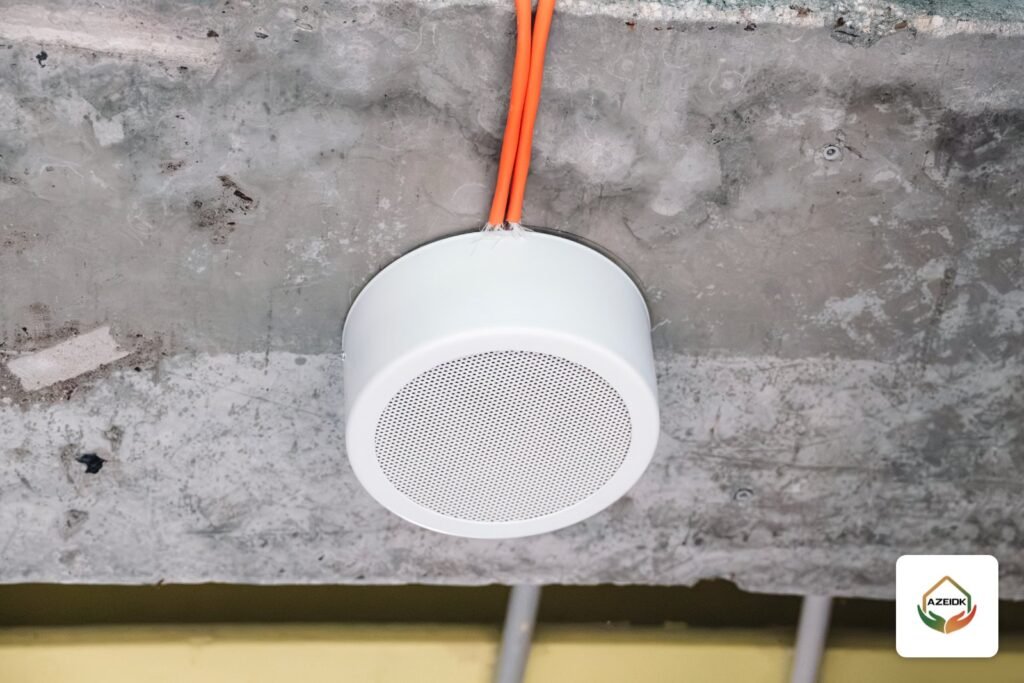
PA system price for a building has no fixed figure, because a public address (PA) system is priced item by item. The price is built from the number and type of speakers, the number of audio zones, the amplifier power, the cable runs, and whether the system is linked to the fire alarm to work as a voice evacuation system. A sound quotation therefore starts with a site visit and a bill of quantities for every item. AZEIDK supplies public address and audio systems as part of its low current systems; see the scope on our public address and audio systems page.
Key takeaways
- Cost follows five main items: speakers, zones, amplifier, cabling and installation, and the fire alarm interface.
- Amplifier power comes from the sum of the speaker taps on the 100 V line, and that sum must not exceed the amplifier rating.
- A voice evacuation system linked to the fire alarm costs more than a plain PA system because it needs line monitoring, standby power and equipment approved for that purpose.
- Compare quotations line by line: model, speaker count, power, cable, programming and testing, not just the total.
In this article
- What determines PA system price?
- Speaker count and type: how they drive ceiling speaker prices and the whole system
- Audio zones and the control unit
- Amplifier power and how to size it
- Building sound system cost when it is linked to the fire alarm
- Analog 100 V system or IP system?
- Cabling, installation and programming: items quotations often leave out
- How to compare public address system quotations
- Frequently asked questions
- Conclusion
What determines PA system price?
When an owner or contractor asks for a “PA system price”, they are really asking for the price of several components that work together. The table shows each item and what pushes its cost up or down. It has no figures, because prices change with brand, quantity and site conditions.
| Item | What raises the cost | What lowers it |
|---|---|---|
| Speakers | High counts due to high ceilings or noisy areas, outdoor weatherproof speakers, speakers approved for evacuation | A correct layout that covers the area without overlap |
| Audio zones | Splitting every floor or department into its own zone, extension units | Grouping areas with the same use into one zone |
| Amplifier and controller | Higher power, standby amplifier, line monitoring, recorded messages | Sizing power to the real load with a sensible margin |
| Cabling | Long runs, fire-resistant cable when the system serves evacuation, conduit work in an existing building | Coordinating routes early with the other low current trades |
| Fire alarm interface | Message programming per zone, interface hardware, joint testing with the fire alarm panel | Defining evacuation needs at the start instead of modifying later |
| Programming, testing, handover | Many zones, schedules and messages | A clear, approved zone plan before installation |
Speaker count and type: how they drive ceiling speaker prices and the whole system
Speakers are the item that multiplies with floor area. The count does not come from floor area alone. Ceiling height, background noise and use all matter: a quiet office corridor is not a warehouse or a car park. Two buildings of the same size can need very different speaker counts.
Common speaker types on Saudi projects:
- Ceiling speakers: the most common choice for offices, corridors, hotels and hospitals with suspended ceilings. Price depends on power, sound quality, a fire dome (back can), and whether the speaker is approved for voice alarm use.
- Wall and box speakers: for areas without a suspended ceiling.
- Horn speakers: for open areas, car parks, outdoor zones and factories, where sound has to carry further over noise.
- Column speakers: for halls, mosques and long rooms.
Outdoor speakers cost more because they need dust and water protection. One example from AZEIDK’s range is the Hikvision DS-QAZ1307G1T-E outdoor horn speaker, a network (IP) speaker rated IP67 and IK10, powered over Ethernet (PoE, IEEE 802.3at) and supporting SIP, according to its product page. This type changes the cost model because it relies on network switches instead of a central amplifier and a 100 V line.
Audio zones and the control unit
A zone is a group of speakers that play together. The more you need to page one floor or department without the others, the more zones you need, and with them more amplifier outputs, control units and programming.
An office building may only need one zone per floor. A hospital or mall usually needs a finer split: reception, wards or shops, car parks, food areas and service areas. In a voice evacuation system the zone plan follows the evacuation strategy and the fire alarm zones, not only the owner’s preference.
Zones show up directly in cost. The DSPPA PAVA9500 unit in AZEIDK’s range combines a 500 W amplifier (100 V) with 8 zone outputs, and the PAVA9500E expansion unit adds 8 more zones, according to the product page. Going from 8 to 16 zones therefore means extra hardware, not just a programming change.
Amplifier power and how to size it
Most building PA systems use constant voltage (a 100 V line). The speaker cable carries high voltage and low current, so cable losses stay low and one amplifier can drive many speakers over long runs. Each speaker has a transformer with several taps, and the installer selects the right power for the space.
The rule given in manufacturer guides: add up the tap wattages on the line, and the total must not exceed the amplifier’s rated power. If it does, lower some taps or choose a larger amplifier. Designers usually leave spare capacity for future expansion, and the size of that margin is a design decision recorded on the drawings.
What raises amplifier cost:
- Total power, which follows directly from the speaker count and taps.
- A standby amplifier that takes over automatically if the main one fails, a feature of evacuation units such as the PAVA9500 according to its page.
- Speaker line monitoring that detects short circuits, open circuits and earth faults.
- A recorded message player and an emergency microphone input.
Building sound system cost when it is linked to the fire alarm
This is where the biggest price gap appears. A plain PA system handles paging and background music. A public address and voice alarm (PA/VA) system receives a signal from the fire alarm panel and broadcasts a recorded evacuation message in the right zones, and it has to stay ready to work during a fire.
That brings items a plain system does not need:
- Equipment approved for the purpose: under European standards, the voice alarm control and indicating equipment falls under EN 54-16 and the loudspeakers under EN 54-24. Not every PA product carries these approvals, so check the datasheet and certificates of the actual product.
- Standby power: TOA states that EN 50849 calls for batteries covering 30 minutes of alarm after 24 hours of standby. Batteries and a charger become part of the cost.
- Fire alarm interface: such as dry contact inputs and outputs. The PAVA9500 has eight of each according to its product page.
- Joint programming and testing: matching each fire alarm zone to the correct message and speaker zones, then a full witnessed test.
Does your building need a voice evacuation system, or is a standard sounder system enough? The designer decides that under the Saudi Fire Code (SBC 801) and Civil Defense requirements for the occupancy, not the speaker supplier. We explain the difference in our article on voice evacuation alarm systems, and fire alarm panels and devices are on the fire alarm systems page.
Analog 100 V system or IP system?
The choice changes the whole cost structure, not only the speaker price.
| Comparison | Analog (100 V line) | Network (IP) |
|---|---|---|
| Cabling | Speaker cable from the amplifier to each zone | Network cable to each speaker or group |
| Power | From the central amplifier | From PoE switches or a separate supply |
| Main cost items | Amplifiers, zone units, cable length | Network speaker price, switches, software and any licence |
| Typical use | All building types and evacuation systems | Spread-out sites and sites on an existing network |
| What to check | Amplifier margin and line monitoring | Switch PoE budget, and approvals if used for evacuation |
If you choose an IP system, size the PoE switches as you would for cameras. We explain the method in our article on PoE switch power budget.
Cabling, installation and programming: items quotations often leave out
Many quotations list speakers and amplifiers and skip the cabling. In a new building, cable routes can be coordinated with the other low current trades. In an existing building, ceilings may need opening and conduit added, which raises installation cost. If the system serves evacuation, the fire-resistant cable type and routes are set by the approved project design.
Other items that affect price:
- Equipment racks and their location in the security room or reception.
- Recording messages in Arabic and English and programming schedules.
- Checking speech clarity in large spaces and adjusting speaker taps after installation.
- As-built drawings and operator training at handover.
A survey before pricing saves later changes. AZEIDK offers technical site inspection and assessment and technical selection of systems and equipment before preparing the quotation.
How to compare public address system quotations
Two quotations at different prices may describe two different systems. Before comparing, ask each supplier to state:
- Brand and model for each item, with datasheets. Audio brands AZEIDK supplies include DSPPA, Hikvision and Bosch, chosen to suit the project.
- Speaker count, type and tap power, with a layout drawing.
- Number of zones, amplifier power, and whether a standby amplifier is included.
- Whether the system is PA only or PA/VA, and which approvals the equipment carries.
- Cable type and estimated length, and whether cabling and conduit are included.
- Programming, messages, testing and handover.
For more practical points, see how to compare fire system quotations; the same logic applies to sound systems.
Frequently asked questions
How much does a PA system for a building cost?
There is no fixed price. It depends on the speaker count and type, the number of zones, amplifier power, cable length, and whether the system is linked to the fire alarm. Send your drawings or request a site visit to get a quotation with a bill of quantities.
What drives the price of ceiling speakers?
Power, sound quality, a fire dome, and whether the speaker is approved for voice alarm systems (EN 54-24 under European standards). A voice alarm approved speaker costs more than a standard PA speaker.
How do I size the amplifier?
Add up the selected taps of all speakers on the 100 V line. The total must not exceed the amplifier rating, and the designer usually leaves a margin for expansion.
Can a PA system be connected to the fire alarm panel?
Yes, if the control unit is designed for it, for example with dry contact inputs from the fire alarm panel. An evacuation system also needs line monitoring, standby power and approved equipment, so it is more than a simple connection.
Which is cheaper: a 100 V system or an IP system?
It depends on the project. A 100 V system is common in central buildings and evacuation systems; an IP system suits spread-out sites or sites on an existing network. Compare the full cost, including switches and cabling, not just the speaker price.
Why do two quotations for the same system differ so much?
Usually because they are not the same system: a different speaker count, no standby amplifier, cabling excluded, or equipment not approved for evacuation. Ask every supplier for a detailed bill of quantities.
Conclusion
The price of a public address system is the result of design decisions: how many speakers, how many zones, what power, and whether the system must work during a fire. Start by defining the use and any evacuation requirement, then ask for a site survey and a bill of quantities, and compare offers line by line. That way you pay for a system that actually covers the building and passes testing the first time.
Need a quotation for a PA or voice evacuation system? Send your drawings or request a site visit, and the AZEIDK team will prepare a clear bill of quantities for your project. Talk to the AZEIDK team
- DSPPA PAVA9500 product page, AZEIDK
- Hikvision DS-QAZ1307G1T-E product page, AZEIDK
- Public address and audio systems, AZEIDK
- Guide to Constant Voltage Systems, HARMAN (Crown)
- Voice alarm systems, TOA Electronics Europe
Related guides
- CO2 Fire Extinguishers: Use, Hazards and Test Intervals
- Upgrading an Old CCTV System: IP, HD over Coax (PoC/Turbo HD), and What to Keep or Replace
- Security Control Room Setup: Video Wall, Operator Workstations, VMS and Operator Staffing
- Home Fire Extinguisher Guide: Type, Size, Placement and Monthly Check