Nursery requirements in Saudi Arabia start with licensing: the Ministry of Education licenses private nurseries and kindergartens once the investor has a commercial registration, approval from the Ministry of Municipalities and Housing, and Civil Defense approval. In practice, Civil Defense approval means the building is ready, with suitable fire extinguishers, a working fire alarm system, clear and lit emergency exits, and a valid maintenance contract. This guide brings together what we could verify from official sources and explains what a specialist checks on site before opening day.
Key takeaways
- In April 2024 the Ministry of Education approved updated licensing requirements for private and international nurseries and kindergartens. Approval from the General Directorate of Civil Defense is one of them.
- Ministry of Municipalities and Housing requirements (December 2025) place a nursery that occupies part of a building on the ground floor, with its own entrance and exit and an activity area of at least 50 m².
- The children’s age changes the occupancy classification. Very young children cannot evacuate on their own, so exits and alarms get closer scrutiny.
- The Security Surveillance Cameras Law covers public and private educational facilities and bans cameras inside toilets and changing rooms.
- The Salamah safety license is requested by the facility owner or investor on the Salamah platform, with proof of site possession and safety system documents.
In this article
- Who licenses private nurseries and kindergartens in Saudi Arabia?
- Nursery requirements in Saudi Arabia for the building and site: what the municipal rules say
- Why does the children’s age change the safety requirements?
- Which safety systems does a specialist check in a nursery?
- Are CCTV cameras mandatory in nurseries?
- Steps to Civil Defense approval (Salamah license) for a nursery
- Common mistakes that delay a nursery license
- Maintenance after opening: staying ready for inspection
- Frequently asked questions
- Conclusion
Who licenses private nurseries and kindergartens in Saudi Arabia?
Private and international nurseries and kindergartens are licensed by the Ministry of Education. According to the ministry’s announcement of 1 April 2024, a license is granted after the investor obtains a commercial registration, approval from the Ministry of Municipalities and Housing, and approval from the General Directorate of Civil Defense. The license covers that nursery or kindergarten only. It does not allow adding other stages, programs or annexed classes, and education departments follow up on completion of the equipment.
The order matters. Civil Defense approval is not something you sort out after opening; it is a condition of the license. Safety systems therefore need to be designed, installed and tested before the opening date.
Workplace nurseries set up for employees’ children fall under a different framework in the Labor Law, handled by the Ministry of Human Resources. This guide covers private nurseries and kindergartens licensed by the Ministry of Education.
Nursery requirements in Saudi Arabia for the building and site: what the municipal rules say
In December 2025 the Ministry of Municipalities and Housing published its requirements for private educational facilities. Local press reported the main points for nurseries and kindergartens:
- A nursery or kindergarten occupying part of a building must be on the ground floor, with an independent entrance and exit and an activity area of at least 50 m². The space must suit children or comply with the Saudi Building Code.
- A nursery in a standalone building may face a single street at least 15 m wide.
- On residential land, nurseries and kindergartens are allowed only in a standalone building.
- On commercial land, a back street carrying the nursery’s entrances and exits must be at least 12 m wide.
- Minimum land area is 4 m² per kindergarten child.
These are planning rules, but they shape safety. A ground floor location and a separate exit shorten the evacuation route, and adequate floor area leaves room for clear corridors. Have the drawings reviewed before you sign the lease, not after.
Why does the children’s age change the safety requirements?
The Ministry of Education infographic on the updated requirements states that upper and lower floors may be used for children over two and a half years old where there are more than five children, subject to the educational occupancy classification. The threshold is familiar to designers. In the International Building Code (IBC), day care for more than five children older than 2½ years is classified as educational (Group E), while care for more than five children aged 2½ or younger is institutional (Group I-4).
The engineering logic is simple: an infant or toddler will not walk out on hearing an alarm. Someone has to carry or lead them. That is why occupancy classification drives the number of exits, where sleeping rooms go, the type of alarm and the evacuation plan. The final classification of your building is set by the designer under the Saudi Building Code, so get it in writing on the drawings before you select systems.
Which safety systems does a specialist check in a nursery?
Exact quantities and locations come from the approved design and the building itself. There is no single number that fits every nursery. On a site inspection, a specialist usually checks the following:
| Item | What is checked on site | Practical note |
|---|---|---|
| Fire extinguishers | Type suited to the hazard, layout, access, inspection tag | Mount out of children’s reach, near exits and the kitchen |
| Fire alarm system | Detectors, manual call points, sounders and visual alarms, panel | The alarm must be heard in every sleeping and activity room |
| Emergency lighting and exit signs | Battery operation, sign visibility, corridor coverage | A mains-off test exposes failed units |
| Emergency exits and doors | Clear route, door swing, not locked from inside during operation | Locks that stop children leaving alone must not obstruct evacuation; the designer approves the solution |
| Kitchen, if any | Extinguisher type, hood suppression if cooking is commercial | Depends on the cooking type and equipment size |
| CCTV | Coverage of entrances, corridors and play areas, storage | Not allowed inside toilets or changing rooms |
For extinguishers, the usual technical reference is NFPA 10, covered in our NFPA 10 extinguisher guide. For fire alarms, the choice between conventional and addressable depends on building size and the number of zones; see fire alarm systems. Exit signs and emergency lighting have their own guide, and doors are part of our fire-rated doors and emergency exit solutions where the design calls for them.
Are CCTV cameras mandatory in nurseries?
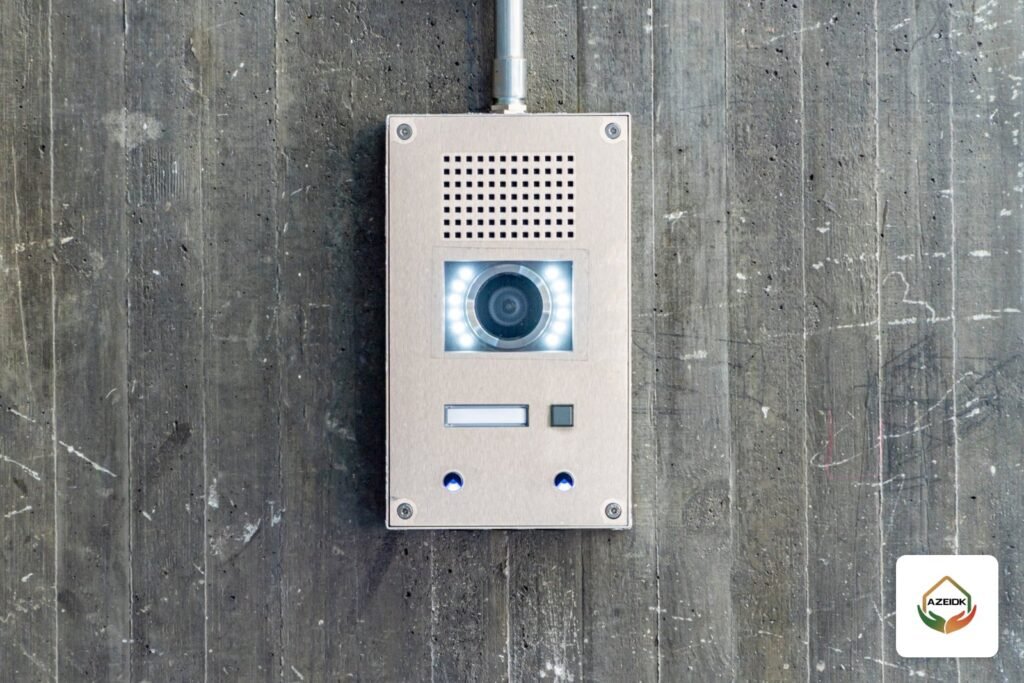
The Security Surveillance Cameras Law was issued by Royal Decree No. (M/34) dated 7/3/1444H. According to Okaz’s October 2022 report on the law, the entities required to install cameras include public and private educational facilities, and installation is banned inside toilets, changing rooms and medical examination rooms. Nurseries and kindergartens licensed by the Ministry of Education are private educational facilities, so we recommend treating cameras as part of the basic fit-out and confirming the details in the security requirements document.
Recording retention and required coverage are set by the law, its implementing regulations and the requirements document. We explain them in obligations under the security cameras law. Supply and installation are part of AZEIDK’s security and surveillance systems.
Steps to Civil Defense approval (Salamah license) for a nursery
The safety license is issued through the Salamah platform of the General Directorate of Civil Defense. The applicant is the facility owner or investor. Safety companies and engineering offices issue invoices, certificates and technical reports; they do not issue the license. In practice:
- Check the activity type and its requirements through the platform’s “investor journey” service.
- Prepare proof of site possession (lease, title deed or investment contract) and make sure the activity matches the commercial registration and municipal license.
- Install and test the safety systems according to the approved design.
- Obtain the safety equipment invoice or technical report, or a safety company contract and maintenance contracts where the activity requires them.
- Close any inspection remarks and resubmit.
Platform details, license validity and renewal are covered in our Salamah certificate guide. The technical report comes from an approved engineering office. AZEIDK installs and maintains the systems, issues the safety equipment installation certificate and coordinates with the engineering office as part of its Civil Defense approval support service, after a site visit and review of the installed systems. You can run a first check with our Salamah inspection checklist.
Common mistakes that delay a nursery license
- Leasing an upper floor or basement, then finding it does not suit the target age group.
- Fitting standalone household smoke alarms where the design calls for a fire alarm system with a control panel.
- Locking the second exit from inside to stop children wandering out, with no arrangement that allows immediate evacuation.
- Storing toys and mattresses in corridors or under stairs.
- Extinguishers with no inspection tag, or mounted behind doors.
- Cameras pointed at private areas the law prohibits.
- The activity description differing between the commercial registration, municipal license and Salamah.
Maintenance after opening: staying ready for inspection
Licenses get renewed and systems age. Extinguishers need periodic inspection, emergency lighting batteries lose capacity and detectors collect dust. We recommend a planned maintenance contract covering extinguishers, fire alarm and emergency lighting, with a record of every visit. Our fire safety log book guide explains the records, and contract options are on the preventive and planned maintenance page.
Fire system maintenance and CCTV maintenance are normally two separate contracts, each with its own scope and visit schedule.
Frequently asked questions
What are the requirements to open a private nursery in Saudi Arabia?
A commercial registration, Ministry of Municipalities and Housing approval and Civil Defense approval, followed by the Ministry of Education license. On residential land, a nursery is allowed only in a standalone building.
Does Civil Defense require a fire alarm system in a nursery?
Civil Defense approval is a licensing condition. The type and extent of the alarm system are set by the design under the Saudi Building Code and the occupancy classification. Ask the designer to specify it in writing before buying.
Can a nursery operate on the first floor or in a basement?
Municipal requirements place a nursery that occupies part of a building on the ground floor. Use of other floors depends on the children’s age and occupancy classification, so check with the authority before leasing.
Are CCTV cameras mandatory in nurseries?
The Security Surveillance Cameras Law covers public and private educational facilities. Cameras are banned inside toilets and changing rooms.
How many fire extinguishers does a nursery need?
There is no fixed number. It depends on floor area, hazards and travel distance to the nearest extinguisher, and is set by the design or technical report.
Who issues the Salamah license for a nursery?
The General Directorate of Civil Defense, through the Salamah platform. The facility owner applies. An approved safety company provides the safety equipment invoice, and an approved engineering office issues the technical report, depending on the activity.
Conclusion
Nursery requirements are a sequence, not a shopping list: a site that suits the children’s age, a design that defines the systems, installation and testing, the Salamah license, then regular maintenance. Start with the drawings before the lease, and put exits and alarms first.
Fitting out a nursery or kindergarten? Send us the floor plan, expected number of children and age groups, and we will review the required safety systems with you before you apply for the Salamah license. Talk to the AZEIDK team
Related guides
- Variation Orders and RFIs on Fire Protection Projects in Saudi Arabia
- Shawarma Restaurant Fire Suppression: Protecting Vertical Broilers, Charcoal Grills and the Tannour
- ZKTeco Access Control: Standalone or Networked, and Which Software
- Corning Fiber Optic Cable in Saudi Arabia: Cable Types and Connectivity for Buildings and Data Rooms