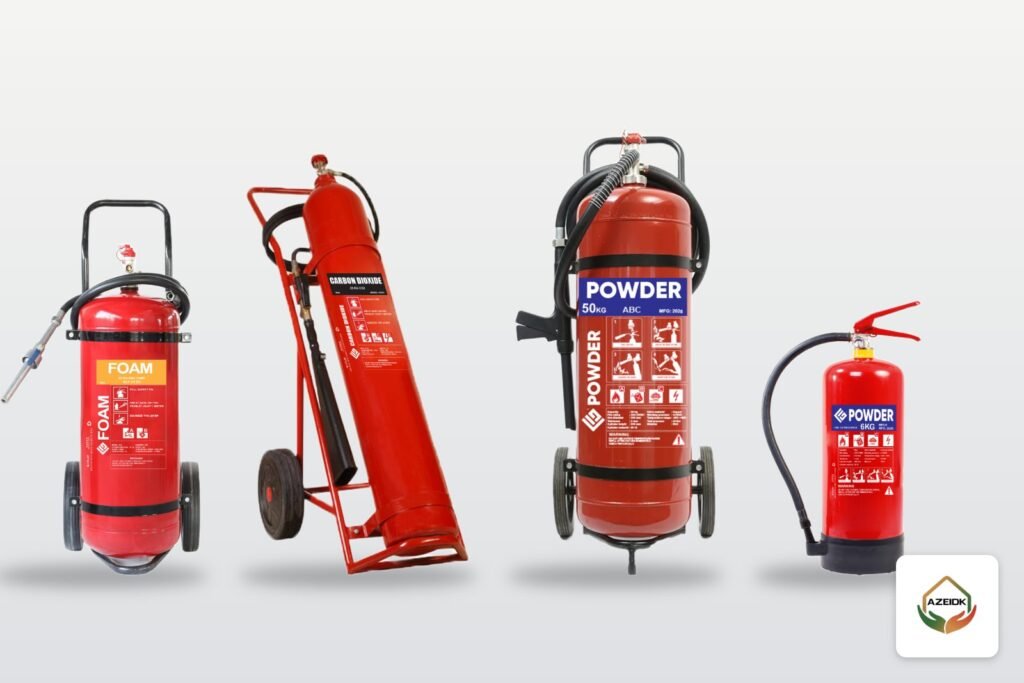
Factory fire extinguishers are chosen by what happens in each part of the plant: ABC dry powder or foam in production halls and raw material stores, foam or powder with a high B rating near oils, solvents and paints, CO2 in motor control (MCC) and switch rooms, and 50 kg or 50 L wheeled units for fuel areas and yards, with a travel distance of no more than 22.9 m for ordinary combustibles. The designer then revisits the layout whenever production lines change.
To compare extinguisher types and choose the right one for each hazard, see our fire extinguishers selection guide for facilities in Saudi Arabia.
A factory is never a single-hazard building. One site can hold machines running on hydraulic oil, a compressor room, a diesel tank for the generator, a welding bay and a carton store for packaging. This guide explains how to split a plant into hazard zones, the type and size for each zone, when a wheeled extinguisher is needed, and the faults Civil Defense inspectors find most often.
Key points
- Start with a list of materials and processes: what is stored, handled and heated in each zone.
- Ordinary combustible zones: travel distance up to 22.9 m, and a minimum 4-A rating in extra hazard.
- Flammable liquid zones: B rating with a 9.1 m or 15.25 m travel distance depending on the rating.
- Control panels and electronics: CO2 or clean agent, not powder.
- Yards and fuel areas: wheeled units as designed.
In this article
How to zone a factory by hazard
Ask the production manager for a list of materials and approximate quantities, and the maintenance lead for a list of equipment that runs on oil or heat. Then mark each zone on the drawing: production hall, maintenance workshop, raw material store, finished goods store, motor room, compressor room, generator and fuel tank, welding bay, loading area and offices.
The designer assigns each zone a hazard class: light, ordinary or extra. Production halls with large quantities of combustible material are usually extra hazard, which changes the minimum extinguisher rating and the number of units. In Saudi Arabia the binding references are SBC 801, Civil Defense requirements and the approved drawings; NFPA 10 tables are the technical reference the designer applies. For all systems in this sector see our industrial facilities page.
Factory fire extinguishers by zone
| Zone | Main hazard | Suitable type |
|---|---|---|
| Production hall (solids) | Class A | ABC powder or foam with an A rating matched to the hazard |
| Hydraulic machines and presses | Class B | ABC powder or foam with a high B rating |
| Paint and solvent rooms | Class B | Foam or powder, alongside the fixed system the design specifies |
| Motor rooms and MCC panels | Class C | CO2 |
| Control rooms and PLCs | Delicate electronics | CO2 or FM-200 |
| Generator and diesel tank | Class B and C | Wheeled powder or foam, CO2 for the generator panel |
| Welding and cutting bay | Class A and B | ABC powder close to the work |
| Yards and loading areas | Class A and B | Portable ABC powder and wheeled units |
For fire classes see the fire triangle and fire classes.
How many extinguishers does a production hall need?
In the NFPA 10 table for Class A hazards, each unit of A covers about 139 m² in ordinary hazard and about 93 m² in extra hazard, the smallest single extinguisher is 2-A for ordinary and 4-A for extra hazard, and no single unit is credited with more than about 1,045 m². Example: a 2,500 m² extra hazard hall needs about 27 units of A by area, so at least seven 4-A extinguishers, then more are added until no walking path to an extinguisher exceeds 22.9 m.
Machines and conveyors block straight lines in a factory, so the real walking distance is longer than the distance measured on the drawing. The designer traces walking routes around the lines and places units at hall entrances, beside columns and at line crossing points. For the full method see our NFPA 10 guide.
Flammable liquid zones
Where liquid depth does not exceed about 6 mm, the table links the B rating to travel distance: in extra hazard, a 40-B unit within 9.1 m or an 80-B unit within 15.25 m. Deeper open tanks and dip tanks follow their own NFPA 10 provisions, usually together with a fixed system.
When does a factory need a wheeled extinguisher?
A hand portable unit handles a small fire in its early stage. In fuel and oil areas with larger quantities, outdoor storage yards and wide loading areas, the responder needs more agent and a longer reach. That is where wheeled units come in: 50 kg powder for mixed fires, 50 L foam for liquid areas, or trolley CO2 for transformer and generator areas. They stand on level ground where they can be pulled easily, clear of forklift routes. See wheeled fire extinguishers.
Control panels and motor rooms
NFPA 10 states that dry chemical extinguishers shall not be installed to protect delicate electronic equipment, because the residue is hard to remove and can cause corrosion, especially with heat and humidity. A line stopped by damaged PLC modules can cost more than the fire itself. Control rooms are protected with CO2 or FM-200, and motor and switch rooms with a CO2 unit beside the door. See the CO2 extinguisher guide.
Combustible metal fires, such as magnesium or aluminium fines in some machining shops, need special Class D extinguishers chosen by the designer for the specific metal; water and ordinary powder units are not used on them.
Common faults in factory extinguishers
- Units clustered at the offices and gate, with the depth of the hall uncovered.
- An extinguisher behind a machine or a pallet stack.
- A powder unit in the control room.
- A production line moved without updating the extinguisher layout.
- Outdoor units with no protection from sun and dust. See fire extinguisher covers.
- An expired service tag or a unit past its hydrostatic test date. See fire extinguisher maintenance.
Factory extinguishers available from AZEIDK
Through its technical supply service, AZEIDK supplies extinguishers for industrial zones, with the datasheet for each model:
- Falcon Gold 6 kg dry powder (FDP6): ABC 70% powder, 8 m range and 15 s discharge per the datasheet.
- SFFECO ABC dry powder extinguishers: stored pressure from 1 to 12 kg, cartridge-operated 6 and 9 kg models, and PD12D rated 55A 233B C per the product page.
- FG 50 kg wheeled dry powder: rated 55A 233BC per the datasheet, for yards and fuel areas.
- FG 50 L wheeled foam: for flammable liquid areas.
- FG 25 kg trolley CO2: for generator and transformer areas.
- FG 6 kg CO2: for motor rooms and panels.
For the full SFFECO range see SFFECO fire extinguishers. AZEIDK’s own team maintains extinguishers under its periodic maintenance contracts.
FAQ
What is the best fire extinguisher for a factory?
No single type covers a whole plant. ABC powder for solids and mixed fires, foam for liquids, CO2 for panels and motors, and wheeled units for yards and fuel.
How many extinguishers does a 2,500 m² factory need?
In extra hazard, at least seven 4-A units by area, plus whatever the 22.9 m travel distance and special hazard zones require.
Do sprinklers replace extinguishers in a factory?
No. Extinguishers are for early response and remain required alongside fixed systems under SBC 801 and the approved drawings.
When should I choose a wheeled unit over a portable one?
In fuel and oil areas with larger quantities and in wide yards, where more agent and longer reach are needed, as set by the designer.
Can I use powder in a control room?
No. NFPA 10 does not allow dry chemical for delicate electronic equipment; use CO2 or FM-200.
How often is an extinguisher shell hydrostatically tested?
As a US reference: every 5 years for CO2 and foam, and every 12 years for powder units with mild steel shells. Follow the schedule set by your service provider and the authority.
Summary
List the materials and processes, zone the plant, match each zone to the right type and size, space units by the real walking route around machines, and update the layout with every change to the production lines.
Fitting out a factory or reviewing its extinguishers before inspection? Send us the drawings and the list of materials and processes, and we will propose types and quantities with a supply and maintenance offer. Contact the AZEIDK team
AZEIDK supplies fire extinguishers of all common types and sells them to individuals and businesses from its branches in Saudi Arabia.
Related guides
- Smart Buildings: How Low Current Systems Integrate in One Building
- Are Sprinklers Mandatory? Civil Defense Sprinkler Requirements Under Saudi Fire Code SBC 801
- CCTV Cameras for Restaurants and Cafes: Cashier, Dining, Kitchen, Store and the Law
- Fire Pumps in Riyadh: Choosing Pumps for Towers, Warehouses and Factories, Supplied by AZEIDK