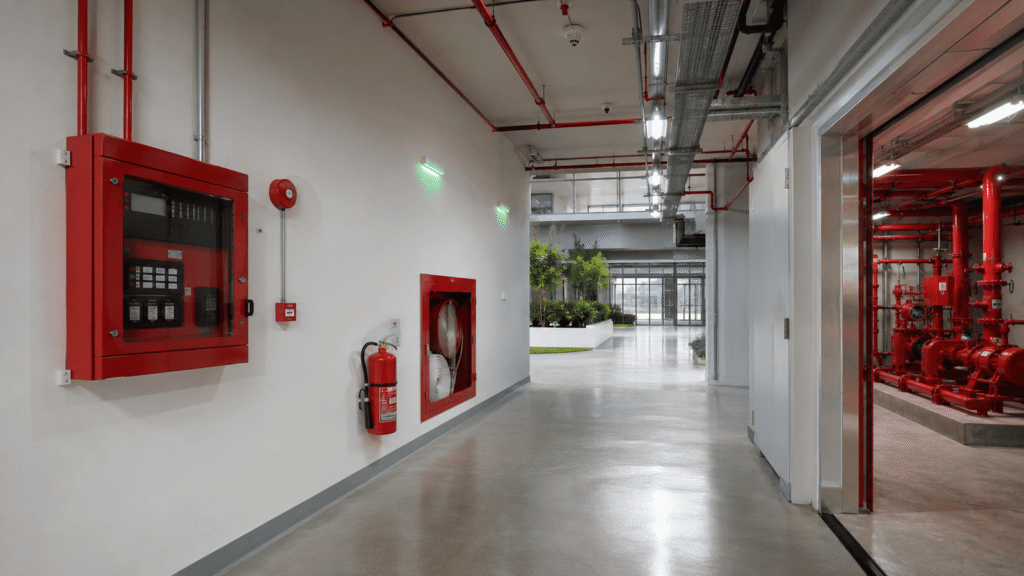
Electrical room fire protection works in three layers: prevent fires through panel and connection maintenance, detect them early with detectors suited to the room, and suppress them with a system suited to energized equipment: sprinklers where the code requires them, clean agent for the whole room, or an automatic system inside the panel. Electrical equipment alone is not a reason to omit sprinklers.
Key takeaways
- Common causes of electrical room fires include loose connections, overloads, arcing and aged insulation, so maintenance is the first line of defense.
- NFPA 13, the National Fire Protection Association (NFPA) sprinkler standard, allows sprinklers to be omitted in electrical equipment rooms only when four conditions are all met, including a dedicated room and a 2-hour fire-rated enclosure.
- Clean agent suits a whole room of energized equipment because it is nonconducting and leaves no residue; in-panel systems such as aerosol protect single panels.
- Early detection in the room and inside critical panels buys time to shed load before a fire develops.
- NFPA 70B became a standard with mandatory language in its 2023 edition, since revised in 2026, requiring a documented maintenance program that includes thermography.
In this article
- Why electrical rooms catch fire
- Do electrical rooms need sprinklers?
- Suppression options for electrical rooms and panels
- Early detection in electrical rooms
- Designing the room itself
- Step by step: choosing electrical room protection
- Common site mistakes
- Maintenance: NFPA 70B and fire systems
- How AZEIDK helps
- FAQ
Why electrical rooms catch fire
An electrical room concentrates heat and ignition sources in a small space: main and sub-distribution panels, transformers, uninterruptible power supply (UPS) units and batteries, and dense cable trays. Fires often start at a hidden hot spot.
- Loose or corroded connections and terminations that heat up under load.
- Overloaded breakers or undersized cables.
- Arc faults when insulation breaks down or moisture gets in.
- Dust buildup, poor ventilation and high room temperature.
- Combustibles stored in the room or in front of panels.
- Oil in oil-filled transformers, and batteries in UPS rooms.
In critical facilities, electrical rooms are tied directly to business continuity, as our guide to data center fire protection explains.
Do electrical rooms need sprinklers?
The short answer: in a sprinklered building, the electrical room stays sprinklered unless the exemption conditions are met. Building codes based on the International Building Code (IBC) state that sprinklers are not to be omitted from a room merely because it is damp, fire-rated or contains electrical equipment.
NFPA 13, in Section 9.2.6 of the 2019 edition, allows sprinklers to be omitted in electrical equipment rooms only where all four of these conditions are met:
- The room is dedicated to electrical equipment only.
- Only dry-type equipment, or liquid-type equipment with listed K-class fluid, is used.
- Equipment is installed in a 2-hour fire-rated enclosure, including protection for penetrations.
- Storage is not permitted in the room.
The IBC also allows sprinklers to be omitted in generator and transformer rooms separated by 2-hour fire-resistance-rated construction, provided an approved automatic fire detection system is installed. In Saudi Arabia, the reference is the Saudi Fire Protection Code (SBC 801), the Saudi Building Code and Civil Defense requirements, so no exemption should be assumed before the authority having jurisdiction (AHJ) approves the drawings. See our NFPA 13 guide for more.
Suppression options for electrical rooms and panels
| Option | Where it fits | Watch points |
|---|---|---|
| Wet or preaction sprinklers | Rooms in sprinklered buildings unless exemption conditions are met | Coordinate with power disconnect; preaction reduces the risk of accidental water release |
| Total flooding clean agent | Enclosed switchgear, panel and control rooms | Sealed room and relief vents; design to NFPA 2001 |
| Condensed aerosol | Panels, cabinets and small enclosures | Not a clean agent under the NFPA 2001 definition; covered by NFPA 2010 |
| Carbon dioxide | Normally unoccupied enclosures | Lethal at design concentrations; strict safeguards needed |
A clean agent is an electrically nonconducting extinguishant that leaves no residue on evaporation, which is why it suits sensitive energized equipment, as our clean agent comparison explains. A condensed aerosol fills the enclosure with fine particles, so it falls outside the clean agent definition; NFPA 2010, whose latest edition is 2025, covers its purchase, design, installation, testing and maintenance. It is offered as a compact option for panels and cabinets.
For carbon dioxide, the U.S. Environmental Protection Agency (EPA) states that it is lethal at the 34% minimum design concentration for total flooding, and that accidental exposure during maintenance or testing has been the largest cause of deaths and injuries. It is therefore usually limited to unoccupied enclosures with a pre-discharge alarm, a time delay and the supervised lock-out NFPA 12 calls for.
Early detection in electrical rooms
Detection here should buy time to shed load or isolate a panel before a fire develops, not just raise an alarm. Choose detectors for the room environment: smoke detectors in clean, air-conditioned rooms and heat detectors where dust or heat is high, as our detector selection guide explains.
- Aspirating detection inside critical panels or at their vents picks up light smoke from overheating insulation early.
- Linear heat detection suits long cable trays.
- Suppression is released through a dedicated releasing panel; two-zone confirmation before release is common practice set by the specification.
- Link alarms to heating, ventilation and air conditioning (HVAC) shutdown, damper closure and building management system status.
- Thermography is a maintenance tool, not a substitute for automatic detection.
Designing the room itself
Many problems are solved before suppression is chosen: a dedicated room with fire-rated walls per the approved drawings and firestopped cable openings is easier to protect and safer for the rest of the building.
- Keep storage out of the room; it is one of the NFPA 13 exemption conditions.
- Maintain adequate ventilation and cooling, since high room temperature speeds up insulation aging.
- Firestop cable penetrations between rooms and floors with a system matching the wall rating.
- Place Class C rated extinguishers, meant for fires in energized electrical equipment that need nonconductive media, near the entrance; see our NFPA 10 extinguisher guide.
- In battery rooms, follow the manufacturer and adopted code ventilation requirements, and treat lithium-ion batteries as a separate hazard needing its own assessment.
Step by step: choosing electrical room protection
- List the equipment: panels, transformers and their insulation type, batteries and cable trays.
- Confirm what the adopted code requires: are sprinklers needed, and are all exemption conditions met?
- Assess criticality and downtime cost to decide on gas or in-panel suppression.
- Select detection and its locations in the room and in critical panels.
- Select a system listed for the application, with calculations and the design manual from the supplier.
- Record interfaces with the alarm panel, HVAC and power in the cause and effect matrix.
- Get the drawings approved by Civil Defense before installation.
- Test at handover, then add the room to the electrical and fire systems maintenance programs.
Common site mistakes
- Omitting sprinklers because the room holds electrical equipment, without meeting the conditions or getting AHJ approval.
- Turning the electrical room into a store.
- Open cable penetrations between rooms and floors.
- An in-panel system that does not suit the panel size or is not listed for the use.
- Dry powder extinguishers next to sensitive electronics, though they leave residue and NFPA 75 does not permit them in information technology equipment (ITE) areas.
- Thermography done only after a failure.
Maintenance: NFPA 70B and fire systems
With its 2023 edition, effective 16 January 2023, NFPA 70B became the Standard for Electrical Equipment Maintenance and moved from recommendations to mandatory language. The American National Standards Institute (ANSI) now lists the 2026 edition as the most recent, so confirm intervals in the edition the facility adopts. The owner must implement and document an electrical maintenance program (EMP), with intervals set by an equipment condition assessment of physical condition, criticality and environment.
According to TÜV SÜD’s summary of the standard, thermographic inspection is required at least every 12 months for equipment in Conditions 1 and 2 and at least every six months for Condition 3, which includes equipment that has missed maintenance cycles. Thermography finds hot connections before they become fires.
Fire systems follow their own standards: NFPA 72 for detection, NFPA 2001 for clean agent, including semiannual agent checks in the 2018 edition, and NFPA 25 for sprinklers; our guide to preventive and corrective maintenance shows how to combine them.
What drives cost
- Number and size of protected rooms and panels.
- System type: total flooding or in-panel.
- Detection type and the number of critical panels monitored.
- Room sealing and firestopping work.
- Interfaces with alarm, HVAC and power.
- The maintenance program, thermography and refills after any discharge.
How AZEIDK helps
Through its special fire suppression solutions, AZEIDK provides suppression for server rooms and electrical rooms, automatic extinguishing systems for panels and equipment, and clean agent and aerosol systems, with technical site surveys, engineering design and calculations, supply, installation, system testing and commissioning, and Civil Defense approvals. For existing buildings the work usually starts with an assessment of existing systems and scope definition and continues through annual maintenance contracts.
Brands AZEIDK supplies here include FirePro, specialized in condensed aerosol suppression, including a compact solution for enclosed spaces such as electrical panels, and Context Plus, including the EP203/CON automatic gas extinguishing control panel alongside its alarm panels and detectors, plus the FM-200 system from American Fire Control.
FAQ
Do electrical rooms need sprinklers?
In a sprinklered building, usually yes. NFPA 13 allows omission only when the room is dedicated to electrical equipment, the equipment is dry-type or uses listed K-class fluid, it sits in a 2-hour fire-rated enclosure, and nothing is stored there. The Saudi code and Civil Defense decide at drawing approval.
Which suppression system suits electrical panels?
It depends on the panel’s criticality and the size of the space. Total flooding clean agent protects a whole room, while in-panel systems such as condensed aerosol protect a single panel or cabinet. Either way, use a system listed for the application and tie it to detection and power disconnect in the approved cause and effect matrix.
Is aerosol a clean agent?
No. A clean agent is electrically nonconducting and leaves no residue on evaporation, while a condensed aerosol fills the space with fine particles, so it falls outside that definition and is covered by NFPA 2010. It suits small enclosures such as panels, provided the model is listed for the enclosure size and installed to the manufacturer’s instructions.
What type of extinguisher suits an electrical room?
Choose one rated for Class C fires, meaning fires in energized electrical equipment that require electrically nonconductive media, such as carbon dioxide or clean agent units. Near sensitive electronics it is good practice to avoid dry powder because it leaves residue, and NFPA 75 does not permit dry chemical extinguishers in ITE areas.
How often should electrical panels have thermographic inspection?
Summaries of the 2023 edition of NFPA 70B give thermography at least every 12 months for equipment in Conditions 1 and 2 and at least every six months for Condition 3, which includes equipment with missed maintenance cycles. Confirm these in the current 2026 edition; the final intervals are set in the facility’s documented electrical maintenance program.
Want your electrical room protection reviewed? Send us the room layout and panel list, and we will help you confirm what the code requires and the right solution. Contact the AZEIDK team