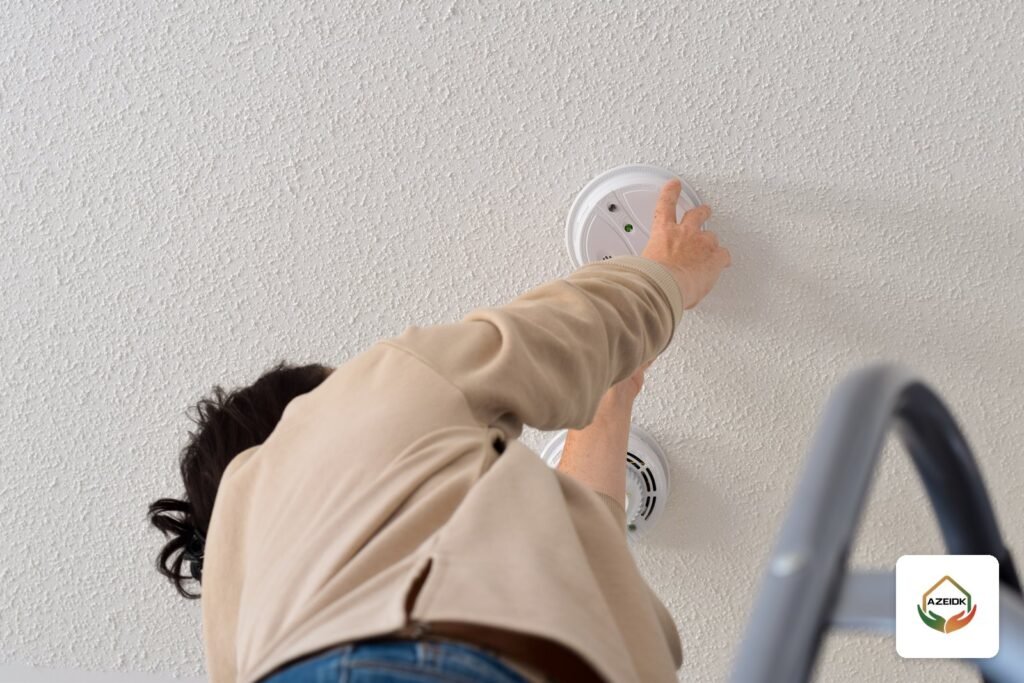
How to test smoke detectors at home: press and hold the test button until the alarm sounds, at least once a month. Change the 9-volt battery at least once a year or as soon as it starts chirping, and replace the whole unit after 10 years, or sooner if the manufacturer says so. Smoke detectors on a building fire alarm panel are a different job: a qualified technician tests them in place with approved test smoke.
This guide covers testing of both kinds, home and building system, and the shortcuts that damage detectors or give false results.
Key takeaways
- The U.S. Fire Administration (USFA) recommends testing home smoke alarms monthly, replacing replaceable batteries at least once a year and replacing the whole alarm every 10 years.
- A single chirp repeating every 30 to 60 seconds usually means a low battery, according to Kidde.
- System smoke detectors are functionally tested every year in place, by getting smoke or a listed test product acceptable to the manufacturer into the sensing chamber, per the NFPA 72 (2019 edition) test table.
- Never test any detector with a lighter, candle or household spray.
In this article
- Which type of smoke detector do you have?
- How to test smoke detectors at home, step by step
- How to test smoke detector battery health and when to change it
- How to test a smoke detector battery
- When should you replace the smoke detector itself?
- Cleaning is part of the check
- How to check a smoke detector in two minutes
- Smoke detector test for conventional and addressable fire alarm systems
- Common smoke detector test mistakes
- Who should handle testing in commercial buildings?
- Frequently asked questions
- Summary
Which type of smoke detector do you have?
Identify the device first; the test method differs:
- Standalone battery smoke alarm: one unit with the sensor, sounder and battery, alarming only where it is installed. These are common in apartments and small villas. One example is the SD-425 standalone photoelectric smoke detector, which runs on a 9 V battery.
- System smoke detector (conventional or addressable): usually has no built-in sounder. It sits on a base wired to the fire alarm control panel, which drives the bells and records the event.
A test button and battery compartment mean a standalone alarm. A ceiling detector with no button, in a building with a fire alarm panel, is a system detector and is not tested the home way. When a standalone alarm is enough is covered in our article on battery smoke alarms vs fire alarm systems.
How to test smoke detectors at home, step by step
These steps apply to battery alarms and mains-powered alarms with a backup battery. Check your model’s manual, since press time and alarm pattern vary.
- Warn the household and ask someone to confirm the alarm is heard in the bedrooms.
- Use a steady ladder, not a swivel chair.
- Press and hold the test button for a few seconds until the alarm sounds. Kidde says to hold it for at least two seconds.
- Listen to the volume: a weak or broken sound usually points to a low battery.
- If the alarms are interconnected (wired or wireless), check that the other units in the home sound as well.
- Log the date on a card in the electrical panel or as a phone reminder.
If the alarm stays silent, fit a new battery and test again. If it is still silent, the unit needs replacing.
How to test smoke detector battery health and when to change it
USFA advises replacing the battery in 9-volt alarms at least once a year, and the same for the backup battery in hardwired alarms. Alarms with a nonreplaceable 10-year lithium battery are not opened for a battery change: the whole unit is replaced at the end of its life.
For the SD-425, the AZEIDK product page gives an approximate battery life of about one year, which fits the yearly change rule.
What does the chirp mean?
Kidde explains that a low battery usually shows as a single chirp repeating every 30 to 40 seconds, or every 60 seconds on some models, for at least seven days. On Kidde alarms, a chirp between flashes of the red light can signal a fault in the alarm itself rather than the battery, so check the signal table in your manual before deciding.
Changing the battery
- Twist the alarm off its base in the direction marked on the unit. For mains-powered models, follow the manufacturer’s instructions before removing it.
- Fit a battery of the type and voltage stated in the datasheet, observing polarity.
- Refit the alarm and test it straight away with the test button.
- Write the change date on a small label next to the alarm or inside the cover.
Do not pull the battery to silence the alarm while cooking. USFA states plainly that disabling a smoke alarm or removing its battery can be a deadly mistake.
How to test a smoke detector battery
You do not need a meter to test a smoke detector battery at home. The test button is the practical check: as Kidde explains, it confirms that the alarm’s horn, battery and electronics are working together. Judge the battery this way:
- Press the test button and listen. A loud, clear alarm means the battery can drive the sounder. A weak, broken or delayed sound is a common sign of a low battery.
- Listen between tests. A single short chirp repeating at regular intervals is the most common low-battery signal, though on some models it can mean the alarm needs maintenance. Check the signal table in the manual.
- If the alarm stays silent, fit a new battery of the type stated on the alarm or in its manual and test again straight away. Kidde warns that a different battery type may not power the alarm properly.
- If it is still silent with a new battery, the problem is the alarm, not the battery, and the unit should be replaced.
The test button does not measure how sensitive the sensing chamber is to smoke, and Kidde notes the sensor loses sensitivity with age. So the alarm’s manufacture date stays part of the check even when the battery is new.
Battery operated smoke detectors: which battery does yours use?
USFA notes that smoke alarms are powered either by battery or by the home’s electrical system, and that hardwired alarms usually have a backup battery. What to do with each type:
| Alarm type | Battery | What you need to do |
|---|---|---|
| Battery operated, replaceable battery | Usually 9 V or AA, depending on the model | Test monthly; change the battery at least once a year or when it chirps |
| Battery operated, sealed 10-year lithium | Built in for the life of the alarm, not replaceable | Test monthly; replace the whole alarm per the manufacturer’s instructions |
| Hardwired with backup battery | Backup battery per model | Test monthly; change the backup battery at least once a year; installation by a qualified electrician |
To identify yours, check the label on the back or look for a battery door. The SD-425, for example, runs on a 9 V battery according to its product page, with a mains supply option. For a villa or multi-storey residential building, a full fire alarm system may suit better than separate units, as explained in our guide to fire alarm systems for villas and residential projects.
When should you replace the smoke detector itself?
Sensors age with dust, humidity and time. USFA recommends replacing the entire alarm every 10 years, while Kidde gives 5 to 10 years depending on the model. In practice: follow the period in your alarm’s manual, and if none is stated, do not go past 10 years.
To find the age, take the alarm off its base and look for the manufacture date on the back. Replace it earlier if:
- it stays silent on test even with a new battery;
- it keeps giving false alarms after cleaning;
- the cover or smoke entry openings are cracked or damaged;
- the manufacture date cannot be found.
Cleaning is part of the check
Dust inside a detector causes false alarms and can weaken its response. Kidde recommends cleaning alarms at least twice a year, gently vacuuming the openings with a soft brush attachment or using short bursts of compressed air. If false alarms return after cleaning, have the unit checked or replace it.
How to check a smoke detector in two minutes
For a quick monthly check of the alarm in your home or office:
- Test button: a clear alarm within seconds.
- LED indicator: compare its behaviour with the manual, since flash patterns and colours differ between manufacturers.
- Chirping: no intermittent chirp between tests.
- Manufacture date: printed on the back, and not older than 10 years or the period the manufacturer sets.
- Cleanliness: smoke entry openings free of dust and not covered.
- Interconnected alarms: testing one unit sets off the others.
This list is for standalone alarms. In buildings with a fire alarm panel, fault messages, silencing and resetting follow different steps, covered in our fire alarm silence and reset guide. A smoke alarm is one of the basic safety items at home, alongside an extinguisher and a first aid kit, as listed in our home safety tools checklist.
Smoke detector test for conventional and addressable fire alarm systems
In buildings with a fire alarm panel, testing is work for a qualified maintenance team, and the results go into a report kept in the building file.
What does NFPA 72 require?
The NFPA 72 testing table (Table 14.4.3.2 in the 2019 edition, as quoted by QRFS) requires smoke detectors to be tested in place to confirm smoke entry into the sensing chamber and an alarm response, using smoke or a listed and labeled product acceptable to the detector manufacturer. System smoke detectors in non-dwelling occupancies are tested annually. Where a detector includes a heat element, both the smoke and heat functions are operated.
Sensitivity testing is a separate requirement: per the same source, in buildings other than one- and two-family dwellings it is done one year after installation and then every alternate year, and sensitivity must not be measured with any device that administers an unmeasured concentration of smoke. Inspection, testing and battery schedules are covered in detail in our guide to fire alarm periodic inspection and maintenance, and the role of the code itself is explained in our NFPA 72 guide.
In Saudi Arabia, NFPA 72 is a technical reference adopted by the designer and the project documents, alongside the Saudi Fire Protection Code SBC 801 and Civil Defense requirements. The approved project documents and the detector manufacturer’s instructions set the final test frequency.
What a test visit looks like
- The technician informs building management and puts the panel in test mode, or isolates linked outputs (HVAC shutdown, door release, lift recall) according to the approved programming, so the test does not trigger unintended actions.
- A test pole with a cup is placed over the detector and a small amount of approved test smoke is released.
- The technician confirms the alarm appears on the panel with the correct address or zone, and that the detector LED lights.
- The panel is reset and each detector’s result is logged in the visit report.
- On addressable systems, the panel may show a sensitivity or contamination reading for each detector, judged against the manufacturer’s instructions.
Detector type (optical, ionisation or multisensor) affects which test tool is suitable. Types and models are covered in smoke detector types: optical, ionisation and multisensor.
| Item | Standalone battery alarm | System smoke detector |
|---|---|---|
| Who tests it | Homeowner or occupant | Qualified maintenance technician |
| Method | Test button | Smoke or listed test product acceptable to the manufacturer, with the panel monitored |
| Reference frequency | Monthly (USFA) | Annual functional test (NFPA 72, 2019 ed.) plus sensitivity testing on its schedule |
| Battery | Yearly change for 9 V, or a 10-year sealed unit | No battery in the detector; standby batteries are in the panel |
| Replacement | Every 10 years or per manufacturer | Based on test results and manufacturer instructions |
| Records | Date written next to the alarm | Visit report per detector |
Common smoke detector test mistakes
- Using a flame: Kidde says to stick with the test button rather than a match or a candle. A flame under the ceiling is a hazard in itself and can damage the unit.
- Household sprays: air freshener, hairspray and insecticide are not test products. NFPA 72 (2019 edition) calls for a listed product acceptable to the manufacturer, and some canned test smoke is itself flammable, so keep it away from heat sources.
- Over-spraying test smoke: the UK Fire Industry Association (FIA) notes that aerosol cans designed for detector testing need only a small amount of spray.
- Testing heat detectors with a hairdryer or heat gun: FIA warns this can melt the detector or damage its sensors, and that shorting the thermistor with a screwdriver to force an alarm should be avoided.
- Testing a building system without notice, so a real alarm later gets treated as another test.
Who should handle testing in commercial buildings?
A building with a fire alarm system needs a written maintenance programme listing devices, test frequency and report format. AZEIDK provides preventive and periodic maintenance contracts for fire alarm systems, including inspection, functional testing of detectors and documented results in line with the manufacturer’s instructions and the project’s adopted technical reference.
Frequently asked questions
How often should I test smoke detectors at home?
At least once a month using the test button. This is the recommendation of USFA and manufacturers such as Kidde.
Why does my smoke detector chirp every minute?
The usual cause is a low battery, shown as a single chirp every 30 to 60 seconds. If it continues after a battery change, check the manual: it may be a fault or the end of the alarm’s life.
Is the test button enough to check a smoke detector?
For a standalone home alarm, the test button is the method manufacturers recommend. System smoke detectors must be tested with smoke or a listed test product that reaches the sensing chamber, per NFPA 72 (2019 edition).
Can I test a smoke detector with a lighter or incense?
No. Flames and random smoke can damage the detector and create a hazard. Use the test button at home and approved test smoke for system detectors.
How long do smoke detectors last?
USFA recommends replacing them every 10 years, and some models sooner per the manufacturer. The manufacture date is usually printed on the back.
How often are system smoke detectors tested in a building?
Functional testing is annual under the NFPA 72 (2019 edition) table, with sensitivity testing on its own schedule, plus the manufacturer’s instructions and project and Civil Defense requirements.
How do I test a smoke detector battery?
Press the test button: it checks the horn, battery and electronics together. If the sound is weak or there is none, fit a new battery of the type stated on the alarm and test again. If it stays silent, replace the alarm.
Do battery operated smoke detectors need an electrician?
An alarm that runs on battery only needs no wiring. USFA advises that hardwired alarms, which run on the home’s electrical system, are installed only by a qualified electrician.
Summary
At home: the test button monthly, a battery every year, cleaning twice a year and a new unit at its age limit. System detectors need a maintenance team using approved test smoke and recording every device. A detector that is never tested cannot be relied on.
Need smoke detectors tested in your building, or a fire alarm maintenance contract? Send us the system type, number of detectors and site location, and we will agree the test scope and report you need. Contact the AZEIDK team
To request a fire alarm system for your facility, see AZEIDK fire alarm systems.
Related guides
- Fire Alarm Cables in Saudi Arabia: Types, Specifications and Selection
- Jockey Pumps: Sizing and Start/Stop Pressure Settings
- Safety and Fire Fighting Company in Buraydah and Qassim: Fire Alarm, Firefighting, Extinguishers and Civil Defense Licensing
- CCTV Commissioning: Testing Views, Retention, Night Vision, User Rights and Handover