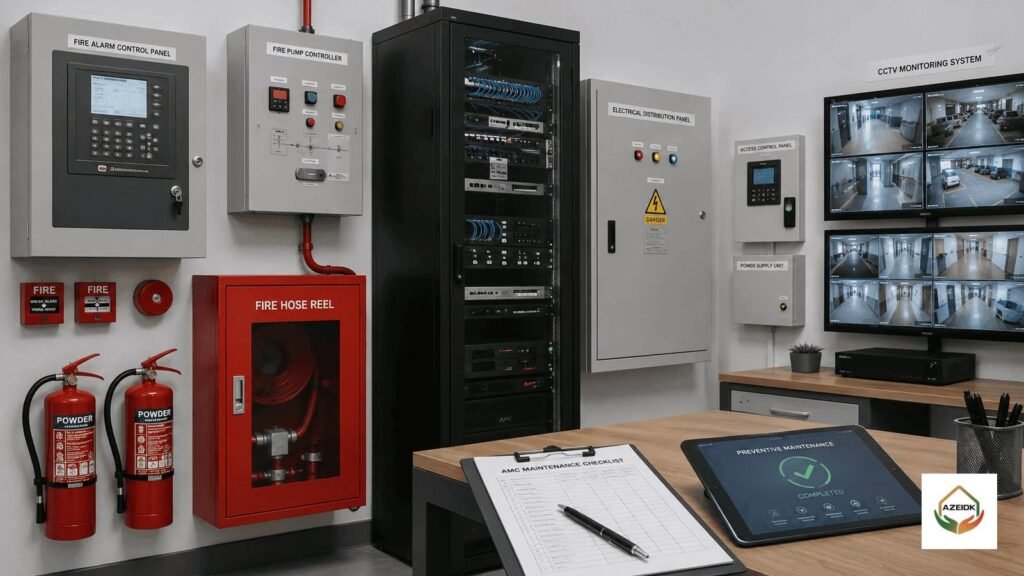
Fire extinguisher refilling is required after any use, however brief, when a monthly inspection or annual maintenance shows low pressure or lost weight, and at internal examination dates. A qualified technician refills the unit to the manufacturer’s instructions with the agent on its nameplate, leak-tests it and returns it with a new tag and collar.
This guide focuses on the refill itself: when an extinguisher should go for refilling, what happens to it in the workshop by type, when replacement makes more sense than refilling, and how to check the work before the unit goes back on the wall. The full fire extinguisher maintenance programme, with its monthly, annual and six-year levels, is covered in Fire Extinguisher Maintenance and Refilling; here we only summarise the intervals.
Key points
- A partly used extinguisher is refilled; it does not go back because the gauge needle is still near green.
- Refill only with the agent stated on the nameplate, and never mix ABC powder with another powder type.
- Ask for loan extinguishers of the same rating for as long as yours are in the workshop.
- On return: a new tag, a verification-of-service collar, an intact seal, the gauge in the green and the correct weight.
- Damaged or end-of-life units are replaced, and new units need a SASO certificate of conformity.
In this article
- When does an extinguisher need refilling?
- How often is an extinguisher inspected and maintained?
- What does fire extinguisher refilling involve in the workshop?
- Does refilling differ by extinguisher type?
- When is replacement better than refilling?
- How do you choose a refill provider in Saudi Arabia?
- How do you accept an extinguisher after refilling?
- What are common refilling mistakes?
- Frequently asked questions
- Summary
When does an extinguisher need refilling?
Many people link refilling to a fixed yearly date, but annual maintenance does not mean emptying and refilling the unit. Refilling is triggered by specific events:
- After any use: even a short burst in training or on a small fire. A partly discharged dry powder unit may slowly lose pressure afterwards, because powder left in the valve can stop it sealing.
- Low pressure: when the gauge needle on a stored-pressure unit leaves the green zone.
- Lost weight: CO2 extinguishers usually have no gauge, so loss is found by weighing against the weight marked on the unit and the manufacturer’s limits.
- Broken seal or missing pin: it may mean the unit was used without anyone reporting it.
- Internal examination or hydrostatic test due: the unit is emptied in both cases and refilled afterwards.
NFPA 10 requires every rechargeable extinguisher to be recharged after any use, or when inspection or maintenance shows the need.
How often is an extinguisher inspected and maintained?
Refilling is part of a wider programme. OSHA’s 29 CFR 1910.157 gives clear intervals that are useful as a reference, although the binding reference for a facility in the Kingdom is the Saudi Fire Protection Code (SBC 801) and the requirements of the General Directorate of Civil Defense:
| Action | Interval | Includes refilling? |
|---|---|---|
| Visual inspection (location, gauge, seal, body) | Monthly | No, unless it finds a fault |
| Annual maintenance | Yearly, with a dated record | Not normally, unless the technician finds a need |
| Emptying and maintenance of stored-pressure dry powder units | Every 6 years for units on a 12-year hydrostatic test | Yes, after emptying |
| Hydrostatic test, CO2 and water units | Every 5 years | Yes, after the test |
| Hydrostatic test, stored-pressure dry powder (mild steel, brazed brass or aluminium shells) | Every 12 years | Yes, after the test |
For full intervals by type, including NFPA 10 internal examination periods, see the NFPA 10 portable fire extinguishers guide.
What does fire extinguisher refilling involve in the workshop?
A proper refill is not topping up powder or gas on top of what is left. The technician follows the manufacturer’s service manual through a sequence of steps:
- Safe depressurisation: the unit is relieved of pressure and remaining agent before the valve is removed.
- Internal and external examination: the shell is checked inside and out for rust, corrosion or dents, along with threads, O-rings, the hose and the nozzle.
- Valve cleaning: powder residue is removed and damaged parts are replaced with parts specified by the manufacturer.
- Correct agent: the agent on the nameplate, or one proven chemically equivalent, filled by weight. NFPA 10 prohibits mixing multipurpose (ABC) powder with alkaline-based powders.
- Correct expellant: dry powder units are pressurised with dry nitrogen meeting the standard’s requirements, since moisture makes powder cake, and set to the pressure marked on the unit.
- Leak test: after recharging stored-pressure and self-expelling units such as CO2.
- Records: a verification-of-service collar around the cylinder neck, a maintenance tag showing month, year, technician and service company, and an entry in the register.
NFPA 10 requires maintenance and recharging to be done by a certified person, while a trained staff member may carry out monthly inspections.
Does refilling differ by extinguisher type?
Yes. Each type has its own method and risks:
| Type | How the need is found | What is specific to refilling | What to check on return |
|---|---|---|---|
| Dry powder, stored pressure | Gauge out of green, use, or broken seal | Emptying, valve cleaning, same powder type, nitrogen pressurisation | Gauge in green, weight, collar, powder type on tag |
| CO2 | Weight, not a gauge | Filled by weight with CO2 using dedicated equipment | Gross weight as marked, horn and hose condition, hydrostatic test date |
| Foam or water | Gauge, or use | Solution of the type and concentration set by the manufacturer | Gauge, foam type on tag, nozzle |
| Clean agent (e.g. FM-200) | Gauge or weight, by model | Only the specified agent; gas is not vented without need | Weight and pressure, tag |
For choosing between types, see the fire extinguisher selection guide for Saudi facilities.
When is replacement better than refilling?
Not every unit is worth refilling. A technician will reject or recommend replacing a unit when, for example:
- the shell is rusted, corroded or dented, or the threads are damaged;
- the unit has been exposed to excessive heat, flame or fire, in which case it does not return to service until a qualified technician confirms the shell is fit;
- the shell fails the hydrostatic test, or the test is overdue and cannot be done;
- the unit is non-rechargeable, designed for single use;
- spare parts or a service manual for the model are unavailable.
A replacement unit falls under the SASO Technical Regulation for Fire Control Materials and Equipment, which does not allow extinguishing equipment on the market without a certificate of conformity. AZEIDK’s Falcon Gold powder, CO2 and foam models are listed in Falcon Gold Fire Extinguishers.
How do you choose a refill provider in Saudi Arabia?
The Salamah platform overview states that high-risk activities need a contract with a safety company and maintenance contracts before Civil Defense inspection. Refilling can therefore be included in a maintenance contract with a safety company rather than as a one-off order. Before signing, ask:
- Is refilling done on site or in a workshop, and how long will units be away?
- Do you provide loan units of the same rating for that period? OSHA requires alternate equivalent protection while extinguishers are removed for maintenance and recharging.
- Where does the agent come from, and does it match my nameplates?
- Who carries out hydrostatic testing, and with what qualifications?
- Does the report list each unit’s number, location and work done, and do the records belong to the facility?
- Is refilling after use priced as a clear line item?
For general contract terms, see Fire System Maintenance Contracts in Saudi Arabia.
How do you accept an extinguisher after refilling?
- A new maintenance tag with today’s date, the technician and the service company.
- A verification-of-service collar on stored-pressure units; it can only be fitted with the valve removed, so it proves the unit was opened.
- Safety pin in place and tamper seal intact.
- Gauge in the green, or correct weight for CO2.
- Hydrostatic test date on the shell not overdue.
- Unit number matches the report, and the unit is back in its own location.
What are common refilling mistakes?
- Topping up pressure without emptying the unit and cleaning the valve.
- Refilling an ABC unit with a different powder, or any unit with an agent not on its nameplate.
- A new tag without a collar, so the unit looks serviced but was never opened.
- Removing all units at once without loan units.
- Putting a unit used in training back without refilling it.
Frequently asked questions
Does a fire extinguisher need refilling every year?
No. Annual maintenance is a check and does not mean emptying the unit. It is refilled after use, on low pressure or lost weight, or after internal examination and hydrostatic testing.
Should I refill an extinguisher used for a few seconds?
Yes. NFPA 10 requires recharging after any use, because a partly emptied unit may not be enough for the next fire and may slowly lose pressure.
How do I know a CO2 extinguisher needs refilling?
By weight, as it usually has no gauge. It is weighed and compared with the weight marked on it and the manufacturer’s limits.
Can facility staff refill extinguishers themselves?
No. NFPA 10 requires maintenance and recharging by a certified person; monthly inspections can be done by trained staff.
What proves an extinguisher was actually refilled?
A verification-of-service collar on the cylinder neck, a new maintenance tag and a report listing the unit number and work done.
Summary
Fire extinguisher refilling is triggered by use, low pressure, lost weight or an internal examination or test date. A proper refill means emptying, examination, the correct agent, a leak test and records, followed by careful acceptance before the unit goes back. A unit that cannot be refilled is replaced with one that holds a certificate of conformity.
Need fire extinguishers supplied or a maintenance contract for your safety systems? AZEIDK supplies Falcon Gold extinguishers and other brands available in the Saudi market, and provides preventive and periodic maintenance contracts for fire-fighting and fire alarm systems, with an agreed visit schedule and a report after every visit. Send us your extinguisher and system list and we will propose a suitable scope. Contact us for extinguisher supply and maintenance contracts
Related guides
- Fire Safety in High-Rise Residential Towers
- Emergency Lighting: Luminaire and Exit Sign Types, Maintained vs Non-Maintained, Duration and Testing
- Context Plus Fire Alarm Application Guide: Panel Selection, Programming, Commissioning and Maintenance
- LPCB Certification: What It Means for Fire Protection Equipment