Choosing ceiling speakers for a PA system comes down to three decisions: the power each speaker draws from the 100 V line (its tap setting), the spacing between speakers based on ceiling height, and the speaker type where the system will also broadcast fire evacuation messages. In practice you add up the taps of every speaker on the line and add headroom for the amplifier, and you work out spacing from the distance between the ceiling and the listener’s ear. This guide walks through both with worked examples and explains when a wall or horn speaker fits better, as part of AZEIDK’s public address and audio systems.
Key takeaways
- On a 100 V line, each speaker has a transformer with taps that set the power it draws, such as 6, 3 or 1.5 W.
- Amplifier power = sum of the speaker taps on the line + headroom. Bose’s design guide adds 10%; a UK installer guide recommends 20% to 50%.
- Bose’s in-ceiling design guide sets spacing as (ceiling height minus ear height) × a factor based on coverage type and speaker size.
- Voice alarm speakers in EN 54-based systems are certified to EN 54-24, typically with a steel fire dome, ceramic terminal block and thermal fuse.
- The number of audio zones is set by the amplifier or host, such as the DSPPA PAVA9500 with eight zones, expandable.
In this article
- How does a 100 V line work for ceiling speakers?
- What is a tap and how do you choose ceiling speaker wattage?
- Ceiling speaker spacing in offices and corridors
- Ceiling, wall or horn speaker?
- Voice evacuation: what changes in a fire-rated ceiling speaker?
- Common mistakes with PA ceiling speakers
- Frequently asked questions
- Conclusion
How does a 100 V line work for ceiling speakers?
In offices, corridors and malls, speakers are not wired straight to the amplifier as in a home system. The amplifier steps its output up to about 100 V, so audio travels at low current through thin cable over long runs without much loss. A small transformer in each speaker steps the voltage back down for the driver.
As the UK guide from Audio Installations explains, the 100 V output does not depend on amplifier power: a 30 W and a 250 W amplifier both deliver the same maximum voltage; the difference is how many speakers each can drive. The transformer also isolates the voice coil impedance, so connecting many speakers on one line does not upset the load. In the US market you will see 70 V systems working the same way, so make sure the speaker transformer voltage matches the amplifier output.
What is a tap and how do you choose ceiling speaker wattage?
A tap is a terminal on the speaker transformer that sets the maximum power the speaker draws from the line. An EN 54-24 ceiling speaker from Protec, for example, offers taps of 6, 3, 1.5, 0.75 and 0.25 W. A quiet corridor needs a low tap; a noisier space or a higher ceiling needs a higher one. Each speaker can sit on a different tap for its location, as long as the total stays within the amplifier rating.
Worked example: amplifier sizing
A corridor has 20 ceiling speakers, each on the 3 W tap, totalling 60 W. With 10% headroom, as in the Bose guide, you need about 66 W; with 20%, as the UK guide recommends, 72 W. Pick an amplifier or zone output no smaller than the figure set in the design. Bose also notes that the 70/100 V transformer adds an insertion loss of 1 to 2 dB, so do not design right at the power limit.
Ceiling speaker spacing in offices and corridors
Sound spreads from the speaker in a cone that widens away from the ceiling. What matters is the distance from the ceiling to the listener’s ear, not the ceiling height alone. Bose’s in-ceiling guide uses:
Speaker spacing = (ceiling height − listener ear height) × M
The guide assumes ear height of 1 m seated and 1.5 m standing. The factor M depends on coverage type and speaker size. These are Bose’s figures for its small (2 to 4 inch) and large (5 to 8 inch) models:
| Coverage type | M, small speaker (2 to 4 in) | M, large speaker (5 to 8 in) | Typical use |
|---|---|---|---|
| Edge to edge | 3.46 | 2.61 | Background music with fixed seating |
| Minimum overlap | 2.45 | 1.84 | Announcements where speech clarity matters |
| Centre to centre | 1.73 | 1.30 | Highest density, critical messages |
Example: a corridor with a 3 m ceiling
Listeners are standing, so the difference is 3 − 1.5 = 1.5 m. With a small speaker and minimum overlap, spacing is 1.5 × 2.45, about 3.7 m. Edge to edge gives about 5.2 m, but clarity drops between speakers. The guide notes that minimum overlap or centre to centre may be needed when critical communication runs over the system, which covers important announcements and evacuation messages. These factors apply to Bose speakers, so use the manufacturer figures for the speaker you install, or acoustic modelling software on large projects.
Ceiling, wall or horn speaker?
| Type | Where it fits | Notes |
|---|---|---|
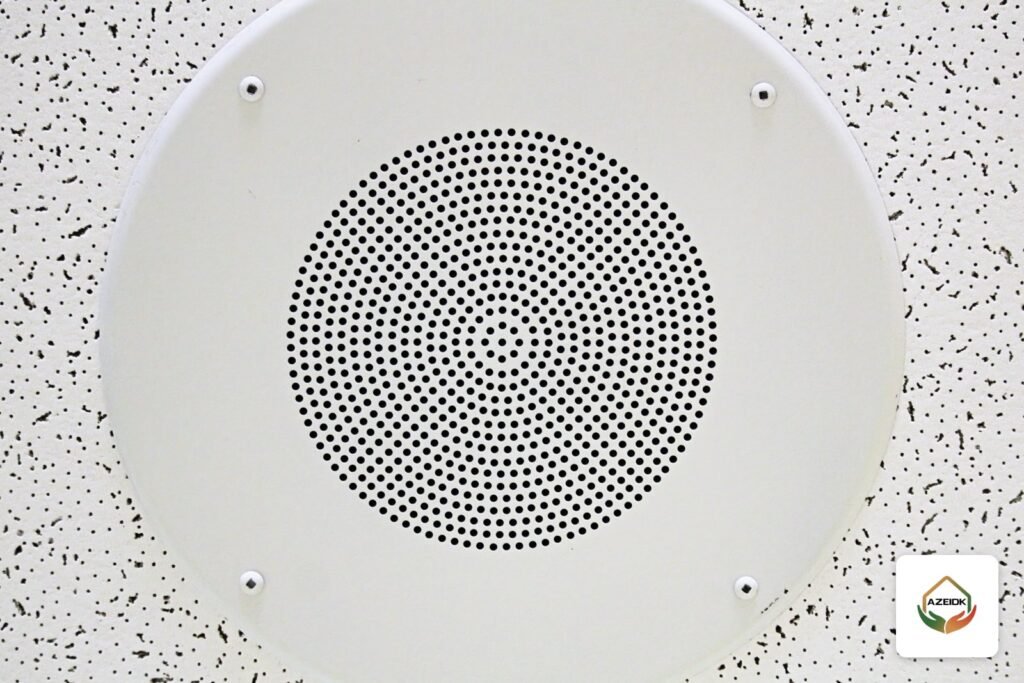
| Ceiling speaker | Offices, corridors, lobbies, meeting rooms with a suspended ceiling | Even coverage and clean look; needs a cut-out in the ceiling |
| Wall speaker | Spaces without a suspended ceiling or with exposed concrete | Projects sound horizontally; place on opposite walls |
| Horn speaker | Car parks, warehouses, outdoor yards, noisy areas | Focused sound over a longer distance, e.g. the Hikvision DS-QAZ1307G1T-E outdoor horn speaker |
Voice evacuation: what changes in a fire-rated ceiling speaker?
If the PA system will broadcast evacuation messages in a fire, the speaker is part of a life safety system, not just an audio device. In systems built to European standards these speakers are certified to EN 54-24, the standard for voice alarm loudspeakers. The Protec speaker mentioned above, for example, is EN 54-24 Type A with a steel fire dome, a ceramic terminal block and a 150 °C thermal fuse. The aim is to keep the speaker and line working as long as possible, and to stop one burnt speaker from shorting and silencing the rest of the line.
The host must also monitor the lines. The DSPPA PAVA9500 voice evacuation host page lists eight zone outputs with a PAVA9500E expansion unit adding eight more, rated output of at least 500 W on 100 V, speaker line fault detection (ground, open and short circuit), and eight dry contact inputs and eight outputs for the fire alarm interface. We cover voice evacuation in detail in voice evacuation alarm systems; for the brand see DSPPA.
Common mistakes with PA ceiling speakers
- Placing speakers by count, not spacing: too many in one room and silent gaps in the corridor.
- Loading the amplifier to the last watt: no margin for losses or for adding speakers later.
- Mixing 70 V and 100 V equipment: actual power no longer matches the marked tap.
- Standard speakers on an evacuation system: the consultant will reject them where the specification calls for certified speakers.
- One audio zone for a whole building: no way to address one floor or run a phased evacuation.
Frequently asked questions
How many ceiling speakers does a 100 m² office need?
Area alone does not decide it. Work out spacing from ceiling height, ear height and the manufacturer’s factor, then lay speakers on a grid at that spacing.
Which tap suits corridor ceiling speakers?
It depends on noise level and ceiling height. Quiet corridors need low taps; busy areas need higher ones. Start from the speaker datasheet.
Can the same ceiling speakers play music and evacuation messages?
Yes, in PAVA systems, provided the speakers and host meet the evacuation specification approved for the project.
What is the difference between a fire alarm speaker and a PA speaker?
A fire alarm sounder produces an alarm tone from the fire panel. A PA speaker carries speech and music from the audio host, and can play recorded evacuation messages when the host is linked to the fire alarm panel.
When should I use a horn speaker instead of a ceiling speaker?
In open or noisy areas such as car parks, warehouses and yards, where sound must carry further.
Is a 100 V speaker line safe to touch?
It is an audio signal, not mains supply, but 100 V is not safe to touch. Isolate the zone before working on connections and follow the installation manual.
Conclusion
Good ceiling speakers are not enough on their own. Set taps by location, add up the taps and leave amplifier headroom, space speakers from the ceiling-to-ear distance, and use certified speakers where the system carries emergency messages. This work is part of the low current systems AZEIDK delivers, including the link between the audio host and the fire alarm panel.
Planning a PA system for an office building or mall? Send the drawings, ceiling heights and the zones you need, and our team will propose speaker layout, amplifiers and the fire alarm interface. Talk to the AZEIDK team
Related guides
- Fire Alarm Bells, Sounders and Strobes: Types, Locations and Required Sound Levels
- CCTV Monitor: Choosing Size, Resolution, HDMI or VGA and 24/7 Operation for Shops and Offices
- General Contracting in Saudi Arabia: Scope, Classification and Specialist Fire and Low Current Works
- Ajax Wireless Intrusion Alarm Systems: Components and Applications