When a specification says the aerosol suppression system must comply with NFPA 2010, it points to the NFPA standard for fixed aerosol fire-extinguishing systems. It is a separate document from NFPA 2001, the clean agent standard, and covers a different kind of extinguishing agent.
This article explains what the standard covers according to its published description and edition history, then what owners and contractors should check when a FirePro system is submitted for approval on a Saudi project, based on the AZEIDK product page and the manufacturer’s catalogue. We do not quote figures from inside the standard; the official NFPA text is the reference for those.
Key points
- Current title: Standard for Fixed Aerosol Fire-Extinguishing Systems.
- First issued in 2006, then the 2010, 2015, 2020 and 2025 editions.
- It covers design, installation, operation, testing and maintenance of condensed and dispersed aerosol systems for total flooding.
- FirePro, available from AZEIDK, is a condensed aerosol system; its catalogue lists UL listing and BSI and KIWA certification depending on model.
What NFPA 2010 is
NFPA 2010 is published by the National Fire Protection Association under the title Standard for Fixed Aerosol Fire-Extinguishing Systems. The first edition, in 2006, was titled Standard on Aerosol Fire-Extinguishing Systems. Later editions followed in 2010, 2015 and 2020, and the 2025 edition is the latest offered by standards sellers.
The published description says the standard contains requirements for the design, installation, operation, testing and maintenance of condensed and dispersed aerosol fire-extinguishing systems for total flooding applications, together with performance requirements and test methods for those systems and their components. The 2020 description adds that it applies to systems made up of one or more generators.
Condensed versus dispersed aerosol
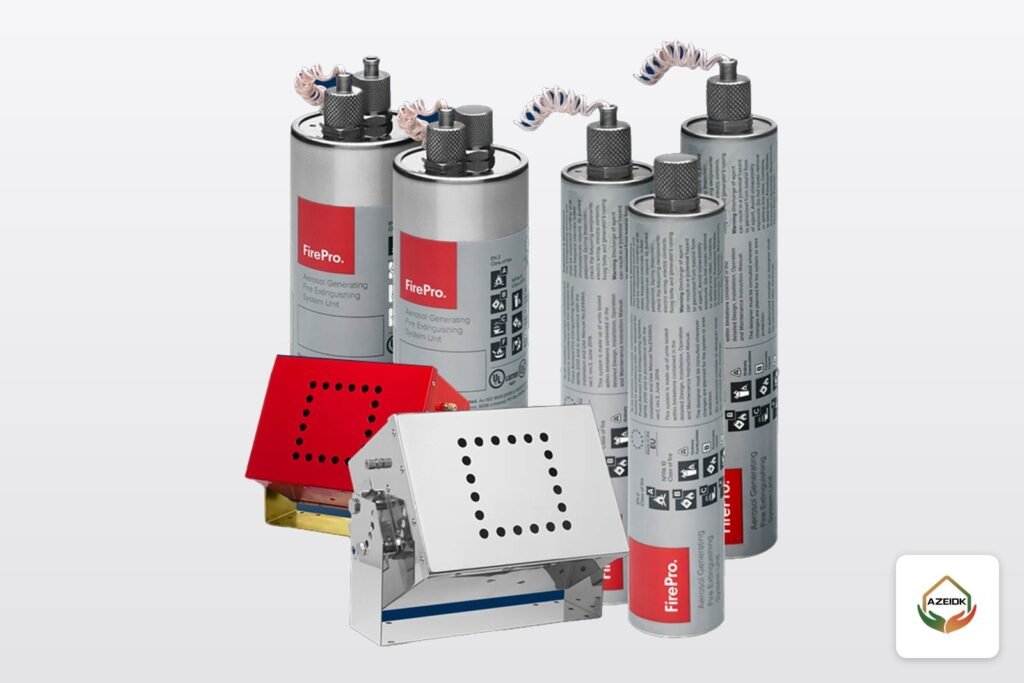
In a condensed aerosol system the agent is produced inside a generator from a solid compound and released as fine particles into the protected space. This is how FirePro works according to the product page: each generator holds a solid compound in a metal housing, and an electrical or thermal activation signal releases aerosol that interrupts the chemical reaction in the flame.
In a dispersed aerosol system the particles are prepared in advance and expelled from a container. When comparing offers, first confirm which type is proposed, because design and testing depend on the type and the listed model.
NFPA 2010 and NFPA 2001 are not interchangeable
NFPA 2001 covers clean agent gases stored in cylinders and discharged through pipes and nozzles, such as FM-200 systems; see our NFPA 2001 guide. NFPA 2010 covers aerosol, usually installed as generators inside the protected space. An aerosol system specified to NFPA 2001, or the reverse, is a specification error. For a practical comparison see FM-200 generator vs aerosol.
What to check when FirePro is submitted for approval
AZEIDK supplies the FirePro condensed aerosol fire suppression system as part of its special fire suppression systems. The product page and catalogue point to items that should appear in the submittal:
| Item | What the submittal should show |
|---|---|
| Calculation | Required compound mass from net enclosure volume and hazard type, using the manufacturer’s approved method |
| Generator selection | Models, quantities and positions, from a family that runs from FP-200 to FP-5700 |
| Distribution | Model-specific discharge distance, outlets not aimed at people or heat-sensitive materials, safety clearances kept |
| Activation | Electrical from the extinguishing control panel, or thermal in standalone uses, with a protected manual release |
| Control and warning | Two alarm stages, pre-discharge delay, hold and abort controls, supervised release circuits |
| Listings | UL, BSI and KIWA by model and version, with the supplied model matched to project requirements |
| Enclosure | Openings and leakage, plus ventilation and equipment shutdown interfaces |
The product page is clear that a FirePro system is never selected by a rough generator count; it is engineered by qualified specialists from the catalogue, project requirements and authority approval. See choosing a FirePro generator model.
Occupied spaces
The product page states that use in occupied areas needs a dedicated safety review covering design density, enclosure volume, concentration of discharge products, evacuation time, pre-discharge alarms, release delay, hold or abort controls, emergency procedures, authority requirements and the manufacturer’s safety information. The system is not assumed suitable for every occupied room without an approved design and safety assessment.
Testing and maintenance
Never test a generator with a real firing signal; use the manufacturer’s test procedures. Commissioning includes ventilation and equipment shutdown tests, fault signal tests, panel programming review, handover of calculations and drawings, and operator training.
Routine maintenance covers visual checks of generators, brackets and cables, testing of the panel, detectors and manual release, review of manufacturing date and service life, confirming that room use has not changed, and recalculating after any room or equipment change. The catalogue states a certified generator life of up to 15 years under FirePro conditions. More in FirePro aerosol maintenance; AZEIDK covers this under its maintenance contracts.
Frequently asked questions
What is NFPA 2010?
The NFPA standard for fixed aerosol fire-extinguishing systems, covering design, installation, operation, testing and maintenance.
What is the latest edition?
The 2025 edition, preceded by 2020, 2015 and 2010, with the first edition in 2006.
Does NFPA 2001 apply to aerosol systems?
No. NFPA 2001 covers clean agents; aerosol systems have their own standard, NFPA 2010.
Is FirePro a condensed aerosol system?
Yes. Its generators contain a solid compound that produces condensed aerosol on activation.
How long does a FirePro generator last?
The catalogue states a certified life of up to 15 years under the manufacturer’s conditions.
Protecting an electrical room or control panel with aerosol? Send us the room dimensions and equipment, and the AZEIDK team will prepare the calculation and submittal. Request a quote from AZEIDK
Related guides
- Fire Alarm Battery Calculation and Secondary Power Supplies
- Sprinkler Hazard Classification Under NFPA 13: Light, Ordinary (Groups 1 and 2) and Extra Hazard, and Their Effect on Density and Pump Size
- Parking Garage Fire Protection: Requirements and Solutions
- CCTV Installation Tenders in Saudi Arabia: Specifications, Scope of Work and BOQ