UPS online vs offline vs line-interactive is about how power reaches the load. An offline (standby) UPS feeds the load from the mains and switches to battery on failure. A line-interactive UPS regulates voltage continuously and transfers to battery without a noticeable break. An online (double conversion) UPS passes all power through the rectifier and inverter, so its output is independent of mains voltage and frequency. A small network room or CCTV cabinet is usually well served by a sine-wave line-interactive unit; larger sensitive loads are designed around online systems.
This guide explains the three types as classified under IEC 62040 and how to read the specification of a unit such as the Legrand Keor SPE R/T 2200VA supplied by AZEIDK under network and communication solutions.
Key points
- IEC 62040-3 classes: VFD (offline) output depends on mains voltage and frequency; VI (line-interactive) voltage regulated, frequency follows mains; VFI (online) output independent of both.
- Offline suits simple loads; Schneider Electric’s guide gives a transfer time under 10 ms.
- Line-interactive suits switches, NVRs and small server rooms.
- Online suits sensitive medium and large loads and unstable supplies.
- Size by watts, required runtime, site power quality and safe shutdown needs.
UPS online vs offline vs line-interactive compared
| Item | Offline (passive standby) | Line-interactive | Online (double conversion) |
|---|---|---|---|
| IEC 62040-3 class | VFD | VI | VFI |
| Normal power path | Mains through a filter | Mains with continuous voltage regulation | All through rectifier and inverter (AC-DC-AC) |
| Transfer to battery | Very short (under 10 ms per source) | No interruption, via static switch | Negligible; inverter always on line |
| Frequency regulation | No | No, follows mains | Yes, output independent of input |
| Typical ratings | Low, below 2 kVA | Mostly low ratings | Medium and high, typically 10 kVA and up (smaller units exist) |
| Typical use | Single PC or home router | Switches, NVRs, network cabinets, small server rooms | Data rooms, sensitive loads, generator or unstable supply |
Based on Schneider Electric’s Electrical Installation Guide; the rating ranges are described there as typical, not as limits.
Line-interactive: the usual choice for network and CCTV rooms
The inverter sits in parallel with the input but interacts with it, regulating voltage and charging the battery, and transfer happens through a static switch without interruption. Output frequency follows the mains. The Legrand Keor SPE R/T 2200VA (311071) is an example: line-interactive VI, 2200 VA / 1980 W, pure sine wave, input 160 to 288 V at full load (230 V nominal), 8 x IEC C13 plus 1 x C19 outlets with one programmable group, 6 x 12 V 7 Ah front-access hot-swappable VRLA batteries, USB, RS232 and SNMP with adjustable EPO and two dry contacts, 3U rack/tower. The series covers 750 to 3000 VA (311065, 311066, 311072/311073). The communication ports allow servers and recorders to shut down cleanly before the battery runs out.
Online: when it is worth the cost
The inverter is in series between input and load, so transfer time is negligible and the output is independent of mains voltage and frequency. Schneider’s guide notes that line-interactive units, lacking frequency regulation, are poorly suited to sensitive medium-to-high-power loads. Choose online for sensitive larger loads such as data rooms, medical or industrial control equipment, sites on generators or unstable supply, or when the specification calls for VFI. It costs more, so it makes little sense for a small office cabinet on stable power.
Sizing a UPS for a network room
- Add up the load in watts from each datasheet, including the PoE budget of switches feeding cameras and access points.
- Compare against the UPS rating in watts, not only VA: the Keor SPE 2200 is 2200 VA but 1980 W.
- Leave headroom for growth.
- Define the runtime you need and ask for the runtime table at your actual load.
- Check outlet types (C13, C19) and the mounting position.
- Set up safe shutdown over USB or SNMP.
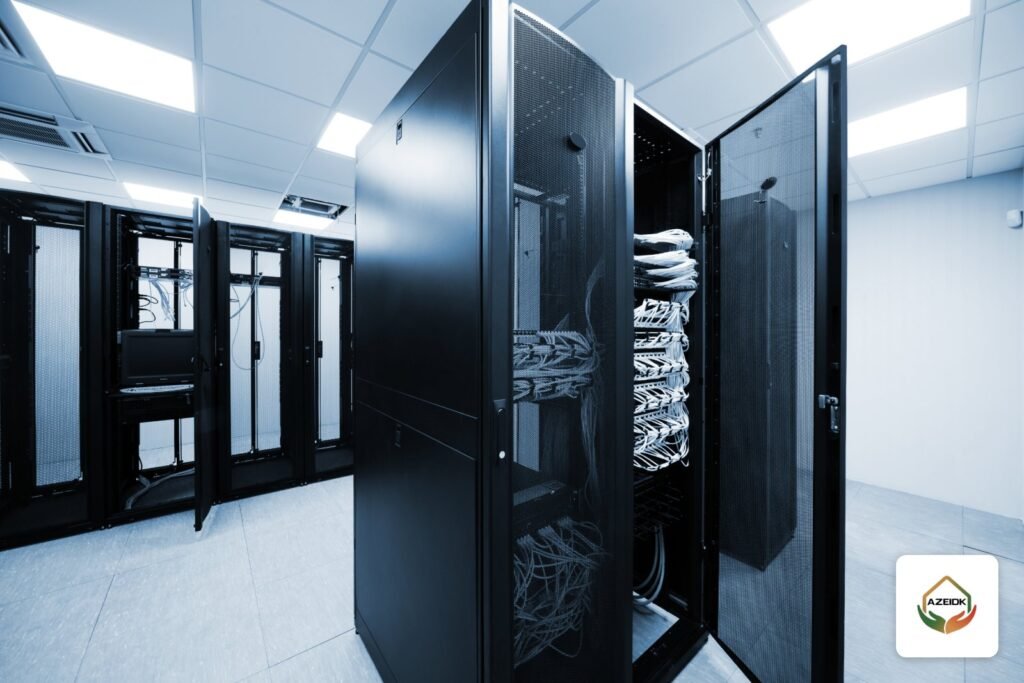
Prioritise the router, firewall and core switch, then PoE switches and the NVR, then servers. Displays and printers can usually stay off the UPS. See also server and network room preparation and CCTV recording during power or internet outages.
Frequently asked questions
What is the difference between an online and offline UPS?
An online UPS passes all power through double conversion, so the output is independent of the mains with no transfer time. An offline UPS feeds the load from the mains and switches to battery on failure.
Is line-interactive enough for a server room?
For a small room with switches, an NVR and one or two servers, a sine-wave line-interactive unit is usually enough. Large sensitive loads need online.
What do VFI, VI and VFD mean?
IEC 62040-3 classes: VFI output independent of input voltage and frequency, VI voltage independent, VFD output dependent on input.
Is the Legrand Keor SPE an online UPS?
No. It is line-interactive (VI) with a pure sine wave output, per the product page and datasheet.
Do I need a UPS for every CCTV camera?
No. If cameras are PoE powered, putting the PoE switch and NVR on the UPS keeps the cameras running.
Need a UPS for your network or CCTV room? Send us the equipment list and required runtime, and we will propose the type and size with datasheets. Read also Legrand in Saudi Arabia: Keor UPS and Linkeo cabinet. Contact AZEIDK
See AZEIDK CCTV solutions: supply, installation and maintenance.
Related guides
- 16-Zone Conventional Fire Alarm Panel Expandable to 28: Context Plus MFP, Extender Cards, Repeater and Battery Standby
- Saudi Fire Code SBC 801 vs SBC 201 vs Civil Defense Requirements: What Each Covers and Who Applies It
- IP PBX and IP Phone Brands in Saudi Arabia: Yeastar, Grandstream, Fanvil, Avaya and Alcatel-Lucent
- Automatic Fire Extinguisher (Ceiling-Mounted): How It Works, Where It Fits and Where It Falls Short