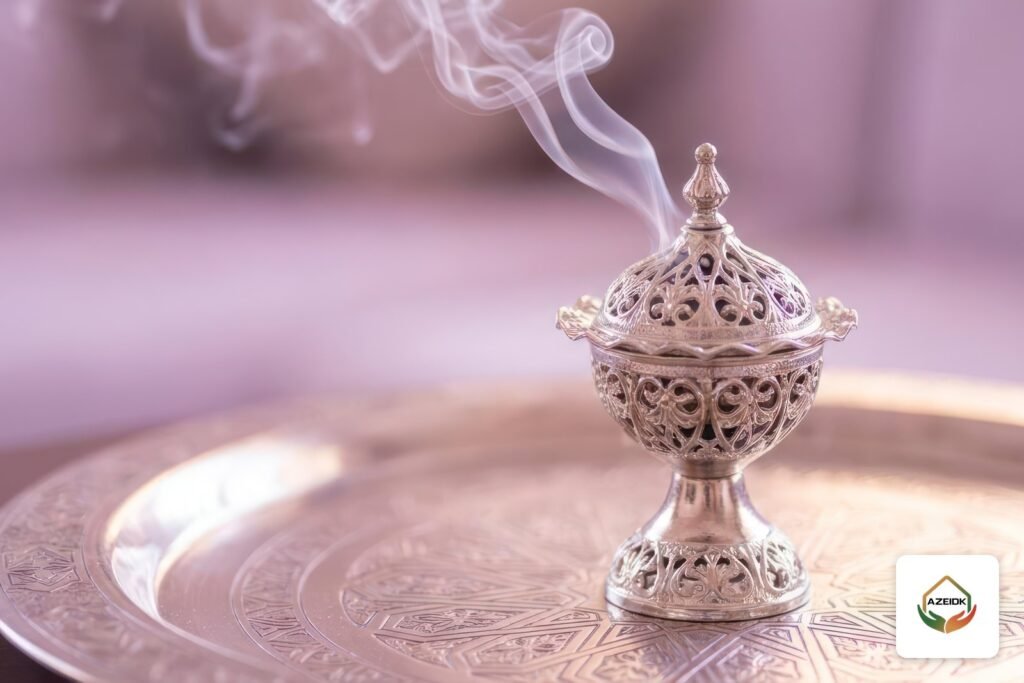
Can incense (bakhoor) set off a fire alarm? Yes, it can. An optical smoke detector cannot tell smoke from a fire apart from smoke from an incense burner: when dense smoke reaches the sensing chamber and passes the alarm threshold, the alarm sounds. The same applies to a dense vape cloud and, less often, to cigarette smoke. The answer is not to cover the detector but to move the burner, ventilate, and use the right detector for the space.
This guide explains why it happens, when it is most likely, what to do at home, in hotels and in offices, and when the space needs a change in the fire alarm system design rather than a workaround.
Key points
- An optical smoke detector uses a light beam inside a small chamber. Any dense particles that scatter the light can trigger it, whether bakhoor, vape aerosol or fire smoke.
- A burner directly under the detector, or in a small closed room, is the most common cause.
- A dense vape cloud near the detector can trigger it; cigarette smoke is less likely but possible in a closed room.
- Covering or removing the detector leaves the room unprotected and is not a fix.
- Where incense is used every day, the designer reviews detector type and position under SBC 801.
In this article
- Why does incense set off a fire alarm?
- When is an alarm most likely?
- Can vaping set off a fire alarm?
- Can cigarette smoke set off a fire alarm?
- Quick comparison: what triggers which detector?
- What to do at home
- Incense in hotels and serviced apartments
- Incense in offices, majlis rooms and oud shops
- What not to do
- When to call a technician
- Frequently asked questions
Why does incense set off a fire alarm?
Most detectors in buildings today are optical. Inside the head there is an infrared light source and a photodiode, arranged so that no light reaches the photodiode in clean air. When smoke enters the chamber, its particles scatter light onto the photodiode; once the signal passes a set level the detector goes into alarm. This is how the Context Plus 55000-685IMC optical detector works, and it is the general principle of optical detection.
Oud and bakhoor smoke is real combustion smoke, with enough particles to scatter light in the chamber. So the fragrance does not matter; what matters is how dense the smoke is when it reaches the sensor and how long it stays there.
When is an alarm most likely?
- Burner directly under the detector: warm smoke rises and collects around the head before it spreads.
- Small closed room: a hotel room, bedroom or small majlis without ventilation fills quickly.
- Perfuming clothes or hair near the ceiling: a short but dense cloud close to the detector.
- Air conditioning blowing toward the detector: a diffuser can carry smoke straight to the sensor. See smoke detector placement near AC diffusers.
- Old or dirty detector: dust in the chamber raises the baseline signal, so the detector sits closer to its alarm threshold.
Can vaping set off a fire alarm?
A vape does not burn like a cigarette, but it releases a dense cloud of very fine droplets. These droplets scatter light inside an optical detector in the same way smoke does, so a cloud exhaled close to the detector, or one that builds up in a small room, can cause an alarm. The bigger the cloud and the closer it gets to the ceiling, the higher the chance.
Can cigarette smoke set off a fire alarm?
One cigarette in a well-ventilated room does not usually trigger a detector, because the smoke disperses before it reaches the ceiling in enough density. Repeated smoking in a closed room, or blowing smoke toward the detector, can trigger it. Do not rely on a detector “not seeing” smoking: it depends on the detector type, its sensitivity and its position.
Quick comparison: what triggers which detector?
| Source | Optical smoke detector | Heat detector |
|---|---|---|
| Dense incense under the detector | High chance | Not affected by smoke |
| Vape cloud nearby | Medium to high chance | Not affected |
| One cigarette in a ventilated room | Low chance | Not affected |
| Repeated smoking in a closed room | Medium chance | Not affected |
| A real fire | Early detection | Detects once temperature rises |
The table is indicative, not a measurement of a specific detector. A heat detector does not see smoke at all, which is why it is not an automatic substitute for smoke detection everywhere. See the heat detector guide.
What to do at home
- Keep the burner away from the detector, never directly under it, and use it in a ventilated spot or near an open window.
- Perfume clothes in a room without a detector, or in a larger space, then close the burner.
- If you have a standalone battery smoke alarm such as the FG SD-425, its alarm is local to the unit. Ventilate until the air clears; do not remove the battery.
- After any alarm, check the detector with its test button as described in how to test smoke detectors.
Incense in hotels and serviced apartments
In a hotel, the room detector is usually connected to a central fire alarm panel and may sit on a sounder base that sounds inside the room. One incense alarm can bring hotel staff to the room, and in some systems it starts a wider alarm sequence, depending on how the panel is programmed. That is why many hotels give guests clear rules on incense and smoking.
If alarms repeat in certain rooms, the fix is a design review, not disabling detectors: detector type, position relative to AC outlets, and panel programming. Room options are covered in hotel fire alarm systems. In apartment buildings, an apartment hush button can stop a flat alarm from evacuating the whole building for a set period, where the approved design allows it.
Incense in offices, majlis rooms and oud shops
Majlis rooms, reception halls and oud and perfume shops use incense every day. The designer chooses the detection type for the actual use and for SBC 801 and Civil Defense requirements. Options that are considered include a multisensor such as the Context Plus 55000-885IMC, which combines an optical smoke sensor and a heat sensor, or a heat detector in specific locations where the design allows it. For oud shops, see perfume and oud shop fire safety.
AZEIDK is the exclusive agent for Context Plus in Saudi Arabia, and FG detectors are also available from AZEIDK.
What not to do
- Do not cover the detector with a bag or tape, even for a short time.
- Do not remove the detector head from its base. On a central system this shows as a fault, and the room is left without detection.
- Do not ask a technician to lower the sensitivity at random. Any change must stay within the manufacturer’s limits and the approved design.
- Do not dismiss an alarm as “just incense” before checking there is no fire.
Repeated false alarms teach people to ignore the bell, which is more dangerous than the alarm itself. Other causes are covered in fire alarm false alarms: causes.
When to call a technician
Ask for a check if the same detector keeps alarming without incense or smoking, if it stays in alarm after the room is ventilated, or if the panel shows a fault. Under annual maintenance contracts, AZEIDK inspects, cleans and tests detectors and proposes a change of detector type or position when that is the cause.
Frequently asked questions
Can incense set off a fire alarm in a hotel?
It can if dense smoke reaches the room detector, especially in a closed room or when perfuming clothes near the ceiling. Use the burner away from the detector with good ventilation, and follow the hotel’s rules.
Can a smoke detector detect vape?
It can. A vape cloud scatters light inside an optical detector like smoke does. The denser the cloud and the closer it is to the detector, the higher the chance.
Does a smoke detector detect cigarette smoke?
It can if smoke builds up around it in a closed room. One cigarette in a ventilated room usually does not trigger it, but that is not guaranteed.
Should I cover the detector while using incense?
No. Covering it disables protection and is easy to forget. Move the burner and ventilate, or review the detector type if incense is used daily.
Can a heat detector replace a smoke detector in a majlis?
That is the designer’s decision. A heat detector ignores incense but detects a fire later, and it is not accepted as a substitute everywhere under the code and Civil Defense requirements.
Incense keeps setting off the alarm in your majlis, hotel or office? Send AZEIDK the type of space, the number of detectors and the panel type, and we will review detector type and position and propose a fix within the approved design. Request a quote from AZEIDK
Related guides
- Wall Mount PA Speakers: Analogue DSPPA DSP116 or Network ZYCOO IPS-W1?
- Cisco Switches in Saudi Arabia: Families and How to Choose the Right Switch for Companies and Buildings
- Salamah Civil Defense Questions and Answers: 15 Questions on the Salamah Platform, Licences and Renewal
- Fire Extinguisher Guide for Facilities in Saudi Arabia: Types, Quantity, Inspection and Expiry