Fire hose cabinet maintenance means opening every cabinet in the building and checking that the door opens freely, the glass is intact, the reel turns, the hose has no cracks, and the hose valve opens and closes without leaking, then recording what was found. A cabinet locked with a missing key, or a hose stuck together by heat, can cost the first minutes of firefighting.
This article does not repeat cabinet types and sizes. It sets out the inspection programme per component, the NFPA 25, NFPA 1962 and EN 671-3 frequencies, and the report content. If you need a team to run this programme under an annual contract, see AZEIDK’s preventive and periodic maintenance service.
Key takeaways
- Short answer: a fire hose cabinet and its components (cabinet, glazing, reel or rack, hose, nozzle and hose valve) get regular visual checks and a full annual inspection with the hose run out, plus a hose pressure test every few years under the adopted standard.
- NFPA 25, 2017 edition as quoted by QRFS, sets annual inspection of the cabinet, hose, nozzle and hose storage device, and quarterly inspection of hose valves.
- NFPA 25 refers cabinet hose to NFPA 1962, which maintenance companies cite for a first service test within 5 years, then every 3 years.
- Semi-rigid hose reels to EN 671-1 are maintained under EN 671-3: annual maintenance by a competent person, and all hoses pressurised to maximum working pressure every 5 years.
- A good report identifies each cabinet by number and location, and states the finding, the action and the next inspection date.
In this article
- What does fire hose cabinet maintenance cover?
- Fire hose cabinet inspection schedule
- Checking the cabinet, glazing and lock
- Checking the fire hose reel and rack
- Hose inspection and pressure testing
- Checking the hose valve and nozzle
- What the technician records in the report
- Common fire hose cabinet maintenance mistakes
- Fire hose cabinet maintenance with AZEIDK
- Frequently asked questions
- Conclusion
What does fire hose cabinet maintenance cover?
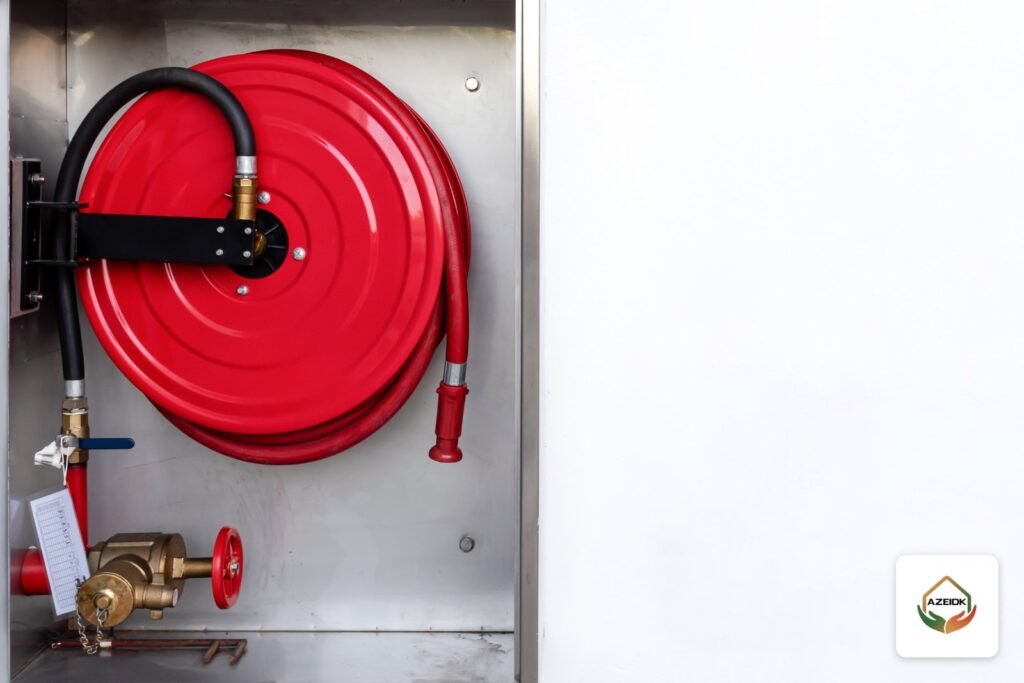
A fire hose cabinet is not one item. It holds six elements, each checked differently: the steel cabinet with its door and glazing, the hose storage device (a swinging reel or a rack), the hose, the nozzle, the hose valve (angle valve) that feeds the hose from the network, and sometimes a 2.5 inch Civil Defense outlet and an extinguisher compartment. Components and cabinet classes are explained in Fire Hose Cabinets: Types, Sizes and Components.
In Saudi Arabia, the Saudi Fire Code SBC 801 and Civil Defense requirements define what a facility must do. NFPA and EN standards are technical references adopted by the designer and project documents, so the frequencies below are attributed to their standards, not to Saudi legal text.
Fire hose cabinet inspection schedule
The table combines what the references say for each component. The monthly walk-round in the first row is common good practice in maintenance contracts, not an NFPA 25 clause.
| Component | What is checked | Frequency | Reference |
|---|---|---|---|
| Visual round of all cabinets | In place, unobstructed, no leaks or visible damage | Monthly or per risk | Good practice; EN 671-3 leaves the interval to the owner based on environment and risk |
| Cabinet, door and glazing | Corrosion or damage, door hard to open, broken glass, break-glass lock not working, missing sign | Annual | NFPA 25, 6.2.8.1 (2017 edition) |
| Reel or rack | Hard to operate, hose wrongly racked or rolled, nozzle clip missing, rack does not swing out 90 degrees | Annual | NFPA 25, 6.2.7.1 (2017 edition) |
| Hose | Mildew, cuts, abrasion, damaged coupling threads, worn gaskets, test overdue | Annual | NFPA 25, 6.2.5.1 (2017 edition) with NFPA 1962 |
| Nozzle | Missing nozzle, damaged gasket, obstruction, stiff operation | Annual | NFPA 25, 6.2.6.1 (2017 edition) |
| Cabinet hose valve | Cap, threads, handle, gasket, leaks, ease of operation | Quarterly | NFPA 25, 13.6.1.1 (2017 and 2020 editions) |
| Class I and Class III hose valves | Full open and close | Annual | NFPA 25, 13.6.2.1 (2020 edition) |
| Class II hose station valves | Open and close | Every 3 years | NFPA 25, 13.6.2.2 (2020 edition) |
Clause numbers are attributed to the edition QRFS quotes them from: the 2017 edition for the Chapter 6 items and 13.6.1.1, and the 2020 edition for the 13.6.2 valve tests. We have not checked them against the latest NFPA 25 text, and they may differ in the edition your facility adopts. The final reference is the edition adopted for the project and the authority having jurisdiction.
Checking the cabinet, glazing and lock
The technician starts outside. The area in front of the cabinet must be clear; storage in front of cabinets is one of the most frequent findings in warehouses and car parks. Then the checks are:
- Paint and corrosion, especially at the bottom edges and hinges, and on outdoor cabinets or those near moisture.
- The door opens fully without rubbing and does not hit a wall or another door.
- The glass is not cracked or broken, and any break-glass lock is present and works.
- The sign and operating instructions are clear and legible.
- The seal is in place. A broken seal means someone opened the cabinet, so the contents must be checked.
For recessed cabinets, also check that the frame is firm in the wall, because cracked plaster around it can jam the door over time.
Checking the fire hose reel and rack
On reel cabinets, the technician pulls out the hose and confirms the drum turns freely in both directions, the swing arm (if fitted) moves through its full angle, and the hose guide is firmly fixed. These checks are set out in EN 671-3 for semi-rigid hose reels. Among the deficiencies listed in NFPA 25 (6.2.7.1, 2017 edition) are a cabinet rack that does not swing out at least 90 degrees, hose improperly racked or rolled, and a nozzle clip not in place.
Falcon Gold reels supplied by AZEIDK come with 25 mm hose, 30 m long, and AZEIDK’s fire hose article lists EN 671-1:2012 as their reference, so the EN 671-3 programme suits them. The same article lists UL 219, NFPA 1961 and NFPA 1962 for the 1.5 inch rack hose, so that hose is inspected under NFPA 1962.
Hose inspection and pressure testing
Annual inspection
Run the hose out fully at least once a year. Look for cracks, abrasion, mildew and oil stains, and for lining separating at the ends, and confirm couplings are tight and their gaskets sound. After the check, re-rack the hose so the folds do not fall in the same places, because permanent folding along one line weakens it.
Service test
Maintenance companies such as Levitt-Safety cite NFPA 1962 as requiring occupant use hose to be removed and service tested at intervals not exceeding 5 years after installation, then every 3 years; other sources count the 5 years from manufacture, so check the edition adopted for the project. For EN 671 reels, EN 671-3 requires all hoses to be pressurised to maximum working pressure every 5 years. The hose is not tested folded in the cabinet: it is disconnected and tested under the standard’s procedure and the manufacturer’s instructions, and the test date is marked on the hose or in the log.
For hose types, sizes and couplings in detail, see Fire Hose Types and Sizes.
Checking the hose valve and nozzle
The cabinet hose valve is the component that fails silently. It may have been stuck for years without being operated, or drip enough to rust the cabinet floor. NFPA 25 (13.6.1.1) sets a quarterly hose valve inspection: cap in place and undamaged, threads, handle and gasket intact, no leaks, and the valve unobstructed and operable. Another clause (6.2.3 in the 2020 edition, as quoted by QRFS) sets an annual inspection of hose connections covering almost the same items; QRFS points out the conflict and notes that the authority having jurisdiction decides which clause applies. In practice, the quarterly check is the safer choice.
The test is a full open and close. QRFS cites annex A.13.6.2.1 (2020 edition) as saying the purpose is to test the valve, not to flow water. A valve that does not open or close smoothly is lubricated, repaired or replaced. The annual hose connection inspection in NFPA 25 (2017 edition) also lists a missing pressure restricting device, so check it is in place wherever the design calls for one. For outlets and hydrants, see Fire Hydrants and Landing Valves.
The nozzle is inspected annually: present, gasket sound, not blocked, and operating smoothly.
What the technician records in the report
The report is what proves maintenance to the Civil Defense inspector at inspection or at licence renewal on the Salamah platform. EN 671-3 requires records to include the date, the result, replacement parts, further action needed, the next inspection date and the identity of each unit. We suggest each visit report contains:
- Cabinet number and location (building, floor, nearest landmark).
- Type: reel or rack, single or double, surface or recessed.
- Condition of each component: OK, or a finding with a short description.
- Date of the last hose pressure test and the next due date.
- Action taken on the visit, and any deferred action with the reason.
- Finding category: a deficiency affecting operation, or a note that does not stop the cabinet working.
- A “checked” tag on the cabinet, or an “out of order” tag with the owner informed immediately.
To organise these records with alarm, sprinkler and pump records, see Fire Safety Log Book and Maintenance Records. For NFPA 25 tables covering the other water-based systems, see Inspection, Testing and Maintenance of Fire Protection Systems in Saudi Arabia.
Common fire hose cabinet maintenance mistakes
- Checking the cabinet from outside and signing the tag without running out the hose.
- Leaving the hose folded on the same lines for years until it weakens at the folds.
- Putting the hose back in the cabinet wet after a test or use.
- Storing goods or furniture in front of the cabinet, or locking it with an ordinary padlock nobody has the key for.
- Ignoring a small valve leak until the cabinet floor rusts.
- Replacing a hose or nozzle with one that does not match the valve size or coupling type.
- Reporting only the number of cabinets, without each cabinet’s number and location, so findings cannot be followed up.
Fire hose cabinet maintenance with AZEIDK
AZEIDK inspects fire hose cabinets as part of its preventive and periodic maintenance contracts for firefighting systems, with a report for every cabinet and follow-up of findings until they are closed. When a cabinet, reel or hose needs replacing, Falcon Gold fire hose cabinets are available in the product catalogue. AZEIDK holds ISO 9001, ISO 14001 and ISO 45001 certificates covering the design, supply, installation and maintenance of firefighting and fire alarm systems.
Frequently asked questions
What does a fire hose cabinet contain that the technician checks?
The cabinet with its door and glazing, the hose reel or rack, the hose, the nozzle and the hose valve. Some cabinets also have a 2.5 inch Civil Defense outlet and an extinguisher compartment, which are checked too.
What is the difference between a hose reel and a hose cabinet in maintenance?
The reel is a hose storage device that may sit inside a cabinet or be wall-mounted on its own. The reel is checked by turning it and running out the hose; the cabinet is checked as a body, door, glazing and lock.
What hose length is approved, 30 m or 20 m?
The length is set by the approved building design and coverage distances, not by the maintenance technician. Falcon Gold reels, for example, come with 25 mm hose, 30 m long; maintenance confirms the installed length matches the drawings.
Do fire hose cabinets need SABER conformity?
The SASO technical regulation for fire-fighting equipment and materials covers fire hoses, nozzles and cabinets. A certificate of conformity through the SABER platform is therefore required when importing or supplying replacement parts.
How does maintenance differ for recessed and surface cabinets?
The internal components are checked the same way. Recessed cabinets add a check that the frame is firm and the plaster around it is not cracked; surface cabinets add a check of fixings and door clearance.
How much does fire hose cabinet maintenance cost?
It depends on the number, type and spread of cabinets, visit frequency, and whether the contract includes spare parts and hose pressure testing. It is priced after the cabinets are surveyed on site.
Conclusion
Cabinet maintenance is simple work at each cabinet, but it repeats dozens of times in one building and is easy to neglect. A regular visual round, an annual inspection with the hose run out, the reel turned and the valve operated, a hose pressure test on time, and a report that identifies every cabinet by number: that is what keeps a cabinet ready when an occupant opens it in a real fire.
Have cabinets in your building that nobody has opened for a while? Send us the number and types of cabinets and the site location, and we will prepare an inspection programme and maintenance offer to suit. Talk to the AZEIDK team
Related guides
- Wall-Mount Network Cabinet (Rack): How to Choose 4U, 6U, 9U or 12U and Its Accessories for CCTV and Networks
- Printing and Checking a Civil Defense Licence on Salamah: Steps, Licence Number and What to Do If It Is Missing
- General Contracting Companies in Jeddah (General Contractors): How to Choose One for Fit-Out or Building Works with MEP and Fire Systems
- Fire Sprinkler Pressure Gauges and Fire Pump Pressure Switches: Selecting WIKA 111.10SP, AGF 7500 and PSM-520